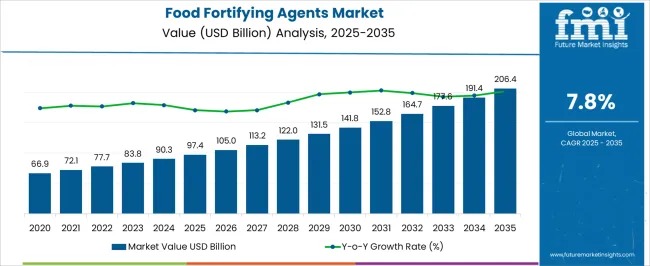
The global food fortifying agents market is entering a decisive growth phase as nutrition, preventive healthcare, and functional food consumption converge worldwide. Valued at USD 97.4 billion in 2025, the market is projected to reach USD 206.4 billion by 2035, expanding at a robust 7.8% CAGR over the forecast period. This sustained expansion reflects the rising role of fortified foods in addressing micronutrient deficiencies and supporting long-term health outcomes across diverse populations.
From 2021 to 2025, the market advanced steadily from USD 66.9 billion to USD 97.4 billion, driven by increased awareness of nutrition security and wider incorporation of vitamins and minerals in processed foods, dairy products, beverages, and infant nutrition. Governments, healthcare bodies, and food manufacturers are increasingly aligned around fortification as a scalable solution to malnutrition and lifestyle-related health risks.
Get Exclusive Access To Data Tables, Market Sizing Dashboards, And Analyst Insights. Request Sample Report! https://www.futuremarketinsights.com/reports/sample/rep-gb-25875
Between 2026 and 2030, the market is expected to accelerate sharply, growing from USD 97.4 billion to USD 141.8 billion. This phase is characterized by heightened demand for functional foods that support immunity, energy, bone strength, and digestive health. Manufacturers are investing in specialized, bioavailable fortifying agents that deliver targeted health benefits, supporting both volume growth and premium pricing strategies.
From 2031 to 2035, the market is projected to reach USD 206.4 billion, passing through incremental milestones of USD 152.8 billion, USD 164.7 billion, USD 177.6 billion, and USD 191.4 billion. Technological advancements in nutrient stability, encapsulation, and absorption efficiency are expected to further strengthen adoption across food and nutraceutical applications.
Market Snapshot Highlights
- Market Value (2025): USD 97.4 billion
- Forecast Value (2035): USD 206.4 billion
- Forecast CAGR: 7.8%
- Leading Segment (2025): Vitamins (31.7% share)
- Key Growth Regions: North America, Asia-Pacific, Europe
Food and Beverage Leads Application Demand
The food and beverage industry remains the largest contributor, accounting for 40–45% of total demand. Fortifying agents are widely used to enhance the nutritional profile of everyday foods and drinks, aligning with consumer demand for functional benefits without altering consumption habits.
Nutraceuticals represent the second-largest segment at 20–25%, supported by rising supplement usage and wellness-focused lifestyles. Healthcare and pharmaceuticals contribute 15–18%, reflecting public health initiatives promoting fortified foods to address nutrient gaps. Food processing accounts for 12–15%, while organic and natural food products contribute 8–10%, driven by growing interest in plant-based and clean-label fortification.
Vitamins Segment Dominates by Type
Vitamins lead the market with a 31.7% share, owing to their critical role in metabolic function, immunity, and overall vitality. High consumer familiarity, regulatory backing, and widespread application across staple and functional foods continue to reinforce demand. Innovations in microencapsulation and plant-derived vitamin sources are further expanding use cases, especially among clean-label and vegan product lines.
Bone Health Emerges as a Key Benefit Area
Within health benefits, the bone health segment holds a 26.5% share, supported by aging populations and increasing osteoporosis awareness. Calcium, vitamin D, and magnesium fortification is gaining traction in dairy, beverages, and supplements, as consumers prioritize long-term musculoskeletal health and preventive nutrition.
Dietary Supplements Drive Application Growth
Dietary supplements dominate application demand with a 37.9% market share, reflecting strong consumer preference for convenient, targeted nutrition. Growth is reinforced by e-commerce expansion, innovative delivery formats such as gummies and powders, and regulatory clarity around labeling and efficacy.
Asia-Pacific Fuels Global Momentum
Regionally, Asia-Pacific leads growth, with China (10.5% CAGR) and India (9.8% CAGR) at the forefront. Government-led fortification programs, rising disposable incomes, and heightened nutrition awareness are accelerating adoption in staple foods and functional products. Europe shows solid momentum, led by Germany (9.0%), while the UK (7.4%) and USA (6.6%) continue to benefit from mature functional food markets and preventive healthcare trends.
Competitive Landscape Focused on Innovation and Clean Label
The market remains highly competitive, with leading players emphasizing science-backed nutrition, sustainable sourcing, and tailored fortification solutions. Key companies include DSM Nutritional Products, BASF SE, ADM, Cargill, Ingredion, Kerry Group, Lonza Group, Tate & Lyle, Glanbia Nutritionals, Nutra Food Ingredients, Watson Inc., SternVitamin, Starbest Brands, Corbion, and Barentz. Strategic priorities center on bioavailability, regulatory compliance, and alignment with clean-label and plant-based trends.
Outlook
As global nutrition challenges persist and consumers increasingly view food as preventive medicine, food fortifying agents are set to play a central role in the future of the food system. Innovation, transparency, and targeted health benefits will define competitive success as the market moves beyond USD 200 billion by 2035.