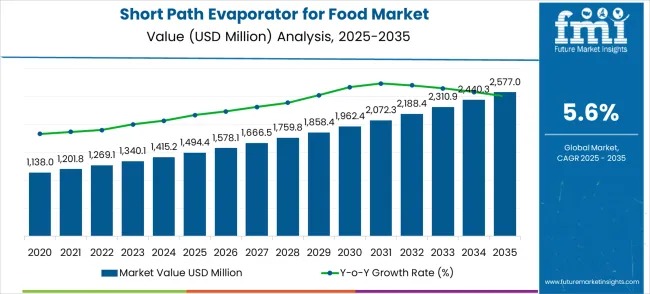
The global short path evaporator for food market is entering a decisive growth phase, driven by rising demand for gentle, low-temperature food processing technologies. Valued at USD 1,494.4 million in 2025, the market is forecast to reach USD 2,577.0 million by 2035, expanding at a CAGR of 5.6% over the decade. Adoption is accelerating as food processors prioritize efficiency, flavor retention, and regulatory compliance across dairy, beverages, extracts, and specialty ingredients.
Short path evaporation has become a preferred solution for concentrating heat-sensitive compounds while preserving nutritional integrity. Unlike conventional evaporation systems, these technologies operate under deep vacuum conditions, reducing thermal stress and enabling higher product quality. This advantage aligns closely with clean-label trends and growing consumer spending on natural food extracts, which is increasing by 15–20% annually across key markets.
Explore trends before investing – request a sample report today! https://www.futuremarketinsights.com/reports/sample/rep-gb-26930
Between 2025 and 2028, the market records moderate but consistent growth as food manufacturers integrate short path evaporators to improve shelf life, aroma retention, and solvent recovery. During this phase, innovations in temperature control, compact system design, and energy efficiency establish a strong foundation for adoption, particularly in established food processing regions of Europe, North America, and parts of Asia-Pacific.
A clear inflection point emerges between 2028 and 2032, when adoption expands rapidly into emerging markets and diversified applications such as dairy concentrates, edible oils, nutraceuticals, and flavor ingredients. Heightened food safety regulations, investments in modern processing infrastructure, and awareness of process optimization accelerate demand. From 2032 to 2035, growth stabilizes as the market matures, supported by replacement cycles, system upgrades, and deeper penetration into niche applications.
From an application standpoint, the market reflects a well-balanced demand structure. Dairy and dairy-based products account for 38%, supported by the need for gentle concentration of milk, cream, and cheese. Beverages, including juices and extracts, represent 26%, while flavor and fragrance ingredients hold 16%. Confectionery and chocolate processing contribute 12%, and specialty applications such as nutraceuticals and plant extracts make up 8%, underscoring the versatility of short path evaporation across food categories.
Technologically, systems with heating areas of 10–30㎡ dominate nearly 45–55% of demand, offering optimal balance between capacity, efficiency, and cost. These units typically achieve evaporation rates of 50–150 kg/h under 0.01–0.05 mbar vacuum, making them ideal for small-to-medium scale food extract production. Their ability to minimize residence time is critical for preserving sensitive bioactive compounds.
Key market highlights include:
- Strong uptake in food extract production, accounting for ~45% of applications
- Rising preference for energy-efficient and modular evaporator designs
- Increased collaboration between equipment manufacturers and food processors for customized solutions
Regionally, Asia-Pacific leads growth momentum, with China (7.6% CAGR) and India (7.0% CAGR) outperforming the global average. China’s expansion is fueled by large-scale food processing clusters and government initiatives aimed at modernization, while India benefits from rising processed food consumption and growing edible oil, dairy, and flavor extraction sectors. Europe remains a technology stronghold, with Germany growing at 6.4% CAGR, supported by advanced food engineering capabilities. The United States, though more mature, continues to adopt short path evaporators in specialty oils, flavors, and nutraceuticals to enhance consistency and quality.
Market growth is fundamentally driven by three factors: increasing demand for clean-label and natural ingredients, stricter food safety and environmental regulations, and continuous improvements in process automation and energy efficiency. However, high capital investment requirements and the technical complexity of optimizing evaporation parameters remain adoption barriers, particularly for smaller processors in developing regions.
The competitive landscape is moderately concentrated, with 15–18 active players. Leading companies such as VTA, Sulzer Ltd, and De Dietrich collectively control nearly half of the global market, leveraging strong technology portfolios and global service networks. Challengers and specialists, including Technoforce, Buss-SMS-Canzler GmbH, 3V Tech, GIG Karasek GmbH, and UIC GmbH, compete through application-specific innovation and regional strength.
Looking ahead, the short path evaporator for food market is positioned for steady, resilient expansion. As food manufacturers align quality, sustainability, and efficiency goals, short path evaporation will remain a cornerstone technology—bridging regulatory compliance with consumer expectations for premium, natural, and minimally processed food products.