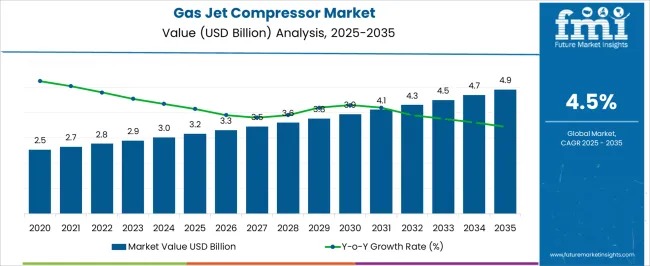
The Gas Jet Compressor Market is entering a decade of measured but resilient growth, supported by rising global energy demand and the expanding need for efficient gas handling across oil & gas, chemical processing, and power generation. Valued at USD 3.2 billion in 2025, the market is projected to reach USD 4.9 billion by 2035, advancing at a CAGR of 4.5%. This growth trajectory reflects the balance between industrial expansion and the industry’s emphasis on reliable, low-maintenance compression systems.
Gas jet compressors continue to stand out for their simple design, operational robustness, and ability to perform reliably under fluctuating pressure conditions. These advantages are particularly relevant in upstream and midstream energy applications, where operational continuity and reduced downtime directly impact profitability.
Subscribe for Year-Round Insights → Stay ahead with quarterly and annual data updates:
Market Drivers Shaping Demand
A key factor supporting market expansion is the sustained investment in oil exploration, natural gas infrastructure, and process industries. As energy systems become more complex, operators increasingly favor compression solutions that minimize maintenance while ensuring stable performance.
Additional drivers include:
- Rising global energy consumption and natural gas utilization
- Increased focus on vapor recovery, gas injection, and pressure maintenance
- Technological improvements that enhance efficiency and lower lifecycle costs
Together, these factors position gas jet compressors as a dependable solution in both mature and emerging industrial markets.
Segmental Insights: Where Growth Is Concentrated
Single-Stage Compressors Lead Adoption
Single-stage compressors dominate the market with 58.9% share in 2025, largely due to their cost-effectiveness and suitability for medium-duty applications. Their straightforward construction, lower capital costs, and ease of maintenance make them a preferred choice in oil exploration, chemical processing, and power plant operations. With industries increasingly prioritizing streamlined and energy-efficient systems, this segment is expected to retain its leadership through 2035.
Medium Pressure Range Remains the Sweet Spot
The medium pressure segment accounts for approximately 45.2% of market share, reflecting its versatility across industrial processes. These compressors deliver balanced performance between low and high pressure systems, offering adaptability and comparatively lower energy consumption. Ongoing infrastructure projects and oilfield developments continue to reinforce demand for medium pressure gas jet compressors globally.
Oil Exploration and Production as a Core End-Use Industry
Oil exploration and production represent about 23.5% of total market demand, underscoring the critical role of gas jet compressors in upstream activities. Applications such as gas injection, vapor recovery, and reservoir pressure maintenance depend heavily on reliable compression technologies. Continued investment in offshore projects and enhanced recovery techniques further supports this segment’s positive outlook.
Technology Trends Influencing the Market
Manufacturers are increasingly offering modular and customized compressor solutions, enabling end users to tailor systems to specific operating conditions. Customization improves efficiency, enhances reliability, and ensures alignment with application-specific requirements.
Another notable trend is the rising demand for oil-free gas jet compressors, particularly in sensitive sectors such as food processing and pharmaceuticals. These solutions help maintain gas purity while opening new investment opportunities for manufacturers focused on high-value applications.
At the same time, the integration of artificial intelligence (AI) and machine learning (ML) is gaining momentum. Advanced control systems powered by AI and ML enable predictive maintenance, performance optimization, and reduced downtime—delivering tangible cost and efficiency benefits.
Challenges: Investment and Upgradation Constraints
Despite positive fundamentals, the market faces challenges related to equipment upgrades and capital expenditure. High upfront costs, operational disruptions during installation, and uncertainty around return on investment can slow adoption of newer systems. Compatibility issues with existing infrastructure and shortages of trained personnel also remain concerns for some operators, potentially creating short-term demand fluctuations.
Regional Trends and Growth Hotspots
North America, Europe, and Asia-Pacific remain the most influential regions in the global gas jet compressor market.
- United States: Adoption of computational fluid dynamics (CFD) is improving compressor design and efficiency, supporting steady growth.
- United Kingdom: Emission reduction goals in natural gas transportation are driving demand for efficient compression technologies.
- South Korea: Investments in hydrogen infrastructure and clean energy initiatives are creating new opportunities for gas jet compressors in hydrogen production and storage.
Canada is also emerging as a notable growth market, supported by sustainability standards and regulatory focus.
Competitive Landscape and Strategic Focus
Leading players such as Spirax Sarco, Schutte & Koerting, GEA Group, Transvac Systems, Körting Hannover, EST Venturi Systems, Forbes Marshall, Kadant, and Croll Reynolds are emphasizing innovation, operational efficiency, and customer-centric customization. Competitive differentiation increasingly revolves around reducing total cost of ownership, improving longevity, and supporting sustainable industrial practices.
Looking Ahead: A Market Built on Reliability
Historically, the gas jet compressor market recorded a 4.2% CAGR between 2020 and 2025, demonstrating consistent demand across multiple industries. From 2025 onward, growth is expected to remain stable as compressors find broader application in energy, chemicals, HVAC, food processing, pharmaceuticals, and aerospace & defense.
Get data that aligns with your strategic priorities — ask for report customization today:
Related Reports
Evaporative Air Cooler Market – https://www.futuremarketinsights.com/reports/evaporative-air-cooler-market
Metal based Safety Gratings Market – https://www.futuremarketinsights.com/reports/metal-based-safety-gratings-market
Tritium Light Source Market – https://www.futuremarketinsights.com/reports/tritium-light-sources-market
Have a specific Requirements and Need Assistant on Report Pricing or Limited Budget please contact us – sales@futuremarketinsights.com
About Future Market Insights (FMI)
Future Market Insights, Inc. (FMI) is an ESOMAR-certified, ISO 9001:2015 market research and consulting organization, trusted by Fortune 500 clients and global enterprises. With operations in the U.S., UK, India, and Dubai, FMI provides data-backed insights and strategic intelligence across 30+ industries and 1200 markets worldwide.
Contact Us:
Future Market Insights Inc.
Christiana Corporate, 200 Continental Drive,
Suite 401, Newark, Delaware – 19713, USA
T: +1-347-918-3531
Why FMI: https://www.futuremarketinsights.com/why-fmi
For Sales Enquiries: sales@futuremarketinsights.com
Website: https://www.futuremarketinsights.com
LinkedIn| Twitter| Blogs | YouTube