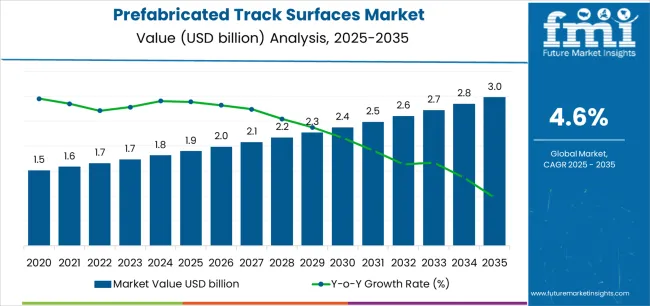
The global prefabricated track surfaces market is set to experience robust expansion through 2035, driven by growing investments in sports and athletic infrastructure, advancements in material technology, and increasing participation in athletic programs worldwide. In 2025, the market is estimated at USD 1.9 billion and is projected to expand to USD 3.0 billion by 2035, reflecting sustained growth as innovation and strategic developments continue to shape industry dynamics.
Prefabricated track surfaces — engineered systems designed for durability, performance, and fast installation — are redefining how sports venues, educational institutions, and community facilities approach athletic track construction. These products are typically manufactured in controlled environments and delivered ready to install, offering improved uniformity in thickness, shock absorption, weather resistance, and overall surface quality. As more stakeholders prioritize performance, safety, and long-term value, both established and emerging manufacturers are advancing their offerings to capitalize on this surging demand.
Market Expansion Driven by Innovation and Infrastructure Investment
The market’s momentum is fueled by several key trends, including the modernization of aging athletic facilities, increased construction of new sports venues, and rising demand for modular solutions that reduce onsite labor and installation time. Established companies with deep expertise in synthetic surfacing are expanding production capabilities and integrating advanced polymer formulations to enhance product lifespans and performance attributes. At the same time, a new generation of regional manufacturers is entering the market with innovative materials and cost-effective solutions that appeal to emerging economies.
Rubber-based prefabricated surfaces remain the leading product type, valued for their balanced combination of elasticity, traction, and durability, making them suitable for a broad range of athletic applications. Synthetic and hybrid types are gaining traction as manufacturers incorporate cutting-edge materials and design concepts that improve weather resistance and customise surface characteristics for various athletic activities. Schools, particularly in regions experiencing rapid educational infrastructure development, continue to be a major application segment, driven by policy-led investments and heightened emphasis on safe, standardized facilities.
Established Players Lead Technology Integration
Among the most recognized names in the prefabricated track surfaces market, long-standing manufacturers are leveraging their global presence to introduce new technologies and strengthen market leadership. These companies have historically invested in research and development to refine polymer blends and surface textures that deliver consistent performance under diverse climatic conditions. Their advanced manufacturing processes emphasize uniform shock absorption, improved UV resistance, and enhanced traction, making their products preferred choices for professional stadiums, national sporting events, and high-performance athletic facilities.
To stay competitive, these industry leaders are also enhancing their service portfolios by implementing digital quality control systems and modular installation platforms that reduce project timelines and improve on-site precision. By focusing on sustainability and recyclability, they are aligning with global environmental goals and offering surfaces that meet stringent certification requirements while reducing lifecycle impacts.
To access the complete data tables and in-depth insights, request a sample report here
Emerging Manufacturers Bring Fresh Energy and Regional Tailoring
At the same time, a vibrant cohort of emerging manufacturers is gaining ground, particularly in Asia Pacific and other developing regions where new stadium construction and community sports programmes are on the rise. These new entrants prioritize agility and local market understanding, offering adaptable prefabricated systems that balance performance with affordability. By integrating contemporary materials and modular design solutions, they are able to meet diverse client needs and shorten delivery cycles.
Their growing presence highlights a broader competitive shift toward inclusive innovation — one that accommodates varying infrastructure budgets and climatic conditions. Many of these companies are embracing sustainable raw materials and exploring alternative composite formulations that address both environmental and performance goals, setting new benchmarks for cost-effective track surface solutions.
Technology Trends Redefining the Playing Field
Technological innovation remains a core driver of market evolution. Manufacturers across the board are incorporating digital tools, such as performance monitoring systems embedded within track surfaces, to gather real-time data about traction, wear, and usage patterns. These advancements are enabling facility operators to predict maintenance needs, optimize surface performance, and extend product lifespans.
Other noteworthy technological trends include the development of roll-out panels and interlocking modules that dramatically reduce site preparation time and labor costs. These modular solutions streamline logistics and installation, making prefabricated surfaces more accessible for a wider range of users, from municipal parks to national athletics centres.
Regional Growth and Opportunities
Geographically, Europe and North America continue to lead demand, supported by well-established sporting standards and substantial public and private investments in athletic infrastructure. However, the Asia Pacific region is rapidly gaining market share as governments and institutions increase funding for sports development initiatives and build new facilities in urban and rural areas alike.
Across regions, factors such as raw material price fluctuations, logistics coordination, and local regulatory requirements will influence project timelines and supply chain strategies. Nonetheless, the overall outlook remains positive, with manufacturers strategically positioning themselves to serve both traditional markets and emerging opportunities.
About the Prefabricated Track Surfaces Market
The prefabricated track surfaces market encompasses a range of product types, from rubber and synthetic to hybrid solutions, serving applications including educational institutions, stadiums, parks, and community recreation centres. As innovation continues to accelerate and demand intensifies, both established and new manufacturers are adopting forward-looking strategies to capture growth and shape the future of athletic infrastructure.