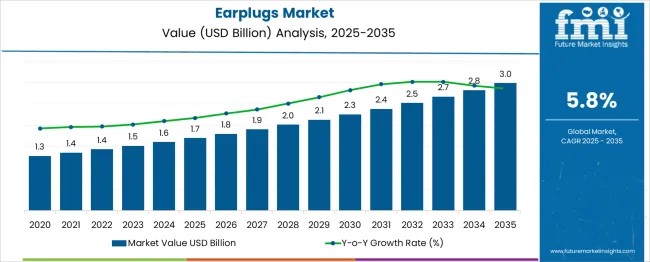
The global earplugs market is entering a phase of sustained and technology-driven growth, fueled by stricter workplace safety regulations, rising industrial activity, and increasing awareness of noise-induced hearing loss across both professional and consumer segments. According to the latest market analysis, the earplugs market is projected to grow from USD 1.7 billion in 2025 to approximately USD 2.99 billion by 2035, registering a CAGR of 5.8% over the forecast period. This reflects an absolute value addition of USD 1.287 billion and a total market expansion of nearly 1.76X within a decade.
To access the complete data tables and in-depth insights — Request Your Sample Report Now
Quick Highlights of the Earplugs Market
- Market Value (2025): USD 1.7 billion
- Forecast Value (2035): USD 3 billion
- Forecast CAGR (2025–2035): 5.8%
- Leading Application: Industrial & Occupational (64% share)
- High-Growth Regions: China, India, Germany
- Key Players: 3M, Moldex-Metric, Hearos, Radians Inc., Loop Earplugs, Lucid Hearing, Magid Glove & Safety, Allens Industrial Products, Honeywell International Inc.
Market Growth Outlook: 2025 to 2035
Between 2025 and 2030, the earplugs market is expected to expand to USD 2.26 billion, accounting for nearly 43.5% of total forecast growth. This phase will be shaped by tighter occupational safety mandates, rapid industrial automation, and heightened employer responsibility toward worker health.
From 2030 to 2035, the market will add another USD 0.73 billion, driven largely by technological innovation, including active noise cancellation (ANC), smart earplugs, and e-commerce-led distribution expansion. Personalized and custom-fit hearing protection solutions will further accelerate adoption among both industrial users and consumers.
Why the Earplugs Market Is Growing
The expansion of the global earplugs market is supported by several structural and behavioral factors:
- Stringent workplace safety regulations across manufacturing, construction, mining, aviation, and energy sectors.
- Rising awareness of long-term hearing damage, encouraging preventive adoption rather than reactive solutions.
- Growth in recreational noise exposure, including concerts, motorsports, shooting sports, and nightlife.
- Product innovation, focusing on comfort, communication-friendly designs, and aesthetic appeal.
- Shift toward premium and smart hearing protection, especially in developed economies.
Key Market Segments – Pointwise Overview
By Application
- Industrial & Occupational: 64% market share
- Consumer Applications: Rapidly growing due to lifestyle and recreational use
By Type
- Disposable Earplugs: 62.3% share
- Reusable Earplugs: Growing adoption in premium and customized solutions
By Material
- Foam: 43% market share
- Silicone
- Wax
- Others
By Technology
- Passive Earplugs: 62.3%
- Active Earplugs (Smart & ANC-enabled): Emerging high-value segment
By Noise Reduction Rating (NRR)
- 10–20 dB
- 21–25 dB
- 26–29 dB (36% share)
- 30–33 dB
Industrial & Occupational Segment Dominates Demand
The industrial & occupational segment remains the backbone of the earplugs market, accounting for 64% of total demand in 2025. Mandatory compliance with OSHA, EU Directives, and similar global safety frameworks ensures consistent demand across:
- Automotive manufacturing
- Construction and infrastructure
- Energy and power generation
- Aviation ground operations
- Healthcare facilities
- Mining and drilling operations
Each industry requires tailored noise reduction solutions, encouraging manufacturers to develop specialized earplugs that balance protection with communication clarity.
Disposable and Foam Earplugs Lead Adoption
- Disposable earplugs dominate due to hygiene, cost-efficiency, and ease of bulk deployment.
- Foam earplugs, with their adaptability and comfort, remain the most widely used material, benefiting from innovations such as hypoallergenic formulations and slow-recovery designs.
Technology Trends Reshaping the Market
- Active Noise Cancellation (ANC): Enables selective filtering of harmful noise while allowing speech and alerts.
- Smart Earplugs: Connectivity, sound profiling, and situational awareness features.
- Customization & 3D Printing: Personalized earplugs for superior comfort and protection.
- IoT Integration: Emerging in industrial safety ecosystems.
These advancements are creating opportunities for new manufacturers and tech-driven startups to enter the market alongside established players.
Regional Growth Insights
- China (7.8% CAGR): Driven by large-scale manufacturing and stricter safety enforcement.
- India (7.3% CAGR): Boosted by industrial corridors, Make in India initiatives, and safety awareness.
- Germany (6.7% CAGR): Focus on advanced acoustic engineering and premium products.
- France & UK: Steady growth through innovation and worker-centric safety policies.
- USA (4.9% CAGR): Mature market emphasizing smart and recreational earplugs.
- Brazil (4.4% CAGR): Growth supported by industrial expansion and improving standards.
Competitive Landscape: Established Leaders and New Innovators
The earplugs market features a balanced mix of global safety equipment leaders and emerging lifestyle-focused brands:
- 3M leads with ~25% global market share, leveraging R&D and global distribution.
- Honeywell International and Moldex-Metric focus on industrial compliance and comfort-driven designs.
- Hearos and Radians Inc. cater to consumer and value-driven industrial segments.
- Loop Earplugs and Lucid Hearing represent the new wave of design-centric and smart hearing protection, appealing to younger and tech-savvy users.
Outlook
With increasing regulatory pressure, technological evolution, and rising consumer consciousness, the global earplugs market is positioned for resilient long-term growth. Both established manufacturers and new entrants have significant opportunities to expand their businesses, introduce innovative hearing protection technologies, and address evolving user needs across industrial and lifestyle applications.
As hearing health becomes a global priority, earplugs are transitioning from basic safety products to smart, personalized, and lifestyle-enhancing solutions, shaping the future of the hearing protection industry through 2035 and beyond.
Why FMI: https://www.futuremarketinsights.com/why-fmi
About Future Market Insights (FMI)
Future Market Insights, Inc. (FMI) is an ESOMAR-certified, ISO 9001:2015 market research and consulting organization, trusted by Fortune 500 clients and global enterprises. With operations in the U.S., UK, India, and Dubai, FMI provides data-backed insights and strategic intelligence across 30+ industries and 1200 markets worldwide.
Contact Us:
Future Market Insights Inc.
Christiana Corporate, 200 Continental Drive,
Suite 401, Newark, Delaware – 19713, USA
T: +1-347-918-3531
For Sales Enquiries: sales@futuremarketinsights.com
Website: https://www.futuremarketinsights.com
LinkedIn| Twitter| Blogs | YouTube