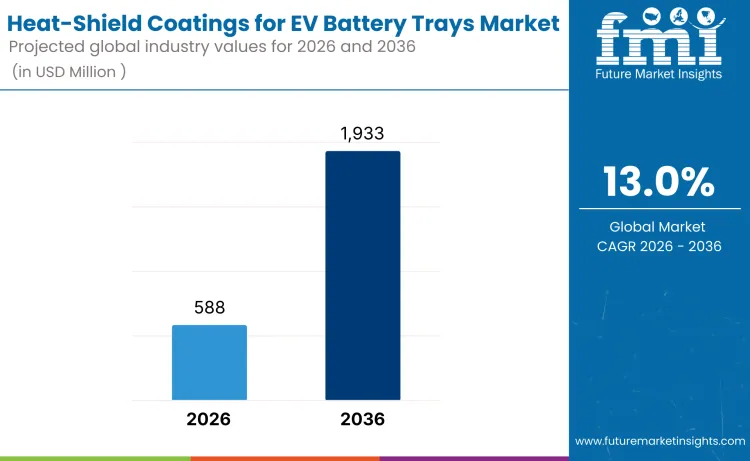
The global Heat-Shield Coatings for EV Battery Trays Market, valued at USD 588 million in 2026, is poised for rapid expansion over the next decade, with projected revenues reaching approximately USD 1.93 billion by 2036. This robust growth trajectory reflects the accelerating demand for electric vehicles (EVs) and the accompanying need for advanced thermal management and safety systems in EV batteries. As the world transitions toward electrified transportation, both established industry leaders and emerging manufacturers are harnessing cutting-edge technologies to deliver innovative heat-shield solutions that protect EV battery systems and enhance overall performance.
Electric vehicle battery systems generate significant amounts of heat during operation, making effective thermal protection critical to battery longevity, safety, and performance. Heat-shield coatings applied to battery trays act as a frontline defense, insulating sensitive components from excessive temperatures and helping to prevent thermal runaway events. This growing need has spurred demand from EV manufacturers globally and opened opportunities for technology innovators looking to make their mark in the rapidly evolving EV supply chain.
Market Dynamics Driving Innovation and Growth
The expanding EV ecosystem — from passenger cars and commercial trucks to two-wheelers and electrified fleets — has created fertile ground for diversification in heat-shield coating materials and applications. Traditional coatings such as ceramic thermal barriers have long been favored for their high heat resistance and durability, but newer solutions including silicone-based, intumescent, polymer composite, and hybrid coatings are gaining traction for their specialized performance characteristics and adaptability to automated manufacturing processes.
Manufacturers are increasingly exploring advanced formulations that not only block or dissipate heat but also integrate seamlessly with battery tray designs, enhance mechanical strength, and conform to evolving safety standards. These technologies are becoming essential for OEMs seeking lightweight, high-performance components that align with stringent regulatory requirements and consumer expectations for EV safety and reliability.
Leaders and Innovators in Heat-Shield Coating Technologies
Several well-established global chemical and materials companies are at the forefront of the heat-shield coatings market, leveraging decades of expertise in specialty coatings and surface protection. Industry stalwarts such as PPG Industries, AkzoNobel, Henkel, 3M, DuPont, and BASF continue to lead with broad portfolios of heat-resistant technologies tailored for EV battery applications. Their deep R&D capabilities, global manufacturing footprint, and strong partnerships with automotive OEMs enable them to deliver solutions that meet both performance and scalability needs.
At the same time, emerging players and niche specialists are disrupting the market with new approaches and innovative technologies. Companies like Thermal Coatings Inc., Fine Ceramic Technology Co. Ltd., and select advanced materials manufacturers are pushing the boundaries of what heat-shield coatings can achieve — exploring coatings with enhanced thermal stability, improved adhesion to diverse substrate materials, and faster, more efficient application processes. These new entrants are attracting attention for their agile development cycles and willingness to collaborate closely with both EV OEMs and battery pack suppliers.
Such innovations are especially attractive to EV makers seeking competitive differentiation through improved battery safety, extended life cycles, and enhanced performance under extreme conditions. The rapidly growing market is also encouraging traditional coating manufacturers to broaden their offerings, invest in next-generation materials science, and accelerate the commercialization of hybrid and multifunctional thermal protection solutions.
To access the complete data tables and in-depth insights, request a sample report here
Regional Growth and Strategic Expansion
The market’s global reach continues to expand as major EV hubs emerge across Asia Pacific, North America, and Europe. China, in particular, is expected to experience strong momentum, driven by its position as the world’s largest EV producer and consumer. Other regions — including India, the United States, the United Kingdom, and Japan — are also projected to witness significant demand growth as EV adoption gains traction and regulatory landscapes evolve to emphasize battery safety and performance.
This geographic diversification presents opportunities for both established corporations and newer technology companies to forge strategic partnerships, establish regional production facilities, and align closely with local EV manufacturing ecosystems. Innovative startups and technology providers are finding fertile ground to pilot product offerings in these high-growth markets, often collaborating with larger partners to scale production and distribution.
Future Outlook: A Market Fueled by Innovation
As the EV revolution accelerates, the heat-shield coatings market is set to become an increasingly integral component of EV battery design and safety strategy. With a forecasted compound annual growth rate that reflects strong long-term demand, the industry is poised for sustained expansion. Continuous innovation around material science, process integration, and performance enhancement will be critical to meeting the evolving needs of EV manufacturers and end users alike.
Established industry leaders are leveraging their experience to refine and expand their product offerings, while ambitious new manufacturers are injecting fresh ideas and technologies into the market. Together, these players are advancing the state of thermal protection solutions for EV batteries — enhancing safety, extending service life, and supporting the broader goal of electrified mobility for consumers and industries around the world.