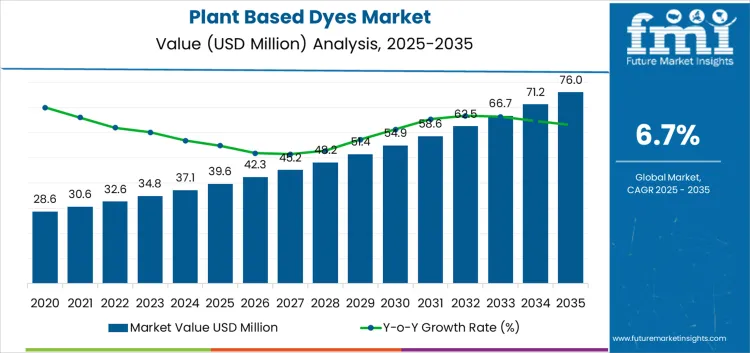
The global plant-based dyes market is set to witness remarkable growth over the coming decade, expanding from an estimated USD 39.6 million in 2025 to approximately USD 76.0 million by 2035. This rapid expansion reflects a compound annual growth rate of 6.7%, fueled by rising consumer demand for natural, sustainable, and transparent color solutions across cosmetics, textiles, food, and personal care industries.
Plant-based dyes — derived from botanical sources such as turmeric, beetroot, annatto, indigo, and other plant extracts — are fast becoming essential ingredients in the portfolios of both established chemical manufacturers and new market entrants alike. The increasing adoption of these dyes highlights a structural shift in global supply chains toward eco-friendly alternatives to traditional synthetic colorants.
Market Dynamics: Demand Across Diverse End-Use Applications
The plant-based dyes market’s growth trajectory is underpinned by expanding usage in a wide range of applications. While hair care and color cosmetics remain the most significant demand drivers, other sectors such as skin care, body care, sun care, men’s grooming, baby & kids care, and professional dermocosmetics are broadening the market base. These applications benefit from the natural appeal of plant-derived colorants, which align seamlessly with clean-beauty trends and ingredient transparency expectations.
In addition to cosmetics and personal care, plant-based dyes are increasingly integrated into sustainable textile production and clean-label food and beverage formulations. This cross-sector appeal underscores the strategic importance of plant-based dyes as both aesthetic and functional ingredients.
Innovation and Technology: From Craft to Industrial-Scale Consistency
A defining characteristic of the plant-based dyes market is the transition from artisanal craft colorants to regulated, industrial-grade ingredients. Breakthroughs in extraction standardization, impurity control, and formulation stability are enabling manufacturers to deliver on industrial criteria such as chroma strength, solubility, pH resilience, and batch-to-batch consistency. These advancements are critical as brands scale production and integrate plant-based dyes into automated manufacturing processes.
Leading players and innovative newcomers are investing heavily in technologies that balance botanical authenticity with industrial reliability. This includes enhanced botanical extraction systems, precision drying and micronization for powder formulations, and advanced dispersion technologies for liquid and high-active concentrate forms.
Established Leaders and Emerging Innovators Driving Growth
The competitive landscape of the plant-based dyes market boasts a mix of multinational chemical companies, specialty ingredient firms, and agile new entrants focused on sustainability and natural product innovation.
Established industry leaders — including globally recognized firms with expansive research and development capabilities — continue to play a foundational role in shaping market standards and scaling production. These legacy manufacturers bring deep expertise in formulation science, regulatory compliance, and global distribution channels that help accelerate mainstream adoption of plant-based colorants.
To access the complete data tables and in-depth insights, request a sample report here
At the same time, emerging manufacturers and niche innovators are making notable impacts by introducing fresh approaches to sourcing, extraction, and product integration. These newer players often emphasize traceability, regenerative agricultural sourcing, and localized production models that resonate with brands seeking differentiated natural solutions. Their agility in adopting cutting-edge technologies and responsiveness to evolving consumer trends are contributing to dynamic competition and broader market penetration.
Collectively, this diverse pool of players — from established conglomerates to up-and-coming botanical specialists — is fueling product innovation across multiple fronts.
Regional Expansion and Market Penetration
Asia Pacific stands out as a dominant region for plant-based dyes supply, with strong volumes driven by manufacturers in India, China, and Southeast Asia. These markets benefit from abundant agricultural inputs and increasing industrialization of natural dye processing. Meanwhile, the United States, Germany, France, and Japan represent critical consumption hubs where demand is propelled by premium cosmetic brands, eco-conscious textile producers, and food manufacturers prioritizing clean-label colorants.
Across regions, the convergence of consumer preference for eco-friendly products, stringent regulatory pressures against synthetic additives, and strategic sustainability commitments by major brands is pushing plant-based dyes from niche adoption toward mainstream acceptance.
Future Outlook: Sustainability and Market Innovation
Looking ahead, the plant-based dyes market is poised for continued momentum fueled by technological advancements and expanding product applications. Manufacturers are exploring novel plant sources and hybrid extraction techniques to enhance pigment stability and broaden usable color palettes. Digital tools and process automation are streamlining supply chain traceability, while collaborative platforms are encouraging co-innovation between ingredient developers and end-use brands.
Clean-label positioning, coupled with sustainability credentials and improved performance characteristics, will continue to make plant-based dyes a compelling choice for product formulators in beauty, textiles, food, and beyond. As both seasoned players and new entrants innovate and compete, the industry’s evolution promises robust growth and transformative impact on the global colorants landscape.