The global magnesium wheel market is projected to grow steadily from USD 1.9 billion in 2025 to USD 2.4 billion by 2035, registering a compound annual growth rate (CAGR) of 2.2% over the forecast period. This controlled yet resilient expansion reflects the market’s evolution into a mature, performance-focused segment, where demand is driven less by volume and more by technological sophistication, regulatory pressure, and premium automotive positioning.
Magnesium wheels have firmly established themselves as a strategic component within the automotive lightweighting ecosystem. Accounting for approximately 1.9% of the global automotive wheel market, the segment plays an outsized role in performance optimization, contributing an estimated 3.2% share within the performance vehicle components sector and 2.4% of the electric vehicle (EV) components industry. The material’s superior strength-to-weight ratio, combined with thermal conductivity and structural rigidity, continues to attract OEMs and aftermarket specialists serving sports, luxury, and electrified vehicle platforms.
Subscribe for Year-Round Insights → Stay ahead with quarterly and annual data updates
https://www.futuremarketinsights.com/reports/sample/rep-gb-23261
Between 2025 and 2029, market expansion remains tightly controlled, rising from USD 1.9 billion to approximately USD 2.1 billion. This phase is characterized by incremental adoption in premium vehicle classes and specialized motorsport applications, offset by the high production costs and technical complexity associated with magnesium alloy manufacturing. From 2030 to 2035, the market progresses from USD 2.2 billion to USD 2.4 billion, reflecting a saturation dynamic in core regions and a shift toward value-driven innovation rather than mass-market penetration.
Performance Engineering and Regulatory Pressure Accelerate Strategic Demand
The market’s fundamentals are anchored in the automotive industry’s accelerating focus on vehicle mass reduction. Magnesium wheels can significantly lower unsprung weight, resulting in measurable improvements in acceleration, braking efficiency, cornering stability, and energy efficiency. These performance gains have positioned magnesium wheels as a preferred solution in motorsports, premium sports cars, and high-end electric vehicles, where efficiency and responsiveness directly influence product differentiation.
Environmental regulations across North America, Europe, and parts of Asia-Pacific have intensified the need for lightweight components. Emission reduction mandates and fuel economy standards are driving manufacturers to integrate advanced materials into structural and rotational components, with magnesium alloys emerging as a viable alternative to traditional steel and advanced aluminum alloys in select use cases.
Cast Magnesium Wheels Dominate Production Landscape
By manufacturing method, the cast magnesium wheel segment is projected to account for 61.0% of total market share in 2025. High-pressure die casting has become the dominant production technique due to its ability to deliver dimensional precision, design flexibility, and faster production cycles. Recent advances in casting technology have significantly improved fatigue resistance and structural integrity, enabling wider application in performance road vehicles while maintaining cost discipline.
The car segment is expected to represent 52.0% of total market demand in 2025, supported by the growing use of magnesium wheels in sports sedans, performance SUVs, and electric vehicles. The integration of magnesium wheels in factory-installed performance packages and limited-edition trims has further strengthened OEM adoption, while the aftermarket segment continues to expand through customization-driven demand.
In terms of wheel size, 19-21 inch magnesium wheels are forecast to command 36.0% market share by 2025, aligning with global design trends favoring larger wheel diameters for enhanced aesthetics, brake system clearance, and handling dynamics.
Regional Dynamics Highlight Asia-Pacific and Europe as Strategic Hubs
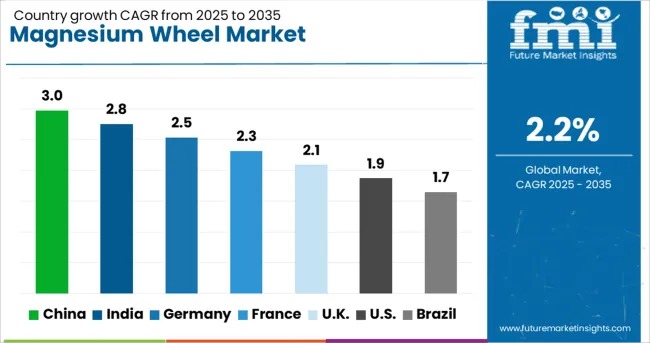
Geographically, China is set to lead growth with a CAGR of 3.0%, supported by its extensive automotive manufacturing infrastructure and expanding performance aftermarket ecosystem. Domestic manufacturers are investing in forged and hybrid manufacturing techniques to meet the growing demand from premium passenger vehicles and performance motorcycles.
India follows with a projected 2.8% CAGR, driven by the rapid expansion of its premium motorcycle segment and a rising culture of vehicle customization in urban centers. Germany, at 2.5% CAGR, remains a core innovation hub, where partnerships between wheel manufacturers and high-performance automotive brands are accelerating the adoption of advanced magnesium alloys and corrosion-resistant treatments.
The United Kingdom, growing at 2.1% CAGR, is benefiting from its strong motorsport culture and classic car restoration market, while the United States, at 1.9% CAGR, continues to see stable demand from racing, luxury SUVs, and electric vehicle platforms.
Technological Advancements Strengthen Market Resilience
Ongoing innovation in forging technologies, heat treatments, and multi-layer surface coatings has addressed historical limitations linked to corrosion and impact resistance. Manufacturers are now delivering magnesium wheels with powder-coated, anodized, and ceramic-based protective finishes, significantly extending operational life and reliability.
Computer-aided engineering and digital simulation tools have enabled optimized structural designs, reducing material usage without compromising strength. These developments have expanded acceptance beyond motorsports into high-end road vehicles and emerging electric mobility applications.
Personalize Your Experience: Ask for Customization to Meet Your Requirements
https://www.futuremarketinsights.com/customization-available/rep-gb-23261
Competitive Landscape Anchored by Performance and Precision
The market remains concentrated around a group of specialized high-performance manufacturers, including BBS USA, Rays Wheels, OZ Group, Ronal Group, Enkei, Forgiato, Vossen Wheels, MKW Alloy, Brembo, and Vorsteiner. These companies are leveraging motorsport partnerships, proprietary alloy formulations, and advanced manufacturing capabilities to maintain technical leadership.
Recent industry developments include expanded OEM-grade magnesium wheel shipments to major automotive markets and strategic realignments in product portfolios, reinforcing the market’s premium positioning and limited-volume, high-value structure.
Outlook: A Technology-Driven, High-Value Market with Long-Term Stability
While the magnesium wheel market operates in a mature growth phase, its strategic importance within performance engineering, luxury vehicle manufacturing, and electric mobility continues to increase. The combination of stable demand, ongoing material science innovation, and tightening emissions standards positions the market as a critical niche within the broader lightweighting and performance enhancement ecosystem.
The full market report provides detailed coverage of segmental forecasts, competitive benchmarking, manufacturing technology trends, and strategic opportunities across more than 40 countries, offering a comprehensive foundation for long-term planning and investment evaluation.