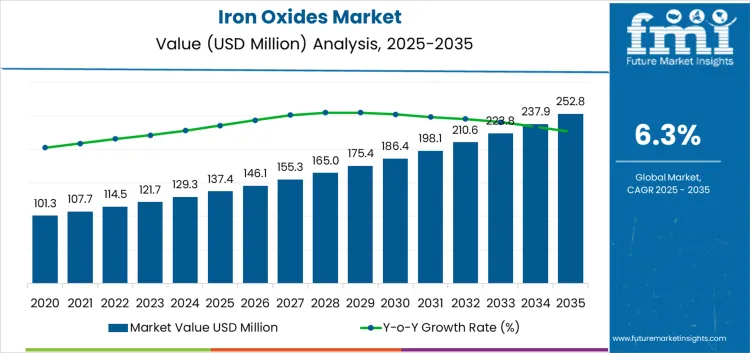
The global iron oxides market is poised for significant expansion, with the industry projected to grow from USD 137.4 million in 2025 to USD 252.8 million by 2035, representing strong growth momentum through the forecast period and signaling robust opportunities for both established players and emerging manufacturers. Steady demand across multiple end-use sectors such as construction, coatings, plastics, and cosmetics is driving sustained interest in iron oxides as indispensable performance pigments.
The widening adoption of iron oxides reflects their unmatched versatility — combining color stability, UV resistance, and thermal durability with increasing demand in modern industrial and consumer applications. This growth story presents a compelling opportunity for existing market leaders to deepen their presence globally, and for newer firms to enter and scale in a dynamic and evolving landscape.
Industry Leaders Driving Market Expansion
The current market ecosystem features key multinational companies that have been instrumental in defining product standards, advancing manufacturing excellence, and investing in cutting-edge processes. These major players have established extensive global networks, diversified product portfolios, and strong R&D capabilities:
-
BASF SE, known for its high-performance pigment solutions and broad application spectrum.
-
Croda International, delivering specialty formulations for personal care and industrial coatings.
-
Evonik Industries, a major innovator in specialty materials and fine chemistry.
-
Symrise, integrating advanced pigment technologies for cosmetics and lifestyle products.
-
Dow, with a deep portfolio of polymer and coating solutions incorporating iron oxides.
-
Ashland and Clariant, both strengthening their foothold through tailored pigment offerings.
-
Seppic, blending scientific innovation with application-specific solutions.
These established firms continue to scale production, optimize supply chains, and expand into high-growth regions.
Emerging Manufacturers Step into the Spotlight
In parallel with legacy players, a new wave of manufacturers is entering the iron oxides market with fresh strategies, regional specialization, and innovative technologies. These companies are leveraging local advantages and agile business models to challenge traditional supply dynamics and meet specialized industry needs.
Emerging firms in China, India, and other parts of Asia Pacific are rapidly expanding capacity to serve booming infrastructure and manufacturing demand in the region. These companies are not only supplying raw pigment volumes at competitive prices but are also investing in customized product forms, such as micronized powders, surface-treated grades, and formulations tailored for advanced coatings, plastics, and cosmetic applications.
Regional players, especially in Asia and Latin America, are gaining traction by offering localized production, reduced lead times, and solutions optimized for regional standards. Many are collaborating with global brands through contract manufacturing, co-development agreements, and joint ventures, underscoring the market’s increasingly interconnected nature.
Technological Advancements Reshaping Market Dynamics
Innovation in the iron oxides market is no longer limited to incremental production gains. A wave of new technologies is transforming manufacturing efficiency, product quality, and application performance. Leading manufacturers are investing in advanced furnace systems, precision pigment synthesis, and digital process controls to reduce energy consumption, improve particle distribution, and ensure consistent quality across batches.
New manufacturing techniques, such as advanced milling, controlled precipitation, and proprietary surface treatments, are enabling producers to offer ultra-fine and specialty grades that meet stringent performance criteria for electronics coatings, high-end cosmetics, and functional plastics. These technological shifts are expanding the addressable market and increasing iron oxides’ prominence in value-added and regulated applications.
Digital tools are also making inroads, with automation and predictive analytics helping streamline production, reduce waste, and anticipate market trends. As manufacturers adopt flexible, data-driven operations, they can accelerate time to market for innovative product lines and respond more proactively to shifts in end-use demand.
To access the complete data tables and in-depth insights, request a sample report here
Market Growth Fueled by Diverse End-Use Sectors
The demand for iron oxides is deeply rooted in their multi-sector utility:
-
Construction and Infrastructure: Iron oxides are essential in architectural finishes, colored concrete, paving blocks, and building materials, contributing to long-lasting and aesthetically pleasing structures.
-
Coatings and Paints: Durable pigmentation and UV resistance make iron oxides indispensable in protective and decorative coatings.
-
Plastics and Polymers: Used for mass coloration and functional properties in a wide range of plastic products.
-
Cosmetics and Personal Care: Growing use in foundations, lip products, eye makeup, and tinted formulations underscores iron oxides’ role in consumer beauty products.
This diversified application base helps stabilize demand even as individual sectors experience cyclical shifts. Increasing interest in sustainability and green manufacturing further underscores iron oxides’ appeal, as they are often favored for their non-toxic profile and performance characteristics.
Outlook: A Balanced Future of Legacy Strength and Agile Innovation
As the iron oxides market heads into the next decade, the combined forces of established industrial giants and dynamic new entrants promise a future rich with innovation, expanded product portfolios, and deeper global reach. Strategic investments in technology, regional capacity expansion, and cross-sector collaboration will be critical to capturing growth opportunities and meeting evolving customer demands.
The market’s projected expansion underscores a vibrant period ahead, where technological transformation and competitive diversification will shape the next chapter of iron oxides’ industrial journey.