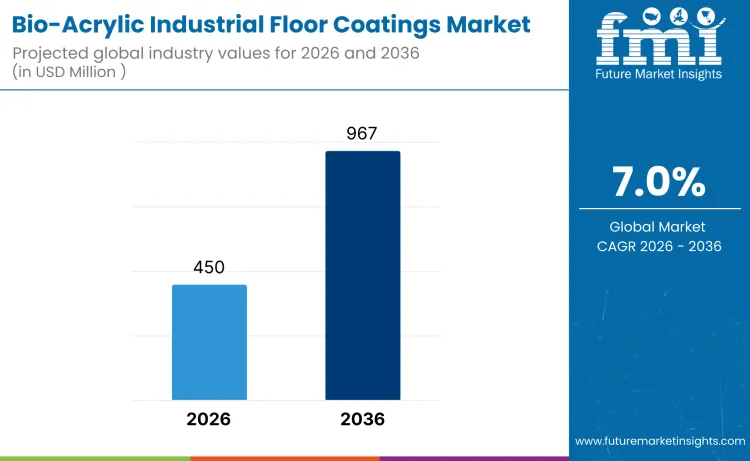
The global Bio-Acrylic Industrial Floor Coatings Market is poised for remarkable expansion, with the market value forecast to rise from approximately USD 450 million in 2026 to USD 967 million by 2036, driven by increasing demand for sustainable, high-performance industrial flooring solutions. This double-digit market acceleration reflects the industry’s commitment to eco-friendly innovation and its alignment with rising global environmental standards.
Bio-acrylic industrial floor coatings have become a cornerstone technology for modern industrial facilities seeking to balance durability with sustainability. With bio-acrylic waterborne coatings already capturing a leading share of the coating type segment, manufacturers worldwide are embracing this next generation of environmentally responsive materials that minimize volatile organic compounds (VOCs) while delivering robust performance for heavy-duty applications.
A Shifting Market Landscape: Established Leaders and New Innovators
The competitive terrain of the bio-acrylic coatings market features a mix of long-standing chemical and coatings giants alongside ambitious new players entering the green materials space. Established industry leaders such as PPG Industries, Sherwin-Williams, AkzoNobel, RPM International, BASF, Sika, Jotun, and Hempel continue to lead with extensive product portfolios, global distribution networks, and deep technical expertise. These companies are leveraging decades of coatings experience to refine formulations that meet the evolving performance and sustainability needs of manufacturing, logistics, and commercial facilities.
Simultaneously, a wave of emerging manufacturers and technology innovators is reshaping the competitive landscape. These newer entrants are rapidly adopting cutting-edge bio-resin technologies, hybrid coating systems, and renewable feedstocks to create differentiated offerings that appeal to eco-conscious industrial buyers. Many are focusing on scalable bio-based platforms that reduce reliance on petroleum-derived polymers and elevate the overall environmental profile of industrial floor coatings without compromising on durability or lifecycle performance.
The intersection of expertise from legacy players and experimental approaches from new technology firms is fostering a vibrant ecosystem of innovation. By integrating bio-based components with advanced curing technologies, digital application tools, and tailored surface chemistries, manufacturers are creating coatings that not only protect industrial floors from abrasion, heavy loads, and chemical exposures but also contribute to workplace safety and improved indoor air quality.
Drivers of Growth: Sustainability, Regulation, and Industrial Expansion
Several key forces are propelling the adoption of bio-acrylic industrial floor coatings. Increasing corporate commitments to environmental, social, and governance (ESG) goals are prompting facility owners and procurement teams to seek coatings with lower carbon footprints and reduced VOC emissions. Additionally, stricter environmental regulations in major markets are accelerating the shift away from solvent-borne systems toward waterborne and bio-derived alternatives.
Industrial segments such as automotive manufacturing, food and beverage processing, warehousing, aerospace assembly, and pharmaceutical production are particularly fertile grounds for these coatings due to their stringent performance requirements and growing sustainability mandates. The need for long-lasting floor protection that supports continuous operations with minimal maintenance is driving innovation and adoption.
Geographically, high growth rates are emerging across Asia Pacific, especially in China and India, where rapid industrial expansion and rising infrastructure investment are fueling demand for advanced floor coatings. North America and Europe continue to show strong uptake, supported by retrofit projects and new construction that prioritize green building certifications and healthier work environments.
To access the complete data tables and in-depth insights, request a sample report here
Emerging Technologies: Advancing Performance and Eco-Efficiency
Technological advancements are at the heart of the market’s future. Bio-acrylic formulations are evolving with improved chemical resistance, faster cure times, and enhanced adhesion properties, enabling their use in increasingly demanding operational settings. Hybrid systems that blend bio-based resins with specialty polymers are offering new levels of performance, while UV-curable and solvent-free options are gaining traction among users seeking rapid installation and lower energy footprints.
Manufacturers are also investing in smart coatings that can be more easily maintained or that provide self-healing properties, and exploring novel feedstocks derived from agricultural byproducts or other renewable sources. These developments are not only expanding the functional capabilities of industrial floor coatings but also creating new avenues for differentiation and competitive positioning among market players.
Market Outlook and Industry Implications
Looking ahead, the bio-acrylic industrial floor coatings sector is expected to sustain robust growth over the next decade as sustainability priorities, regulatory pressures, and industrial modernization efforts converge. Both established leaders and innovative newcomers are well-positioned to benefit from this trend, provided they continue to invest in R&D, strategic partnerships, and market education initiatives that highlight the advantages of eco-conscious flooring solutions.
This dynamic market presents significant opportunities for manufacturers aiming to scale their operations, adopt breakthrough technologies, and deliver value-based solutions that align with the needs of future-focused industries.