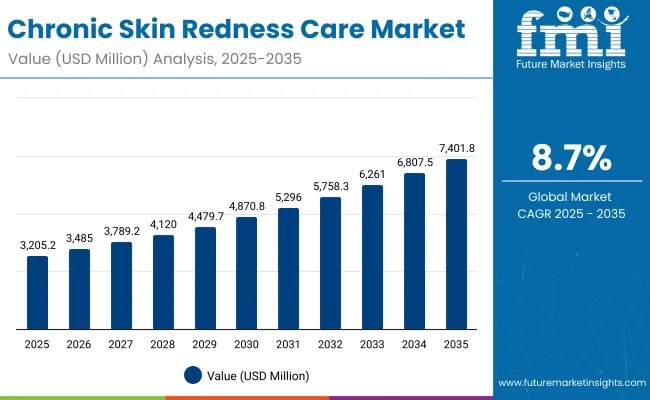
The global Chronic Skin Redness Care Market is entering a decade of sustained expansion, supported by rising dermatological awareness, stronger clinical validation, and rapid innovation by both established leaders and emerging manufacturers. Valued at USD 3,205.20 million in 2025, the market is projected to reach USD 7,401.80 million by 2035, reflecting an absolute growth of USD 4,196.60 million and an impressive 8.70% CAGR over the forecast period. This growth represents a 2.3X expansion, underscoring the market’s long-term structural strength and resilience.
To access the complete data tables and in-depth insights — Request Your Sample Report Now
Market Overview: A Decade of Clinically Driven Growth
Chronic skin redness—commonly associated with conditions such as rosacea, post-inflammatory erythema, and sensitive skin reactions—has transitioned from a niche concern to a mainstream dermatological priority. Increasing diagnosis rates, combined with heightened consumer demand for dermatologist-tested, fragrance-free, and hypoallergenic solutions, are redefining skincare standards worldwide.
Between 2025 and 2030, market revenues are expected to rise from USD 3,205.20 million to USD 4,870.80 million, accounting for nearly 40% of the total decade-long growth. This phase will be anchored by pharmacy-led trust, professional recommendations, and expanding access through organized retail and digital health platforms. From 2030 to 2035, incremental growth of USD 2,531.00 million is anticipated, led by Asia-Pacific markets and accelerated innovation in barrier-repair formulations.
Why the Chronic Skin Redness Care Market Is Growing
The expansion of the chronic skin redness care market is being fueled by a combination of medical credibility and consumer-centric innovation:
- Rising awareness and diagnosis of rosacea and redness-prone skin conditions
- Growing preference for dermatologist-tested claims, which held 51.5% market share in 2025
- Pharmacy and drugstore dominance, accounting for 48.5% of global sales, reinforcing trust
- Teledermatology and digital skin consultations, improving access and early intervention
- Innovation in barrier-repair actives such as niacinamide, centella asiatica, and azelaic acid
Together, these factors are creating a durable demand trajectory that benefits both multinational brands and agile new entrants.
Key Market Takeaways at a Glance
- Market Size (2025): USD 3,205.20 million
- Forecast Value (2035): USD 7,401.80 million
- CAGR (2025–2035): 8.70%
- Leading Claim Segment: Dermatologist-tested (51.50%)
- Leading Channel: Pharmacies/Drugstores (48.50%)
- Fastest-Growing Region: Asia-Pacific (India & China)
Segmental Insights Shaping Market Expansion
- Claim Segment: Dermatologist-Tested Leads with Authority
Dermatologist-tested products generated USD 1,648.50 million in 2025, reflecting strong consumer reliance on clinically validated solutions. This segment continues to set the benchmark for credibility as regulatory scrutiny around claims intensifies globally. Emerging manufacturers are increasingly investing in clinical trials to compete alongside established brands.
- Channel Segment: Pharmacies as the Trust Anchor
Pharmacies and drugstores remain the most influential distribution channel, valued at USD 1,551.50 million in 2025. Pharmacist counseling and professional guidance make these outlets critical for first-time users. At the same time, e-commerce and specialty retail are rapidly expanding, especially among younger, digital-first consumers.
- Product Type Segment: Lightweight Formats Gain Momentum
While creams continue to play a foundational role, gels, serums, and lotions collectively held 52.5% of the market in 2025. These lightweight, multifunctional formats are gaining popularity due to faster absorption and compatibility with modern skincare routines.
Regional Outlook: Asia-Pacific Drives Scale, Western Markets Provide Stability
- India (CAGR 20.4%): The fastest-growing market, driven by urban pharmacy expansion, teledermatology adoption, and localized manufacturing
- China (CAGR 17.6%): Growth supported by dermocosmetics mainstreaming, live-commerce, and strong omnichannel integration
- Japan (CAGR 14.6%): Aging demographics and high skincare awareness sustain premium demand
- United Kingdom (CAGR 11.4%): Pharmacist engagement and claim scrutiny favor evidence-backed brands
- Germany (CAGR 8.7%): Compliance-led growth anchored in pharmacy ecosystems
- United States (CAGR 7.9%): A mature but expanding market, projected to reach USD 1,292.29 million by 2035
Competitive Landscape: Established Leaders and New Innovators
The chronic skin redness care market remains moderately fragmented, creating opportunities for both global leaders and emerging brands. Eucerin, with an 8.6% global value share, leads the market, followed by prominent players such as La Roche-Posay, Avene, Clinique, Bioderma, Paula’s Choice, CeraVe, Vanicream, Dermalogica, and Murad.
- Established manufacturers are strengthening their positions through clinical substantiation, pharmacy partnerships, and global expansion strategies.
- New and emerging players are leveraging digital-first launches, microbiome-friendly formulations, and affordability-driven innovation to capture share.
Recent developments, including No7’s dermatologist-approved Derm Solutions launch in the USA and Codex Labs’ microbiome-certified eczema relief lotion, highlight the industry’s strong focus on science-backed innovation.
Key Segments of the Chronic Skin Redness Care Market
- By Concern: Rosacea, post-inflammatory redness, sensitive skin redness, environmental redness
- By Active Ingredient: Niacinamide, centella asiatica, green tea extract, azelaic acid, allantoin
- By Product Type: Creams, serums, gels, lotions
- By Channel: Pharmacies/drugstores, e-commerce, specialty beauty retail, dermatology clinics
- By Claim: Dermatologist-tested, fragrance-free, hypoallergenic, vegan
- By End User: Adults, women, men, sensitive-skin–prone consumers
- By Region: North America, Europe, Asia-Pacific, Latin America, Middle East & Africa
Outlook Through 2035
Looking ahead, the chronic skin redness care market will be defined by evidence-backed claims, barrier-repair innovation, and omnichannel integration. Brands that successfully combine clinical rigor with consumer-friendly accessibility—across pharmacies, digital platforms, and dermatologist networks—are expected to emerge as long-term winners.
With Asia-Pacific accelerating scale and Western markets reinforcing trust and regulatory discipline, the market is well-positioned for sustained global expansion through 2035 and beyond.
Why FMI: https://www.futuremarketinsights.com/why-fmi
About Future Market Insights (FMI)
Future Market Insights, Inc. (FMI) is an ESOMAR-certified, ISO 9001:2015 market research and consulting organization, trusted by Fortune 500 clients and global enterprises. With operations in the U.S., UK, India, and Dubai, FMI provides data-backed insights and strategic intelligence across 30+ industries and 1200 markets worldwide.
Contact Us:
Future Market Insights Inc.
Christiana Corporate, 200 Continental Drive,
Suite 401, Newark, Delaware – 19713, USA
T: +1-347-918-3531
For Sales Enquiries: sales@futuremarketinsights.com
Website: https://www.futuremarketinsights.com
LinkedIn| Twitter| Blogs | YouTube