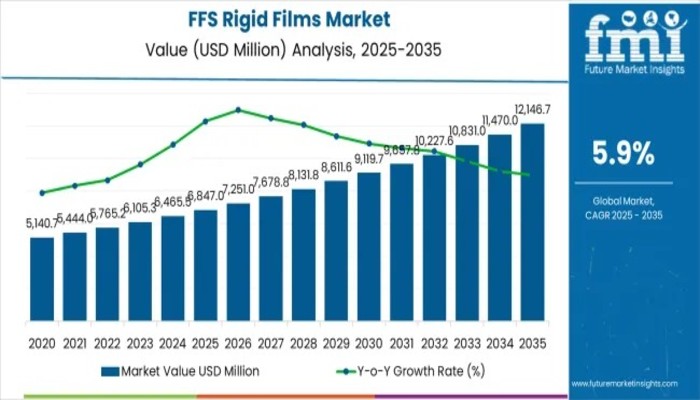
The global FFS rigid films market is entering a transformative decade, projected to grow from USD 6,847 million in 2025 to USD 12,146.7 million by 2035, expanding at a CAGR of 5.9%. This growth highlights the rapid evolution of automated packaging systems, form-fill-seal (FFS) technologies, and barrier protection materials across diverse industries including food processing, pharmaceutical manufacturing, consumer goods, and industrial applications.
As manufacturers pursue greater automation, product safety, and cost efficiency, FFS rigid films are becoming indispensable to modern production lines. The decade-long expansion reflects not only rising packaged food demand but also a growing emphasis on sterile packaging, quality preservation, and operational precision in high-speed manufacturing environments.
Unlock Growth Potential – Request Your Sample Now and Explore Market Opportunities!
Market Overview and Growth Trajectory
From 2025 to 2035, the FFS rigid films market will nearly double in size, adding USD 5.3 billion in absolute value.
- 2025–2030: Market rises from USD 6,847 million to USD 8,903 million, accounting for 39% of decade-long growth. This period will be driven by the rapid adoption of automated form-fill-seal systems, particularly within food and beverage manufacturing.
- 2030–2035: Growth accelerates, adding USD 3,253 million (61% of total expansion), as advanced barrier films and universal FFS platforms become standard in packaging automation systems worldwide.
Key material advancements especially in polypropylene-based systems, which represent 52% of the market — are setting new benchmarks in durability, transparency, and barrier integrity.
Regional Growth and Market Highlights
North America, Europe, and Asia-Pacific remain the growth engines of the FFS rigid films industry:
- China (7.2% CAGR) and India (6.9% CAGR) lead regional expansion, driven by the surge in food packaging automation and pharmaceutical production.
- The USA (6.5% CAGR) continues to be a hub of innovation, emphasizing advanced barrier technologies and sustainability compliance.
- Germany (5.8%) and Japan (5.5%) showcase precision-driven integration of FFS films into their dairy and pharmaceutical industries.
Emerging economies are witnessing increased adoption of automated packaging solutions as manufacturers localize production and adopt global safety and performance standards.
Market Drivers and Trends
- Automation and Efficiency: Growing investments in automated filling and sealing lines are propelling demand for FFS rigid films that support continuous, contamination-free production.
- Food Safety and Sterile Packaging: Rising food safety concerns and strict pharmaceutical regulations are driving the shift toward multi-layered barrier films that prevent moisture and oxygen ingress.
- Production Optimization: FFS rigid films enable high-speed packaging, reducing material waste and improving cost efficiency, making them the go-to solution for global manufacturers.
However, equipment compatibility and recycling complexity remain challenges — particularly for multilayer constructions that require specialized disposal and recovery systems.
Opportunity Pathways for Industry Players
With the market set to expand significantly, both established manufacturers and emerging innovators are aligning their strategies to capture growth opportunities:
- Pathway A – Food Processing Automation Expansion:
Development of high-barrier FFS films for dairy, ready meals, and liquid foods, expected to generate revenues of USD 2.2–2.9 billion. - Pathway B – Geographic Expansion:
Strong opportunities in China and India through partnerships and localized manufacturing, estimated at USD 1.9–2.6 billion. - Pathway C – Pharmaceutical & Healthcare Solutions:
Growth in sterile packaging and unit-dose applications could add USD 1.7–2.4 billion to the global market. - Pathway D – Advanced Barrier Technology Development:
Introduction of nanocomposite and multi-layer films supporting modified atmosphere packaging to generate USD 1.5–2.1 billion in value.
Material and Application Insights
- By Material Type:
- Polypropylene (52%) dominates due to its superior thermoforming properties, temperature resistance, and cost-effectiveness.
- By Application:
- Food & Beverage (48%) remains the top consumer segment, driven by demand for ready-meal packaging, liquid filling, and tamper-evident designs.
This leadership underscores the shift toward automated packaging systems that enhance product integrity, minimize contamination risks, and extend shelf life.
Competitive Landscape
The FFS rigid films market features a moderately concentrated competitive environment, with leading players leveraging advanced polymer engineering and supply chain integration to expand their global footprint.
Key players include:
- Amcor plc
- Berry Global Inc.
- Sealed Air Corporation
- Coveris Holdings SA
- Constantia Flexibles Group
- Winpak Ltd
- Südpack Verpackungen GmbH & Co. KG
- Printpack Inc.
- Taghleef Industries
- Schur Flexibles Group
These companies are investing heavily in multi-layer barrier systems, coextrusion technologies, and sustainable rigid film solutions to meet evolving market needs. Meanwhile, new entrants are introducing cost-effective, high-barrier, and customized film designs, targeting niche applications in food safety and pharmaceutical packaging.
Why FMI: https://www.futuremarketinsights.com/why-fmi
About Future Market Insights (FMI)
Future Market Insights, Inc. (FMI) is an ESOMAR-certified, ISO 9001:2015 market research and consulting organization, trusted by Fortune 500 clients and global enterprises. With operations in the U.S., UK, India, and Dubai, FMI provides data-backed insights and strategic intelligence across 30+ industries and 1200 markets worldwide.
Contact Us:
Future Market Insights Inc.
Christiana Corporate, 200 Continental Drive,
Suite 401, Newark, Delaware – 19713, USA
T: +1-347-918-3531
For Sales Enquiries: sales@futuremarketinsights.com
Website: https://www.futuremarketinsights.com
LinkedIn| Twitter| Blogs | YouTube