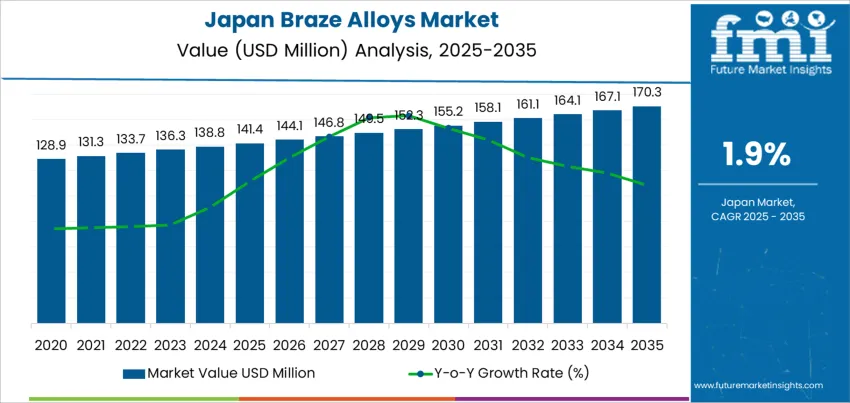
The Japan Braze Alloys Market is projected to reach an impressive USD 170.3 million by 2035, up from USD 141.4 million in 2025, reflecting robust industrial demand and ongoing technological evolution. This growth underscores the critical role that braze alloys play across high-performance manufacturing sectors, from automotive and electronics to aerospace and industrial machinery.
As Japan continues to position itself at the forefront of advanced manufacturing, this growth trajectory presents exciting opportunities not only for established global players but also for newer manufacturers entering the market with innovative solutions.
Strong Market Fundamentals Fuel Long-Term Expansion
Braze alloys are essential materials used to join metals in high-temperature environments where traditional welding or soldering falls short. Their ability to create durable and reliable bonds makes them indispensable in applications such as engine components, heat exchangers, electronic modules, and aerospace assemblies.
Japan’s dynamic industrial landscape—marked by precision manufacturing and stringent quality requirements—has helped sustain steady demand for advanced braze solutions. With industries pushing toward greater efficiency, lighter weight components, and higher performance standards, the adoption of braze alloys is expected to broaden significantly over the next decade.
Established Leaders Driving Innovation
The Japan market has long been anchored by respected names that deliver quality, reliability, and technological depth. These players have built reputations for their advanced material portfolios and comprehensive industry expertise:
-
Johnson Matthey Plc continues to lead with a strong industry share, providing a broad range of braze alloys tailored for high-temperature and aerospace applications.
-
Umicore AG is recognized for its high-performance brazing materials used extensively across automotive and electronics sectors.
-
SAINT-GOBAIN S.A. offers diverse brazing solutions that address sectors from industrial manufacturing to precision electronics.
-
Fusion, Inc. excels in specialized braze alloy formulations used in demanding environments such as heat exchangers.
-
Materion Corporation brings precision alloys essential for critical aerospace, semiconductor, and industrial applications.
These established manufacturers leverage decades of expertise to meet stringent industrial standards, often pioneering the next wave of performance and reliability in brazing materials.
New Players and Technologies Reshaping the Market Landscape
Alongside the industry stalwarts, the Japan Braze Alloys market is witnessing the entry of emerging manufacturers and technology innovators keen to capture growing demand with cutting-edge solutions. These newer entrants are often characterized by their agility, niche focus, and disruptive approaches:
-
Advanced material startups are introducing novel alloy compositions designed for next-generation electronics and high-efficiency thermal systems.
-
Specialized service providers are offering integrated brazing solutions that blend materials expertise with automated processing capabilities, appealing to sectors focused on Industry 4.0 and smart manufacturing.
-
R&D-focused firms are collaborating with universities and research institutions to develop alloys tailored for evolving applications such as electric vehicle (EV) battery systems and renewable energy components.
This influx of innovation not only diversifies the competitive landscape but also accelerates the adoption of brazing technologies that emphasize sustainability, performance, and cost efficiency. These new players are contributing fresh ideas that complement the strengths of legacy manufacturers, ultimately benefiting end users across industries.
To access the complete data tables and in-depth insights, request a sample report here
Technology Advancements Driving Market Demand
Technological factors are key catalysts for the market’s upward trajectory. Emerging trends include:
-
Lightweight and high-strength materials tailored for EVs and aerospace components, where traditional joining methods are inadequate.
-
Smart manufacturing and automation, which require brazing solutions compatible with precision robotics and digital quality control systems.
-
Heat-resilient alloys for advanced electronics and high-performance computing hardware.
-
Sustainable and environment-friendly formulations that align with stricter regulatory standards and corporate ESG goals.
These advancements reflect broader industrial trends toward efficiency, performance, and sustainability—forcing all market participants, from established leaders to agile newcomers, to innovate continuously.
Market Outlook and Industry Implications
Looking ahead, the Japan Braze Alloys Market is poised for stable growth, backed by rising demand in key sectors such as automotive, electronics, aerospace, and industrial manufacturing. Automotive remains a dominant application segment as manufacturers pursue lighter, more efficient vehicles. Electronics and high-precision industries are also expected to drive future demand as connectivity and miniaturization trends accelerate.
For established manufacturers, this growth signals a chance to expand product portfolios and solidify market leadership. For new companies and technology innovators, it represents fertile ground to introduce differentiated solutions that meet evolving industrial needs.
Together, these industry participants are building a competitive ecosystem that fosters innovation, expands capabilities, and strengthens Japan’s position as a global hub for advanced materials and manufacturing technology.