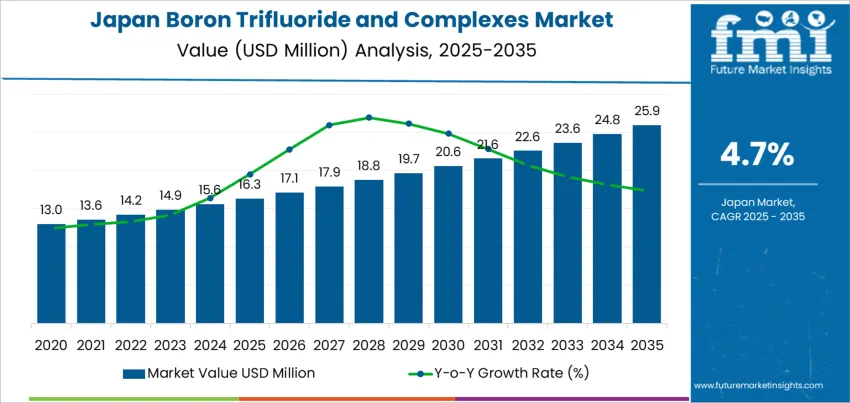
The Japan Boron Trifluoride and Complexes Market is projected to grow from USD 16.3 million in 2025 to USD 25.9 million by 2035, underlining a dynamic period of expansion driven by both established chemical manufacturers and emerging technology-focused firms. This growth highlights the increasing importance of boron trifluoride (BF₃) and its complexes across key industrial sectors, including polymers, pharmaceuticals, electronics, and advanced materials manufacturing.
As Japan continues its industrial revitalization, established manufacturers such as Stella Chemifa Corporation, Morita Chemical Industries Co., Ltd., and Kishida Chemical Co. Ltd. remain at the forefront of supply, setting market benchmarks with their reliable production and deep expertise in BF₃ catalysts and reagent complexes. At the same time, new entrants are bringing fresh perspectives, innovative formulations, and advanced application technologies that are reshaping how BF₃-based products are used across high-growth sectors.
Market Dynamics: Growth Fueled by Demand and Innovation
The boron trifluoride and complexes market in Japan is experiencing sustained demand due to the compound’s essential role in chemical synthesis, polymer production, petroleum refining, and specialty chemical manufacturing. BF₃’s unique properties as a potent Lewis acid make it invaluable in catalyzing organic reactions such as polymerization, alkylation, and esterification, supporting the production of high-performance materials used in automotive, electronics, and industrial goods.
In addition to traditional uses, there is a growing trend toward high-purity BF₃ applications for advanced semiconductors and specialty pharmaceuticals. As Japan strengthens its position in semiconductor fabrication and fine chemicals, demand for BF₃ gas and its complexes tailored to rigorous purity and performance standards is on the rise. This has opened the door for new manufacturers specializing in high-grade chemical products and precision application technologies.
New Players Accelerate Technological Adoption
The market’s evolution is further accelerated by innovative companies entering the sector with next-generation BF₃ solutions. These players are focusing on improvements such as enhanced safety handling systems, eco-friendly synthesis techniques, and custom complex formulations that broaden BF₃’s applicability while addressing regulatory and environmental challenges.
Startups and technology-driven firms are also contributing to the diversification of boron trifluoride offerings with specialized complexes designed for niche applications in agrochemicals, advanced polymer blends, and bespoke chemical intermediates. This trend is encouraging collaboration between traditional chemical producers and new market participants to co-develop products and expand supply chain resilience.
Regional Trends and End-Use Markets
Japan’s geographic market landscape reflects varied growth rates across regions. Industrial hubs such as Kyushu & Okinawa and the Kanto region, anchored by Tokyo’s technological ecosystem, are leading the adoption of BF₃ and complexes due to vibrant chemical, electronics, and manufacturing industries. Meanwhile, regions with emerging industrial activities, including Chubu and Tohoku, are gradually increasing their demand as local sectors modernize and adopt advanced production practices.
Across end-use segments, polymer and petrochemicals remain the largest consumers of boron trifluoride due to its critical role in producing high-performance plastics and specialty resins. However, the electronics and pharmaceutical sectors are quickly catching up, driven by the need for high-purity BF₃ reagents in semiconductor processes and fine chemical synthesis.
Competitive Landscape: Innovation, Quality, and Reliability
Competition among market players is intensifying, with strategies centered on quality control, customization, supply reliability, and technical support. Established leaders continue to leverage their scale, strong distribution networks, and long-standing industry relationships to maintain market share. In contrast, innovative newcomers emphasize advanced product differentiation, specialty complex formulations, and strategic partnerships that enhance their value proposition to industrial customers.
Companies that prioritize safe handling, robust regulatory compliance, and environmental sustainability are gaining preference among buyers who face increasingly stringent industry norms. Collaborative efforts between manufacturers and end-users are also becoming more common, enabling tailored solutions that meet exacting performance requirements in cutting-edge applications.
To access the complete data tables and in-depth insights, request a sample report here
Technology and Future Outlook
Technological advancements are shaping the future of the boron trifluoride market. Process innovations that improve the efficiency and safety of BF₃ production and handling are particularly noteworthy. Additionally, research into new BF₃ complexes and derivatives is expanding potential end uses, especially in specialized chemical synthesis and next-generation materials.
Looking ahead, the Japanese market is expected to maintain its growth trajectory well into the next decade, with ongoing investment in research and development, expanded production facilities, and heightened cross-industry collaboration. The convergence of established manufacturers with new technology entrants is fostering a more resilient and forward-looking market ecosystem.
Conclusion
The Japan Boron Trifluoride and Complexes Market is on track for substantial growth from 2025 to 2035, driven by a combination of sustained industrial demand, innovation from new players, and strategic advancements by established manufacturers. With evolving technologies and expanding applications across high-value sectors, the industry is poised for a new era of expansion, collaboration, and competitive differentiation.