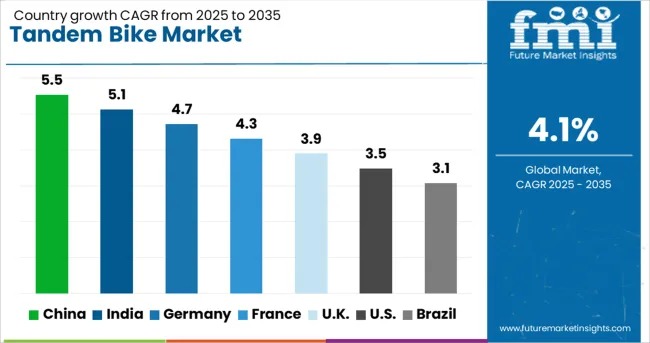
The global tandem bike market is entering a decade of steady, structurally sound expansion, progressing from USD 2.0 billion in 2025 to USD 3.0 billion by 2035, registering a CAGR of 4.1% over the forecast period. The market’s low Growth Rate Volatility Index (GRVI) confirms a predictable and resilient demand pattern, favoring long-term planning, disciplined capacity expansion, and stable investment cycles.
Between 2025 and 2028, market expansion remains controlled, with annual value increases ranging from USD 0.0 to USD 0.1 billion and year-on-year growth between 2.5% and 4.7%, reflecting consistent uptake from recreational cyclists, tourism operators, and specialty retailers. From 2029 to 2032, growth stabilizes further with annual rates holding near 3.8% to 4.0%, supported by expanding cycling tourism infrastructure, rising participation in urban leisure cycling, and growing availability of premium tandem models. From 2033 to 2035, growth slightly accelerates to approximately 4.5%, driven by replacement demand and growing participation in event-based and competitive tandem cycling.
Subscribe for Year-Round Insights → Stay ahead with quarterly and annual data updates
https://www.futuremarketinsights.com/reports/sample/rep-gb-23263
Tandem Bikes Transition from Niche Category to Strategic Leisure Mobility Segment
Once confined to specialist cycling communities, tandem bicycles are now gaining strategic relevance within leisure mobility, adaptive sports, and eco-tourism ecosystems. Tandem bikes account for approximately 1.6% of the global bicycle market, 2.4% of the recreational sporting goods sector, and 1.9% of the outdoor mobility equipment industry, underscoring their growing role in shared mobility experiences and inclusive cycling design.
Electric-assist tandem models are also gaining traction, now representing around 1.7% of the electric bicycle and pedelec segment, while adaptive and inclusive tandems contribute roughly 2.3% within specialized mobility markets. These trends reflect increasing interest in shared, assisted, and experiential cycling, especially among couples, families, senior riders, and visually impaired riders.
Europe currently demonstrates the fastest adoption rate, supported by dense cycling infrastructure and cross-country touring culture, while North America sustains strong rental and adventure-tourism demand.
Road Tandem Bikes Lead Performance-Focused Growth
The road tandem bike segment dominates the market with a 46.0% revenue share in 2025, driven by demand for aerodynamic efficiency, lightweight frames, and performance-oriented drivetrains. Preferred by endurance cyclists and club riders, road tandems are increasingly used in amateur races, couple cycling expeditions, and long-distance touring.
Ongoing product innovations-including carbon fiber frames, dual disc braking systems, and adjustable seating configurations-continue to increase the appeal of road tandems across both recreational and performance sub-segments.
Two-Seater Configurations and Offline Channels Anchor Market Structure
Two-seater tandem bikes remain the market standard, accounting for 63.0% of total market share in 2025. Their dominance stems from ease of handling, optimal balance, and broad suitability for family, partner, and adaptive riding scenarios. Their manageable length and improved maneuverability make them ideal for urban trail use and rental fleet deployments.
From a distribution perspective, offline retail channels command 71.0% of total sales, reflecting the importance of in-person fittings, expert consultations, and test rides. Specialty bicycle retailers play a critical role in delivering custom sizing, mechanical adjustments, and after-sales service, which are essential for tandem bicycle purchases.
Tourism, Inclusive Mobility, and Competitive Sports Strengthen Demand Fundamentals
The tandem bike market is increasingly supported by cycling tourism, inclusive mobility initiatives, and organized sporting activities. Tourism operators across Europe, North America, and Asia are integrating tandem bikes into guided cycling tours, allowing couples, families, and mixed-ability participants to share interactive riding experiences.
Competitive cycling and para-cycling segments are also expanding demand. Tandem bikes are widely used in Paralympic track events and visually impaired cycling partnerships, requiring precision-engineered frames, high-performance gearing, and aerodynamic structures.
Manufacturers are responding with adjustable ergonomics, adaptive pedal systems, step-through frames, and electric-assist variants, significantly improving comfort, accessibility, and ride endurance.
Geographic Expansion: Asia-Pacific Emerges as a Manufacturing and Demand Hub
Global growth remains geographically diversified:
• China (5.5% CAGR) leads global expansion through strong manufacturing capacity, cycling tourism growth, and rising export volumes.
• India (5.1% CAGR) benefits from adventure tourism, community cycling initiatives, and expanding e-commerce availability.
• Germany (4.7% CAGR) advances through premium engineering and high adoption of electric-assist tandems.
• United Kingdom (3.9% CAGR) demonstrates stable growth through charity rides, folding tandem demand, and scenic route tourism.
• United States (3.5% CAGR) maintains consistent demand from recreational cycling, tandem racing, and winery-region tourism.
Asia-Pacific is expected to remain the strongest growth engine through 2035, supported by manufacturing scale-up and infrastructure investments.
Competitive Landscape: Craftsmanship and Customization Define Market Leadership
The tandem bike market is led by highly specialized manufacturers with strong reputations in performance engineering and custom craftsmanship. Notable industry leaders include Co-Motion Cycles, Santana Cycles, Bike Friday, Burley Design, Calfee Design, Cannondale, Dawes Cycles, Hase Bikes, KHS Bicycles, and Thorn Bicycles.
Personalize Your Experience: Ask for Customization to Meet Your Requirements
https://www.futuremarketinsights.com/customization-available/rep-gb-23263
Key competitive strategies include:
• Development of lightweight alloy and carbon fiber frames
• Advanced drivetrain synchronization systems
• Modular and foldable tandem architectures
• Strategic collaborations with cycling tour operators
Recent developments include expanded manufacturing investments across Asia-Pacific and the rollout of electric-assist tandem bikes, widening the market’s appeal to older riders and endurance cycling enthusiasts.
Outlook: Tandem Bikes Enter a Decade of Predictable, Experience-Driven Growth
With USD 1.0 billion in incremental market value expected by 2035, the tandem bike market stands out as a highly stable segment characterized by low volatility, consistent replacement demand, and increasing relevance in tourism, wellness, and inclusive outdoor mobility.
As manufacturers continue to focus on lightweight materials, electric assistance, modular designs, and rider-centric ergonomics, tandem bicycles are positioned to transition from novelty products to strategic assets in the global experiential mobility ecosystem.
Why Choose FMI: Empowering Decisions that Drive Real-World Outcomes: https://www.futuremarketinsights.com/why-fmi
About Future Market Insights (FMI)
Future Market Insights, Inc. (FMI) is an ESOMAR-certified, ISO 9001:2015 market research and consulting organization, trusted by Fortune 500 clients and global enterprises. With operations in the U.S., UK, India, and Dubai, FMI provides data-backed insights and strategic intelligence across 30+ industries and 1200 markets worldwide.