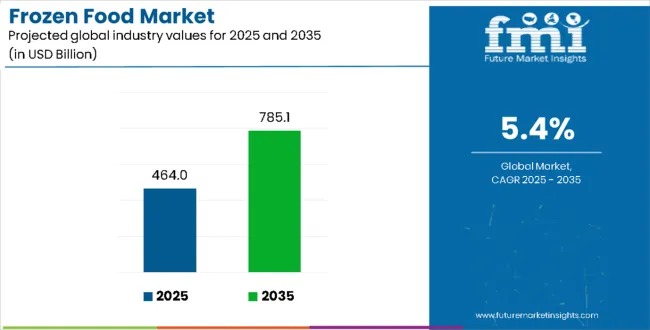
The global frozen food market is entering a decisive decade of expansion, projected to grow from USD 464.0 billion in 2025 to approximately USD 785.1 billion by 2035. This represents an absolute value addition of USD 321.1 billion, translating into total growth of 69.2% over the forecast period. Advancing at a steady CAGR of 5.4%, the market is expected to scale nearly 1.69 times its current size, underpinned by rising demand for convenient meal solutions, technological progress in freezing methods, and expanding cold-chain infrastructure across both developed and emerging economies.
Explore trends before investing – request a sample report today!
Between 2025 and 2030, the frozen food industry is forecast to expand rapidly from USD 464.0 billion to USD 609.8 billion, capturing nearly 45.4% of the total decade-long growth. This phase will be shaped by accelerating urbanization, dual-income households, and increased reliance on time-saving food formats. Manufacturers are scaling production capacities and diversifying portfolios to meet evolving consumer preferences across ready meals, frozen proteins, fruits, vegetables, and bakery items.
From 2030 to 2035, market value is expected to rise further to USD 785.1 billion, adding USD 175.3 billion and accounting for 54.6% of total forecast growth. This latter phase will be driven by premiumization, deeper penetration in emerging markets, and innovation in sustainable packaging and clean-label frozen products. Technological advancements in freezing processes will enable higher-quality offerings with better texture, taste, and nutritional retention.
Convenience, Quality, and Technology Fuel Market Momentum
The frozen food market is growing in response to fundamental lifestyle shifts. Consumers increasingly prioritize convenience without sacrificing quality, nutrition, or food safety. Advanced freezing technologies preserve freshness, extend shelf life, and reduce food waste, positioning frozen foods as reliable alternatives to fresh products for households and foodservice operators alike.
Expansion of cold-chain infrastructure is further unlocking new geographies and improving product consistency. At the same time, manufacturers are introducing frozen foods tailored to modern dietary preferences, including organic, gluten-free, high-protein, and plant-based options. The foodservice sector also continues to drive demand, using frozen ingredients to ensure operational efficiency and consistent quality.
Individual Quick Freezing Leads Processing Technologies
By freezing technique, Individual Quick Freezing (IQF) is projected to account for 42% of the global frozen food market in 2025. IQF enables rapid freezing of individual food pieces, preventing clumping and preserving cellular structure, texture, and nutritional value. This method is widely adopted across fruits, vegetables, seafood, and meat products where portion control and premium quality are critical.
The dominance of IQF reflects rising consumer expectations for frozen foods that closely resemble fresh products. Investments in advanced airflow and temperature-controlled IQF systems are allowing manufacturers to process delicate items efficiently while minimizing waste, making IQF the preferred technology for high-value frozen categories.
Frozen Ready Meals Dominate Product Demand
Frozen ready meals are expected to represent 35% of product-type demand in 2025, making them the largest segment in the market. Their popularity is driven by busy lifestyles, smaller household sizes, and growing acceptance of complete, portion-controlled meals with minimal preparation time.
Continuous innovation is reshaping this segment, with manufacturers introducing gourmet-quality meals, global cuisines, and health-focused formulations. Premium frozen meals now rival restaurant-quality offerings, supported by advanced packaging and multi-component assembly techniques that maintain flavor and presentation through freezing and reheating.
Asia Emerges as the Fastest-Growing Growth Engine
Growth dynamics vary significantly by country, with Asia-Pacific markets leading expansion. India is projected to register the highest CAGR at 7.9% through 2035, supported by urbanization, rising disposable incomes, and rapid development of cold-chain infrastructure. China follows with a 6.3% CAGR, driven by urban lifestyles, e-commerce grocery adoption, and government investment in food safety and logistics.
Japan’s frozen food market is expected to grow at 5.2% CAGR, supported by advanced food technology, an aging population, and strong demand for high-quality, portion-controlled meals. In Europe, the United Kingdom, France, and Germany show steady growth between 4.5% and 4.8%, while the United States records a stable 3.8% CAGR in its mature yet innovation-driven market.
Competitive Landscape and Strategic Outlook
The frozen food market remains highly competitive, led by global players including Nestlé, Conagra Brands, General Mills, Unilever, and Tyson Foods. These companies are strengthening market positions through product innovation, premium offerings, sustainability initiatives, and supply-chain optimization.
Looking ahead, the frozen food sector is transitioning from a convenience-driven category to a strategic pillar of modern food systems. Premiumization, plant-based innovation, digital retail integration, and sustainable cold-chain solutions are expected to create USD 73–100 billion in incremental opportunities by 2030, positioning frozen foods at the intersection of nutrition, efficiency, and global food security.