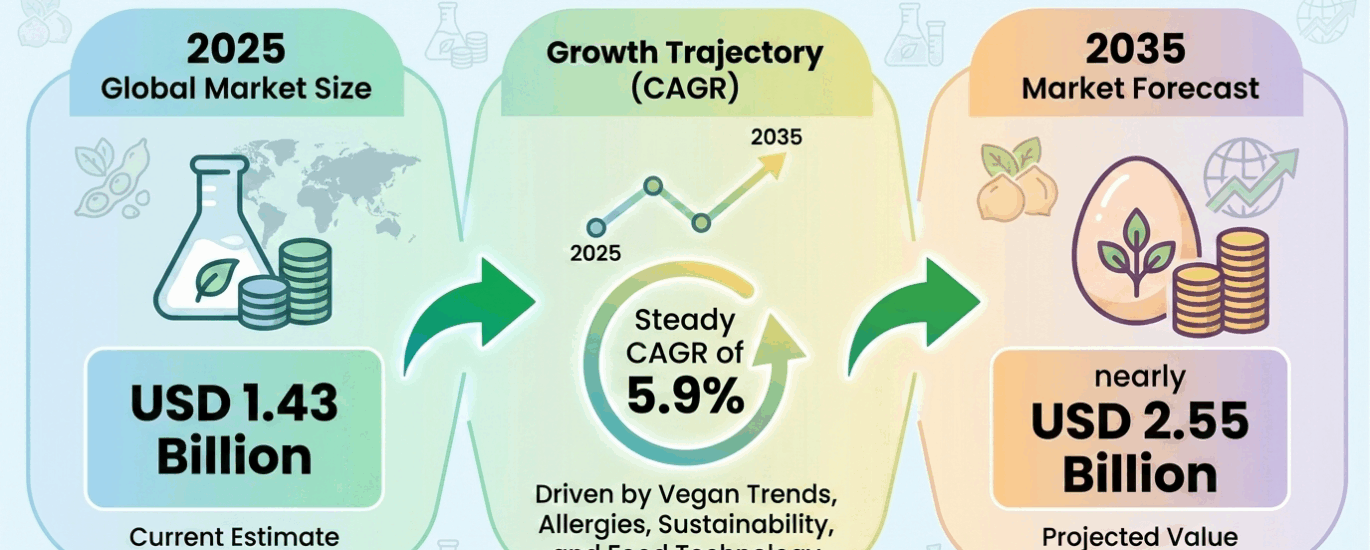
The global egg white substitute market is entering a phase of sustained expansion, underpinned by structural shifts in consumer diets, food manufacturing priorities, and ingredient innovation. Valued at USD 1.43 billion in 2025, the market is forecasted to reach nearly USD 2.55 billion by 2035, growing at a steady CAGR of 5.9% over the projection period. This growth trajectory reflects the accelerating replacement of conventional egg whites with plant-based, allergen-free, and cholesterol-free alternatives across industrial and artisanal food processing.
Egg white substitutes are increasingly viewed not merely as replacements, but as functional ingredients that deliver consistent performance in foaming, emulsification, binding, and surface browning. Their adoption is particularly strong in bakery, confectionery, and processed foods, where manufacturers face rising cost volatility in eggs, supply chain disruptions, and growing regulatory scrutiny around allergens and sustainability.
Explore trends before investing – request a sample report today! https://www.futuremarketinsights.com/reports/sample/rep-gb-11671
Market Expansion Anchored in Dietary Shifts and Functional Performance
The global rise in vegan, vegetarian, and flexitarian diets remains a core growth driver. Consumers are actively seeking products aligned with health-conscious lifestyles, ethical sourcing, and environmental responsibility. Egg white substitutes address these demands by offering solutions that are free from cholesterol and major allergens while maintaining sensory appeal.
Beyond consumer trends, food manufacturers are adopting egg white substitutes for their functional reliability. Unlike fresh eggs, substitutes provide uniform results, longer shelf life, and ease of handling—critical advantages for large-scale bakeries and packaged food producers operating under tight quality controls.
A widely cited industry example underscores this momentum. According to Josh Tetrick, CEO of Eat Just, “Just Egg sales are five times higher this year than last year. In many stores, we’re the only egg on the shelves.” This verified statement highlights the mainstream acceptance of egg alternatives and reflects broader market confidence in plant-based innovation.
Surface Browner Functionality Leads by Performance Advantage
Among functional categories, surface browner substitutes are projected to command a 34.2% share of the global market in 2025, making them the dominant segment. These formulations are designed to replicate the golden gloss and uniform coloration traditionally achieved through egg washes.
Their appeal lies in several advantages:
- Consistent browning across batches
- Compatibility with clean-label and vegan claims
- Reduced allergen risk in commercial kitchens
Bakeries across North America and Europe are rapidly integrating plant-based surface browner solutions into cakes, pastries, breads, and even processed meat analogues. The rising importance of food aesthetics—especially in premium baked goods—continues to support strong demand for this functionality.
Bread Applications Drive the Largest Share of Demand
By application, bread manufacturing is expected to account for 35.3% of total market share in 2025, positioning it as the leading end-use segment. Bread remains a global dietary staple, and its visual appeal, crust texture, and structural integrity play a decisive role in consumer purchasing behavior.
Egg white substitutes help bakers achieve:
- Uniform crust sheen and color
- Improved dough stability
- Alignment with vegan, allergen-free, and clean-label positioning
From large commercial producers to artisanal bakeries, demand for reliable egg alternatives is rising across sandwich loaves, rolls, buns, and specialty breads. The growth of vegan and gluten-free bread varieties further reinforces this segment’s dominance.
Sustainability and Animal Welfare Shape Purchasing Decisions
Sustainability has evolved from a niche concern into a mainstream purchasing criterion. Egg white substitutes offer a cruelty-free and resource-efficient alternative to conventional egg production, which is often associated with environmental challenges and animal welfare issues.
Advancements in food technology have significantly improved the taste, texture, and versatility of plant-based egg white substitutes. These innovations allow manufacturers to meet performance benchmarks once dominated by animal-derived ingredients, accelerating adoption across new product categories.
Regional Outlook: North America Leads, Asia Pacific Accelerates
North America is expected to remain the leading regional market, supported by a strong vegan movement, high consumer awareness, and the presence of key manufacturers. The United States alone accounts for 33.7% of global revenue, reflecting widespread adoption across bakery and packaged food segments.
Europe follows closely, driven by clean-label preferences and a mature bakery industry. Germany stands out, accounting for 29% of the regional market, as consumers increasingly favor plant-based and environmentally responsible food choices.
Asia Pacific represents the fastest-growing opportunity, fueled by rising disposable incomes, expanding urban populations, and a large vegetarian consumer base. Japan, in particular, is projected to grow at a CAGR of 6.4% through 2035, supported by increasing availability of plant-based alternatives and growing health awareness.
Market Structure and Competitive Landscape
The egg white substitute market exhibits a fragmented structure:
- Tier 1 players hold approximately 20% market share, characterized by global reach, advanced formulations, and high production capacity.
- Tier 2 companies account for 30%, with strong regional influence and solid regulatory compliance.
- Tier 3 players, largely local and niche-focused, collectively represent 50% of the market, reflecting strong demand diversity across regions.
Prominent manufacturers shaping the competitive landscape include Ener-G Foods Inc., Bob’s Red Mill Natural Foods, Orgran, The EVERY Company, Eat Just Inc., Puratos, Dawn Foods, Corbion, KMC, Pak Group, and Zero Egg. These companies are actively investing in formulation innovation, bakery partnerships, and geographic expansion to secure long-term growth.
Outlook
As food systems continue to evolve toward sustainability, transparency, and health-focused consumption, egg white substitutes are positioned as a critical ingredient category. With strong functional performance, expanding applications, and rising consumer acceptance, the global egg white substitute market is set to remain on a resilient growth path through 2035.