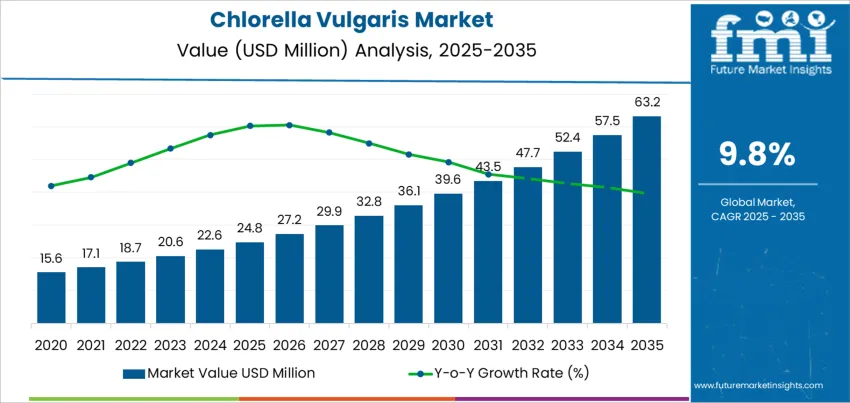
The global Chlorella Vulgaris market is experiencing remarkable momentum, starting at an estimated USD 24.8 million in 2025 and projected to grow to more than USD 63 million by 2035. This strong expansion reflects rising demand across sectors such as nutraceuticals, functional foods, personal care, and emerging bio-applications, combined with ongoing investments from both established and new manufacturers aiming to diversify product offerings and harness cutting-edge technologies.
Chlorella Vulgaris, a nutrient-rich microalgae renowned for its high protein, chlorophyll, and micronutrient content, is quickly transitioning from a niche ingredient to a mainstream functional component used by a spectrum of global industries. Its adaptability has made it an ingredient of choice for dietary supplements, plant-based proteins, cosmetic actives, and fortified beverages, elevating its profile among health-conscious consumers and forward-thinking manufacturers alike.
Established Industry Leaders Expand Horizons
Top global players such as BASF, Croda International, Evonik Industries, Symrise (including IFF/Givaudan actives), Dow, Ashland, Clariant, Seppic, Lubrizol, Lonza, and Inolex are at the forefront of Chlorella Vulgaris innovation. These companies have long recognized the commercial and functional value of Chlorella biomass and extracts, integrating them into advanced product formulations across personal care, nutrition, and specialty ingredient portfolios.
Leading ingredient producers are leveraging robust R&D capabilities to improve extraction efficiencies, enhance nutrient retention, and refine processing methods that support large-scale adoption. For example, advancements in cell disruption techniques and pigment stabilization have enabled these manufacturers to deliver high-performance Chlorella derivatives tailor-made for premium skincare and wellness applications.
This focus on performance and quality not only strengthens existing applications but also opens doors for Chlorella Vulgaris to enter new industry verticals such as dermocosmetics and professional care products, where purity and bioactive efficacy are paramount.
New Players and Emerging Technologies Drive Innovation
Alongside established corporations, emerging manufacturers and niche biotech firms are reshaping the competitive landscape. These innovators are deploying new technologies like precision photobioreactors, heterotrophic cultivation systems, and advanced drying and encapsulation methods to boost biomass yield, lower production costs, and expand application versatility.
Smaller enterprises are experimenting with high-purity Chlorella extracts customized for targeted functions—such as enhanced immune support, detoxification supplements, and specialized animal nutrition formulations. Their nimble approach allows them to quickly adapt to evolving market needs and launch unique variants that differentiate them from traditional powder and tablet formats.
Growing consumer interest in sustainable, plant-based nutrition has also encouraged startups and mid-sized manufacturers to explore partnerships with food and beverage developers. Functional beverages, protein-enhanced snacks, and fortified meal replacements now often feature Chlorella Vulgaris as a headline ingredient, tapping into the trend toward holistic nutrition and clean-label products.
Technological Shifts Fuel Product Development
The integration of new technologies is accelerating product innovation across the Chlorella Vulgaris market. Automation and sensor-based cultivation systems improve consistency and reduce contamination risk, while breakthroughs in fermentation technologies allow for controlled nutrient profiles tailored to specific end-use needs.
In the personal care segment, nano-encapsulation and emulsion systems are enhancing bioavailability and sensory appeal, allowing Chlorella compounds to perform effectively in skincare lines, anti-aging serums, and hydration-focused formulations. These advances are enabling brands to deliver premium quality products with measurable benefits, reinforcing Chlorella’s position as a valuable natural active.
Integration of smart analytical tools is also helping manufacturers better understand composition variability, streamline regulatory compliance, and ensure consistency—even as production scales to meet global demand. These technology investments are particularly beneficial for smaller manufacturers seeking to compete with industry incumbents on quality and innovation.
To access the complete data tables and in-depth insights, request a sample report here
Expanding End-Use Markets and Geographic Growth
The versatility of Chlorella Vulgaris is expanding its adoption across a wider array of end-use applications. Beyond traditional dietary supplements and functional foods, producers are exploring its potential in animal nutrition, aquaculture, and eco-friendly biomaterials. Demand from the cosmetics industry continues to grow, driven by consumer preference for natural actives and sustainable ingredients.
Geographically, growth is robust across Asia, Europe, and North America. Emerging markets in Asia are benefiting from increased health awareness, e-commerce penetration, and a shift toward plant-based wellness products, while mature markets in the United States and Europe continue to support steady innovation and premium product launches.
Looking Ahead
As health trends evolve and manufacturers continue to invest in technological capabilities, the Chlorella Vulgaris market is poised for sustained growth. Both established players and new entrants are uniquely positioned to capitalize on expanding applications and consumer demand, signaling a dynamic future where this humble microalga plays a central role in global nutrition and wellness solutions.