The global automotive fastener market is entering a sustained expansion cycle, underpinned by structural shifts in vehicle design, electrification strategies, and manufacturing automation. Valued at USD 19.5 billion in 2025, the market is projected to reach USD 33.3 billion by 2035, achieving a compound annual growth rate (CAGR) of 5.5% over the forecast period. This represents an absolute value increase of USD 13.8 billion and reflects the growing strategic importance of fastening technologies in modern vehicle platforms.
From 2025 to 2030, the market is expected to grow from USD 19.5 billion to USD 25.5 billion, adding USD 6.0 billion and accounting for nearly 43% of total decade-wide expansion. This growth phase is being driven by rising adoption of electric vehicles (EVs), stronger demand for lightweight vehicle structures, and increasing use of specialty fasteners in safety-critical assemblies. During this period, manufacturers are accelerating investments in aluminum-compatible and composite-ready fasteners to meet global fuel efficiency and emissions regulations.
Subscribe for Year-Round Insights → Stay ahead with quarterly and annual data updates
https://www.futuremarketinsights.com/reports/sample/rep-gb-23262
Between 2030 and 2035, the market is forecast to add a further USD 7.8 billion, reaching USD 33.3 billion. Although growth moderates slightly in this phase, momentum remains supported by the development of customized fastening systems for autonomous vehicle architectures, the adoption of corrosion-resistant coatings, and the emergence of smart fasteners with embedded sensing and real-time structural health monitoring. These innovations are positioning fasteners as active components within predictive maintenance and vehicle safety ecosystems.
Fasteners Increasingly Central to Multi-Billion-Dollar Automotive Ecosystems
Automotive fasteners now represent 35-38% of the industrial fasteners market, underlining the automobile sector’s dominance in mechanical joining demand. Within automotive body and structural systems, fasteners contribute 10-12% of total component value, reflecting the critical role of mechanical joints in crash safety and structural rigidity. In electric vehicle material ecosystems, fasteners account for nearly 6-8% of value, as high-strength and lightweight joining technologies become essential for battery enclosures and aluminum-intensive platforms.
The rise of hybrid and battery-electric vehicles continues to accelerate demand for fastening systems capable of managing vibration, thermal expansion, and long-term fatigue resistance. At the same time, OEMs are increasingly prioritizing modular assembly and disassembly, creating sustained demand for reversible, high-precision fastening solutions across both manufacturing and aftermarket channels.
Threaded and Steel Fasteners Anchor Segment Leadership
Threaded fasteners are projected to maintain a 63.0% revenue share in 2025, driven by their widespread use across chassis, engines, transmissions, interiors, and electronic module assemblies. Their ability to deliver consistent clamping force, torque retention, and serviceability makes them indispensable across both internal combustion and electric vehicle platforms. Compatibility with automated torque tools further strengthens their role in high-speed production environments.
In terms of material, steel fasteners are expected to command a 74.0% market share in 2025, owing to their superior tensile strength, affordability, and machinability. Advances in high-strength and corrosion-resistant steel alloys are extending fastener durability under extreme thermal and mechanical stress. Their recyclability and alignment with end-of-life vehicle directives also support long-term adoption across global markets.
The non-permanent fastener segment is projected to account for 68.0% of total revenue in 2025, reflecting growing OEM focus on modularity, circular manufacturing, and ease of servicing. These fasteners are increasingly central to EV platforms, where battery, electronics, and thermal management systems require regular access and future upgradability.
Regional Growth Shaped by Electrification and Manufacturing Scale
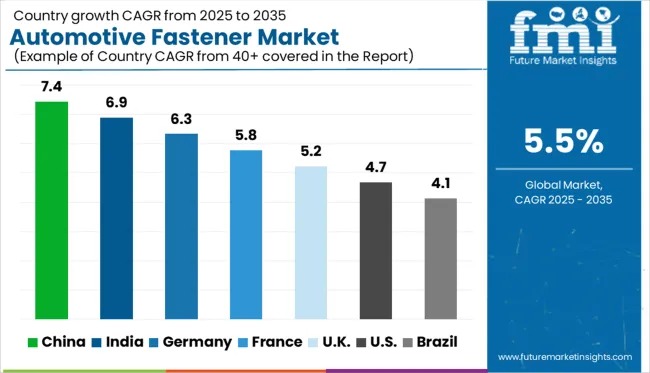
Asia-Pacific remains a cornerstone of global demand, with China forecast to grow at a CAGR of 7.4% through 2035, supported by large-scale EV production, deep supplier ecosystems, and rapid automation of assembly lines. Chinese manufacturers are expanding the use of corrosion-resistant and high-torque fasteners in battery systems, structural modules, and lightweight chassis platforms.
India is projected to grow at a 6.9% CAGR, driven by rising passenger vehicle production, strong two-wheeler volumes, and rapid adoption of hybrid and electric mobility. Localization strategies and government-backed manufacturing initiatives are encouraging domestic development of cost-efficient, high-performance fastener systems.
In Europe, Germany (6.3%), France (5.8%), and the United Kingdom (5.2%) are benefiting from premium vehicle production, stringent safety regulations, and expanding EV assembly capacity. Meanwhile, the United States, growing at 4.7% CAGR, is being supported by sustained SUV and light truck demand and increasing electrification of mainstream vehicle platforms.
Technology Trends Redefining the Role of Fasteners
The market is undergoing rapid technological transformation as OEMs and suppliers integrate lightweight alloys, hybrid metal-polymer structures, and high-performance surface coatings. Fasteners are increasingly being designed for robotic installation, real-time torque validation, and compatibility with automated quality control systems.
Emerging innovations include RFID-enabled fasteners to prevent counterfeiting and enhance traceability, as well as sensor-integrated designs to monitor joint integrity in real time. These advancements are critical as vehicles evolve into software-defined platforms with higher dependency on structural precision and reliability.
Personalize Your Experience: Ask for Customization to Meet Your Requirements
https://www.futuremarketinsights.com/customization-available/rep-gb-23262
Competitive Landscape Marked by Innovation and Regional Expansion
The competitive landscape is characterized by continuous investment in engineering, materials science, and digital manufacturing capabilities. Leading market participants such as Illinois Tool Works Inc. (ITW), Acument Global Technologies, ARaymond Network, Bollhoff Group, Bossard Group, KAMAX Holding, LISI Automotive, Nifco Inc., Norma Group, Stanley Black & Decker, Sundram Fasteners Limited, and Wurth Group are expanding production footprints to reduce supply chain risk and support localized OEM demand.
Strategic priorities across the industry include the development of lightweight, high-fatigue fasteners for EV platforms, expansion of corrosion-resistant coating capabilities, and integration of smart fastening solutions into next-generation automotive architectures.
Outlook
The automotive fastener market is transitioning from a traditional mechanical component segment into a high-value, technology-driven ecosystem. As electrification, lightweighting, and digital manufacturing continue to redefine vehicle design, fasteners are expected to play an increasingly critical role in enabling safety, performance, and manufacturing efficiency. The full market report provides comprehensive coverage of technology pathways, competitive strategies, regional dynamics, and future investment opportunities shaping this rapidly evolving industry.
Why Choose FMI: Empowering Decisions that Drive Real-World Outcomes: https://www.futuremarketinsights.com/why-fmi
About Future Market Insights (FMI)
Future Market Insights, Inc. (FMI) is an ESOMAR-certified, ISO 9001:2015 market research and consulting organization, trusted by Fortune 500 clients and global enterprises. With operations in the U.S., UK, India, and Dubai, FMI provides data-backed insights and strategic intelligence across 30+ industries and 1200 markets worldwide.