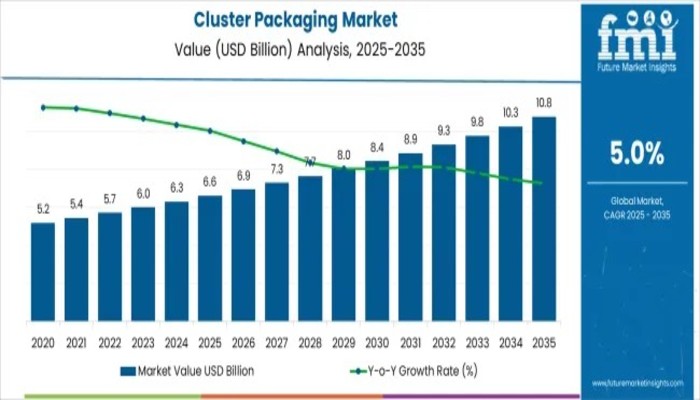
As industries embrace multipack solutions that optimize storage, transport, and consumer convenience, the Cluster Packaging Market is positioned for strong expansion through 2035. The market is expected to grow from USD 6.6 billion in 2025 to USD 10.8 billion by 2035, at a steady CAGR of 5.0%, reflecting rising demand across food, beverages, pharmaceuticals, personal care, and consumer goods.
Meaning of Cluster Packaging
Cluster packaging refers to a flexible, multi-unit packaging format designed to group identical or related products—such as bottles, jars, cans, or containers—into compact units that simplify handling, transport, and retail display. These cluster packs may be made from paper, corrugated board, plastics, or hybrid materials. They serve as both protective and promotional packaging, ensuring product safety while enabling brands to stand out on shelves.
Subscribe for Year-Round Insights → Stay ahead with quarterly and annual data updates –https://www.futuremarketinsights.com/reports/sample/rep-gb-2699
Cluster packaging is widely favored for:
- Efficient bulk handling
- Reduced material consumption
- Sustainability benefits
- Greater convenience for consumers
- Economical logistics and storage
With recyclability and lightweight design at its core, cluster packaging aligns perfectly with modern sustainability goals.
Market Outlook (2025–2035)
The next decade will witness robust expansion driven by rising consumption of packaged foods, beverages, dairy, and personal care products—categories where multipacks are the preferred packaging style. Sustainability regulations are further accelerating the shift from plastic-based materials to paper and paperboard, which already account for 36.2% of the market in 2025.
Emerging markets across Asia-Pacific and Latin America will contribute significantly to volume growth, while high-income regions such as North America and Europe will lead in technological upgrades like automation, digital printing, and lightweight formulations.
By 2035, the market will increasingly favor eco-friendly cluster formats, biodegradable materials, and digitally supported manufacturing processes.
Market Overview & Key Growth Drivers
The growth trajectory of the cluster packaging industry is shaped by several dynamic factors:
Rising demand for sustainable packaging
As consumer awareness grows, companies are prioritizing recyclable materials. Paper & paperboard formats remain dominant due to biodegradability, cost-efficiency, and versatility.
Expansion of multipack food and beverage products
Cluster packs are heavily used for:
- Beverages (bottles & cans)
- Ready-to-eat meals
- Dairy products
- Sauces and condiments
This segment alone accounts for 32.5% of market revenue.
Growth in e-commerce
The surge in online retail has increased demand for durable, lightweight packaging. Corrugated paper, holding 28.7% market share, remains the backbone of e-commerce shipping solutions.
Convenience-driven consumer behavior
Consumers prefer value packs that reduce frequent purchases and offer better storage convenience.
Corporate and regulatory push for reduced plastic usage
Stricter sustainability requirements are encouraging rapid innovation in eco-friendly cluster packaging.
Demand & Growth Analysis
The global cluster packaging market is forecast to grow at a steady 5.0% CAGR, supported by:
- High consumption of packaged beverages in Asia and North America
- Increasing adoption of automation for cluster pack manufacturing
- Shifting preferences toward bulk and family-sized packs
- Material cost advantages and improved printing capabilities
Key Trends Shaping the Cluster Packaging Market
Shift toward paper-based sustainable packaging
Recyclability and compliance with environmental norms make paperboard the leading material category.
Lightweight and flexible design innovations
Manufacturers are optimizing material usage to reduce costs and carbon footprint without compromising durability.
Digital printing and branding advancements
Enhanced print quality enables brands to create attractive multipack designs that improve shelf presence.
Automation and robotics in packaging lines
Automation helps meet high-volume demands efficiently while reducing labor costs.
Growth of multi-tier cluster packs
Used for beverages and FMCG goods, multi-tier designs improve storage optimization during shipping.
Competitive Landscape
The cluster packaging industry is competitive and innovation-driven, with major global players expanding capabilities to meet rising industry demands. Key companies include:
- Amkor Technology, Inc.
- ASE Group
- Intel Corporation
- Samsung Electronics Co., Ltd.
- TSMC
- Texas Instruments
- STMicroelectronics
- Broadcom Inc.
- Qualcomm Incorporated
- NXP Semiconductors
- Infineon Technologies AG
- Renesas Electronics Corporation
- Micron Technology, Inc.
- SK Hynix Inc.
These companies are investing in automation, digital workflow enhancement, and eco-friendly material capabilities to maintain leadership in the evolving packaging landscape.
Why FMI: https://www.futuremarketinsights.com/why-fmi
About Future Market Insights (FMI)
Future Market Insights, Inc. (FMI) is an ESOMAR-certified, ISO 9001:2015 market research and consulting organization, trusted by Fortune 500 clients and global enterprises. With operations in the U.S., UK, India, and Dubai, FMI provides data-backed insights and strategic intelligence across 30+ industries and 1200 markets worldwide.
Contact Us:
Future Market Insights Inc.
Christiana Corporate, 200 Continental Drive,
Suite 401, Newark, Delaware – 19713, USA
T: +1-347-918-3531
For Sales Enquiries: sales@futuremarketinsights.com
Website: https://www.futuremarketinsights.com
LinkedIn| Twitter| Blogs | YouTube