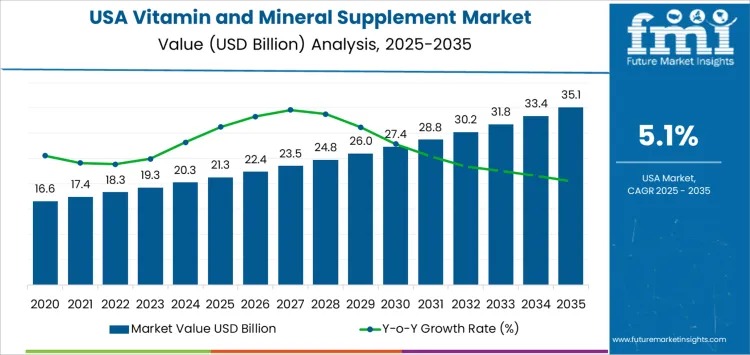
The demand for vitamin and mineral supplements in the USA is on a sustained growth trajectory, reflecting changing consumer attitudes toward preventive healthcare and daily wellness. Valued at USD 21.3 billion in 2025, the market is projected to reach USD 35.1 billion by 2035, expanding at a compound annual growth rate (CAGR) of 5.1% over the forecast period. Supplements are increasingly viewed as an essential part of modern health routines rather than optional add-ons, particularly as Americans seek practical ways to address nutritional gaps.
Rising awareness of micronutrient deficiencies, lifestyle-related health risks, and the long-term benefits of preventive nutrition is accelerating adoption. Vitamins and minerals are now widely used to support immunity, bone strength, energy levels, and overall well-being across age groups. The market’s steady expansion also reflects broader societal trends, including aging demographics, busier lifestyles, and greater access to health information.
PR to Explore Detailed Market Data, Segment-Wise Forecasts, and Competitive Insights, Request Sample Report!
From a value perspective, the industry demonstrates consistent year-on-year momentum. After reaching USD 21.3 billion in 2025, demand is expected to climb to USD 22.4 billion in 2026, USD 23.5 billion in 2027, and USD 24.8 billion in 2028. By 2029, the market is forecast to touch USD 26.0 billion, before continuing its upward progression throughout the 2030s. This growth pattern highlights both early-stage adoption gains and long-term market stability.
Preventive Health and Lifestyle Shifts Fueling Demand
One of the primary drivers behind this expansion is the growing emphasis on preventive healthcare. Consumers increasingly recognize that diet alone may not consistently meet daily nutritional requirements due to time constraints, stress, limited food variety, or age-related changes in nutrient absorption. Supplements provide a convenient solution to maintain recommended intake levels without major lifestyle disruption.
Older adults represent a significant consumer base, relying on vitamins and minerals to support bone health, immunity, cardiovascular function, and vitality. At the same time, younger demographics are adopting supplements as part of proactive wellness strategies, often influenced by fitness trends, digital health content, and personalized nutrition guidance.
Product and Form Preferences Shape Market Structure
The U.S. vitamin and mineral supplement market is clearly defined by product composition and preferred dosage forms. Vitamins account for approximately 58% of total demand, making them the dominant product category. These include widely consumed nutrients such as vitamin D, vitamin C, B-complex formulations, and multivitamins, all of which support broad preventive and maintenance health goals.
In terms of form, tablets lead with a 35% share, reflecting their familiarity, cost efficiency, and precise dosing. Tablets are commonly recommended in clinical settings and are favored by consumers seeking straightforward daily supplementation. While alternative formats such as gummies, powders, and liquids are gaining popularity—particularly among younger users—tablets remain the backbone of routine supplement consumption.
Early Growth Versus Market Maturity
Between 2025 and 2029, the market is expected to experience relatively faster adoption as awareness expands and supplement use becomes more normalized in daily health routines. Wider availability through online retail and pharmacies, combined with improved product variety, supports this early growth phase.
From 2029 to 2035, growth remains positive but slightly more moderated, reflecting a maturing market. During this period, demand is increasingly driven by long-term, habitual use rather than first-time adoption. Competition intensifies as brands focus on formulation quality, transparency, and targeted benefits to retain consumers in an established marketplace.
Regional Demand Trends Across the United States
Demand growth is projected across all major U.S. regions, though at varying rates:
- West USA leads with a 5.9% CAGR, supported by strong wellness culture, fitness-oriented lifestyles, and early adoption of preventive nutrition.
- South USA follows at 5.3%, driven by rising awareness of diet-related health concerns and improved retail access.
- Northeast USA records a 4.7% CAGR, reflecting stable demand in urban, health-literate populations.
- Midwest USA shows 4.1% growth, indicating steady adoption as nutritional awareness and product accessibility improve.
These regional differences highlight how lifestyle, demographics, and access to wellness infrastructure influence supplement consumption patterns nationwide.
Competitive Landscape and Market Outlook
The U.S. vitamin and mineral supplement industry operates within a broader dietary supplements market that was valued at approximately USD 64 billion in 2024, with vitamins accounting for a substantial share. Leading players compete on formulation breadth, brand credibility, and distribution strength. According to available estimates, Amway Corporation holds around 18.2% market share, followed by other established names such as Herbalife Nutrition Ltd., Bayer AG, and Pfizer Inc.
Competition remains robust as companies emphasize quality assurance, ingredient transparency, and ease of use. As preventive health continues to influence consumer behavior, the demand for vitamin and mineral supplements in the U.S. is expected to remain resilient, positioning the market for consistent long-term growth.
Key Players in the U.S. Vitamin and Mineral Supplement Industry:
- Amway Corporation
- Herbalife Nutrition Ltd.
- Bayer AG
- Pfizer Inc.
- Other Companies (combined)