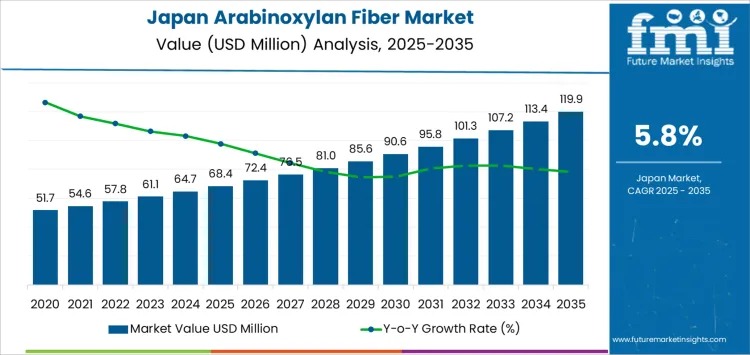
The demand for arabinoxylan fiber in Japan is witnessing steady growth, driven by the country’s increasing focus on digestive health, functional foods, and plant-based nutrition. Valued at USD 68.4 million in 2025, the market is projected to reach USD 119.9 million by 2035, reflecting a CAGR of 5.8% over the forecast period. Key sectors driving this growth include animal feed, dairy products, beverages, meat products, dietary supplements, and bakery & confectionery, with animal feed accounting for 27% of total demand. Powder remains the most preferred form at 44%, owing to its versatility, ease of use, and high concentration of fiber.
The primary sources of arabinoxylan fiber are wheat, rye, corn, barley, rice, and sorghum, with wheat being the dominant contributor. Regionally, Kyushu & Okinawa leads the market with a 7.2% CAGR, fueled by growing interest in digestive wellness among the aging population. Kanto follows at 6.6% CAGR, supported by urban health-conscious consumers, while Kansai, Chubu, Tohoku, and the rest of Japan are expected to witness moderate growth ranging from 4.3% to 5.8% CAGR. The adoption of plant-based fibers, clean-label products, and advancements in extraction and processing technologies are further boosting the market’s appeal.
To Explore Detailed Market Data, Segment-Wise Forecasts, and Competitive Insights, Request Sample Report!
The rising interest in arabinoxylan fiber is closely linked to Japan’s growing awareness of digestive health and wellness. As a soluble dietary fiber found in plant cell walls, arabinoxylan offers multiple health benefits, including improved digestion, enhanced gut microbiome, and weight management. With consumers increasingly seeking natural and functional ingredients, arabinoxylan is finding applications in functional foods, dietary supplements, and fiber-enriched beverages, making it easier for consumers to integrate into daily diets.
Moreover, plant-based diets and clean-label food trends are enhancing the appeal of arabinoxylan as a sustainable, plant-derived fiber. Its incorporation into food products such as bakery items, functional bars, cereals, and beverages is expanding, supported by research validating its health benefits. As the availability and variety of arabinoxylan-enriched products increase, the market is expected to maintain steady growth through 2035.
Segment-Wise Insights: Application, Form, and Source
- Application: Animal feed leads at 27%, followed by dietary supplements, beverages, dairy, meat products, and bakery & confectionery. In animal feed, arabinoxylan improves gut health, digestion, and nutrient absorption in poultry, swine, and cattle.
- Form: Powder dominates at 44%, preferred for its ease of use, stability, and high fiber concentration. Its ability to blend seamlessly into liquids and dry ingredients makes it ideal for functional foods and beverages.
- Source: Wheat remains the primary source, complemented by rye, corn, barley, rice, and sorghum.
Regional Demand Highlights
- Kyushu & Okinawa (7.2% CAGR): Driven by aging populations and interest in gut health. Okinawa’s longevity-focused wellness culture accelerates adoption.
- Kanto (6.6% CAGR): Urban health-conscious population fuels demand for fiber-rich and functional foods.
- Kansai (5.8% CAGR): Vibrant food culture and interest in dietary supplements support steady growth.
- Chubu (5.1% CAGR), Tohoku (4.5% CAGR), Rest of Japan (4.3% CAGR): Moderate growth driven by rising awareness of functional nutrition and plant-based diets.
Trends, Drivers, and Challenges
The market growth is propelled by increasing consumer focus on digestive wellness, prebiotic fibers, and functional nutrition. Technological innovations in extraction and purification have improved solubility, viscosity, and prebiotic potential, making arabinoxylan suitable for diverse food and supplement applications.
However, adoption faces challenges, including:
- Higher production and processing costs compared to simpler fibers.
- Variability in raw material quality, which can affect consistency.
- Competition from established prebiotics like inulin and FOS.
- Regulatory and labeling requirements that add complexity for manufacturers.
Key Players Shaping the Market
The Japan arabinoxylan fiber market is led by Acetar Bio-tech Inc., Antimex Pharmaceuticals & Chemicals Ltd., BioActor BV, Cargill, and Comet Biorefining. Acetar Bio-tech Inc. holds the largest market share of 33%, supplying high-quality fibers for both food and pharmaceutical applications. These companies are driving growth by delivering innovative, natural fiber solutions and expanding their offerings in functional foods, supplements, and nutraceuticals.
Outlook
With sustained interest in digestive health, plant-based nutrition, and clean-label products, the arabinoxylan fiber market in Japan is expected to grow steadily through 2035. Advancements in fiber technology, greater awareness of health benefits, and increasing inclusion in functional foods and supplements position arabinoxylan as a key functional ingredient in Japan’s evolving food and nutrition landscape.