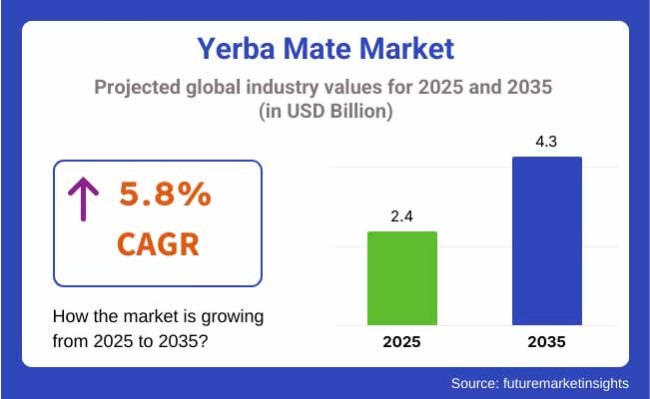
The global yerba mate market is estimated to be valued at USD 2.4 billion in 2025 and is projected to grow to USD 4.3 billion by 2035, reflecting a robust CAGR of 5.8% over the forecast period. The growth is largely driven by rising consumer interest in natural, plant-based, and functional beverages, as well as the increasing popularity of clean-label and organic brands.
The yerba mate plant, a traditional South American herbal tea, is renowned for its stimulating effects and high anti-bacterial properties. It is increasingly perceived as a healthier alternative to coffee and synthetic energy drinks, making it a staple in the growing functional beverage segment.
To Explore Detailed Market Data, Segment-Wise Forecasts, and Competitive Insights, Request Sample Report!
Rising awareness of health benefits such as enhanced metabolism, improved cognitive function, and strengthened immunity has spurred global adoption. Additionally, the shift toward natural energy sources in daily routines has led to higher consumption of both traditional loose-leaf yerba mate and ready-to-drink (RTD) products. Consumer preferences for minimally processed and plant-based beverages are shaping the market’s expansion.
Innovation in product formulation—including flavored and enhanced drinks with vitamins, probiotics, and natural sweeteners—has expanded the consumer base by addressing taste, stability, and storage challenges. Moreover, the rise of e-commerce and direct-to-consumer (DTC) platforms has accelerated brand awareness and global penetration.
Despite challenges such as fluctuating raw material availability, regulatory approvals, and strong competition from other herbal and functional drinks, opportunities for growth remain strong. Sustainable sourcing and fair-trade practices, coupled with RTD product innovations, are opening new avenues for market development.
Key Trends Driving the Yerba Mate Market
- Growing popularity as a natural energy stimulant and antioxidant, particularly in North America and Europe.
- Increasing incorporation into dietary supplements for weight management, metabolism enhancement, and immune support.
- Expanding niche applications in cosmetics for anti-aging and skin rejuvenation.
- Shift from traditional loose-leaf consumption to RTD, cold brew concentrates, and single-serve sachets.
Shifts in Market Consumption and Future Trends
From 2020 to 2024, the industry witnessed rapid growth driven by functional hybrid beverages blending adaptogens, nootropics, and probiotics. Consumers increasingly favored natural energy sources over synthetic drinks, with North America and Europe leading adoption. Convenience-driven formats like RTD drinks, cold brew concentrates, and single-serve sachets further accelerated market penetration.
Looking ahead to 2025–2035, hybrid products—such as electrolyte-fortified and botanically supplemented beverages—are expected to grow rapidly. Innovations like intelligent brewing devices, tailor-made pods, and cognition-enhancing blends with ginseng, L-theanine, and medicinal mushrooms will cater to performance-focused consumers.
Risk Assessment
The cultivation of yerba mate faces environmental challenges including climate change, which can affect quality and yield. Companies must implement sustainable farming practices and explore alternative sourcing regions to maintain a stable supply chain. Regulatory issues, such as caffeine content limits, organic certification, and food safety compliance, differ across markets, leading to higher operational costs for global expansion.
Competitive pressure is increasing, with both established brands and emerging players introducing new flavors, functional combinations, and RTD formats. Volatility in raw material prices due to production changes, trade restrictions, or logistics costs can affect profitability, making long-term supplier contracts and efficient distribution networks essential for market stability.
Country-Wise Insights (2025–2035)
- USA (6.5% CAGR): Rising demand for functional beverages and natural energy drinks among young and health-conscious consumers.
- UK (5.2% CAGR): Emergence as a niche health drink with premium organic brands gaining popularity.
- France (4.9% CAGR): Health-conscious youth driving metabolism-boosting and energy-enhancing consumption.
- Germany (7.1% CAGR): Strong adoption of natural energy drinks and functional beverages.
- Italy (4.7% CAGR): Growth driven by fusion beverages combining yerba mate with Mediterranean herbs.
- South Korea (6.3% CAGR): Wellness trends and younger demographics fueling demand.
- Japan (5.8% CAGR): Functional tea alternatives marketed in convenient cans and bottles.
- China (8.2% CAGR): Rising middle-class demand for herbal and functional beverages.
- Australia (5.6% CAGR): Health-conscious consumers seeking natural energy and antioxidants.
- New Zealand (5.0% CAGR): Outdoor lifestyle and sports enthusiasts driving consumption of herbal drinks.
Segment Insights
- By Form: Loose-leaf yerba mate dominates with a 52% share, favored for traditional brewing, higher nutrient retention, and premium single-origin varieties. Powdered forms hold 24%, offering convenience, versatility, and fast energy absorption.
- By Sales Channel: Online retail leads with 38%, driven by DTC platforms, subscriptions, and e-commerce marketplaces. Hypermarkets and supermarkets account for 24%, providing visibility and accessibility to traditional and new consumers alike.
Competitive Outlook
Major players in the global yerba mate market include Las Marías (20–24%), Guayakí Yerba Mate (15–19%), Taragüí (12–16%), CBSe (8–12%), and Rosamonte (6–10%). These companies focus on organic certification, flavor innovations, sustainable sourcing, and direct-to-consumer strategies.
Emerging brands are leveraging RTD formats, functional blends, and digital marketing campaigns to capture market share. Niche strategies include carbon-neutral production and botanical-infused beverages, targeting younger and health-conscious consumers in North America and Europe.
With growing consumer interest in natural, functional, and energizing beverages, the global yerba mate market is poised for continued expansion. Companies that innovate, embrace sustainability, and adopt omnichannel distribution strategies are expected to emerge as market leaders.