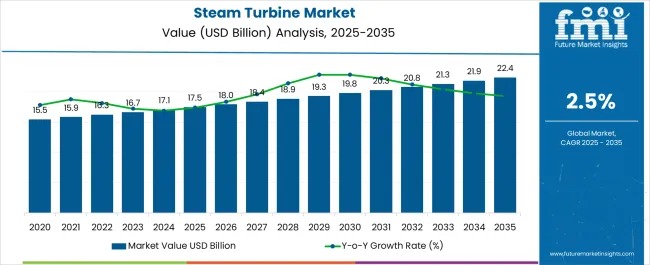
The Steam Turbine Market is projected to grow from USD 17.5 billion in 2025 to USD 22.4 billion by 2035, advancing at a CAGR of 2.5%. While this is not explosive growth, it reflects a resilient and strategically important market anchored in global electricity demand, infrastructure upgrades, and the continued relevance of thermal and combined-cycle power generation.
Steam turbines continue to serve as the backbone of electricity generation worldwide, supporting coal, gas, nuclear, biomass, and waste-to-energy plants. Even as renewables expand, turbines remain essential for grid stability, baseload power, and industrial energy needs—particularly in emerging economies and energy-intensive industries.
Subscribe for Year-Round Insights → Stay ahead with quarterly and annual data updates:
https://www.futuremarketinsights.com/reports/sample/rep-gb-5374
Why the Steam Turbine Market Continues to Grow
Market growth is being shaped less by greenfield installations and more by modernization, retrofitting, and efficiency optimization. Aging thermal infrastructure across North America, Europe, and parts of Asia is driving demand for advanced turbines that deliver higher output with lower fuel consumption.
Key growth drivers include:
- Rising global electricity consumption from industrialization and urbanization
- Retrofitting of existing power plants to meet efficiency and emissions targets
- Integration of digital monitoring, predictive maintenance, and automation
- Expansion of combined heat and power (CHP) systems in industrial facilities
- Continued investments in nuclear and waste-to-energy projects
Technological improvements in blade aerodynamics, steam flow optimization, and advanced materials are extending turbine lifespans while reducing operational downtime and maintenance costs.
Axial Steam Flow: Efficiency at Scale
Axial steam flow turbines are expected to account for 32.4% of total market revenue in 2025, making them the leading steam flow configuration. Their dominance stems from their ability to handle large steam volumes efficiently, a critical requirement for high-capacity power generation.
Key advantages driving adoption include:
- High thermal efficiency with minimal energy losses
- Stable performance under variable load conditions
- Suitability for large-scale power stations and industrial plants
- Enhanced reliability through aerodynamic blade advancements
As utilities and industrial operators focus on extracting maximum output from existing assets, axial flow turbines remain the preferred choice for large and mid-scale installations.
Impulse Blade Design: Reliability Meets Performance
By blade design, impulse turbines are projected to hold 57.6% of market revenue in 2025, reinforcing their leadership position. These turbines excel at converting high-pressure steam into mechanical energy with exceptional reliability.
Growth factors supporting impulse blade adoption include:
- Strong performance in high-temperature and high-pressure environments
- Long operational lifespans with reduced maintenance requirements
- Suitability for both power generation and industrial applications
- Continuous improvements in materials science and blade geometry
Their ability to maintain consistent efficiency during fluctuating load conditions makes impulse turbines a dependable choice for utilities prioritizing uptime and operational flexibility.
Power Stations Remain the Primary Application
Power stations are forecast to represent 41.8% of total market revenue in 2025, making them the largest application segment. Steam turbines continue to play a central role in converting thermal energy into electricity across coal, gas, nuclear, and hybrid power plants.
Key drivers for this segment include:
- Modernization of aging thermal and combined-cycle plants
- Integration of advanced control and monitoring systems
- Government incentives for energy-efficient power generation
- Rising electricity demand across developing and developed economies
Even as renewable capacity grows, steam turbines remain critical for ensuring grid reliability and supporting baseload generation.
Regional and Country-Level Momentum
Growth trends vary by geography, reflecting differences in energy policy and infrastructure maturity:
- China leads with a 3.4% CAGR, driven by large-scale power investments
- India follows at 3.1%, supported by expanding industrial demand
- Germany grows at 2.9%, fueled by efficiency upgrades and retrofits
- The United States shows stable demand, driven by plant modernization
- Japan, at 1.9% CAGR, reflects a mature but stable market
Asia-Pacific remains the most dynamic region, while North America and Europe continue to generate steady replacement and upgrade demand.
Competitive Landscape: Engineering-Led Differentiation
The market is characterized by established global players focused on efficiency gains, digital integration, and lifecycle services. Leading companies include Siemens Energy, General Electric, Mitsubishi Power, Toshiba Corporation, Bharat Heavy Electricals Limited, Ansaldo Energia, Doosan Škoda Power, Fuji Electric, Kawasaki Heavy Industries, MAN Energy Solutions, Elliot Group, and Trillium Flow Technologies.
Competition increasingly centers on long-term service contracts, retrofitting capabilities, and digital performance optimization rather than standalone equipment sales.
Strategic Outlook
Over the next decade, steam turbines will remain a cornerstone technology—quietly evolving to meet efficiency, reliability, and sustainability goals. Their role may shift, but their relevance will not diminish as long as the world requires dependable, scalable power generation.
Get data that aligns with your strategic priorities — ask for report customization today:
https://www.futuremarketinsights.com/customization-available/rep-gb-5374
Related Reports
Japan Compact Construction Equipment Market- https://www.futuremarketinsights.com/reports/japan-compact-construction-equipment-market
United Kingdom Compact Construction Equipment Market- https://www.futuremarketinsights.com/reports/united-kingdom-compact-construction-equipment-market
Gulf Countries Compact Construction Equipment Market- https://www.futuremarketinsights.com/reports/gulf-countries-compact-construction-equipment-market
Have a specific Requirements and Need Assistant on Report Pricing or Limited Budget please contact us – sales@futuremarketinsights.com
About Future Market Insights (FMI)
Future Market Insights, Inc. (FMI) is an ESOMAR-certified, ISO 9001:2015 market research and consulting organization, trusted by Fortune 500 clients and global enterprises. With operations in the U.S., UK, India, and Dubai, FMI provides data-backed insights and strategic intelligence across 30+ industries and 1200 markets worldwide.
Contact Us:
Future Market Insights Inc.
Christiana Corporate, 200 Continental Drive,
Suite 401, Newark, Delaware – 19713, USA
T: +1-347-918-3531
Why FMI: https://www.futuremarketinsights.com/why-fmi
Website: https://www.futuremarketinsights.com
LinkedIn| Twitter| Blogs | YouTube