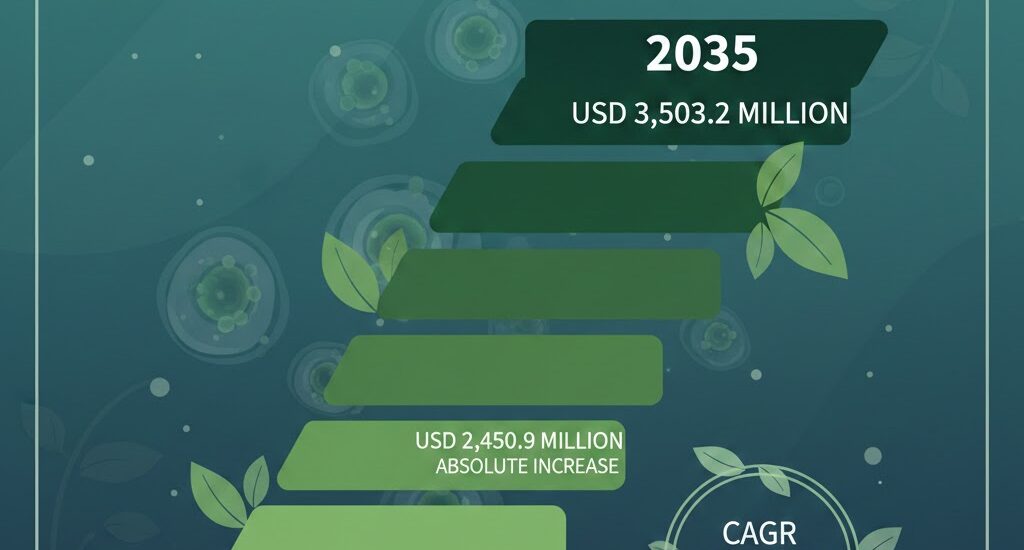
The global Algae-Based Eco-Pigments Market is poised for rapid expansion, projected to reach USD 1,052.3 million in 2025 and surge to USD 3,503.2 million by 2035, representing an impressive absolute growth of USD 2,450.9 million. With a strong CAGR of 12.8%, the market is positioned at the forefront of sustainable pigment innovation—driven by tightening regulations on synthetic colorants, rising environmental consciousness, and growing demand for clean-label beauty formulations.
Algae-based eco-pigments have emerged as a preferred alternative to petrochemical and artificial pigments, primarily across beauty and personal care industries. Between 2025 and 2030, the market is expected to grow from USD 1,052.3 million to USD 1,920.0 million, contributing over one-third of the decade’s total growth. The second expansion phase (2030–2035) is projected to add USD 1,583.2 million, led by strong demand from Asia and rapid penetration of e-commerce channels.
Key market leaders—including Sensient Cosmetic Technologies, BASF, Givaudan Active Beauty, DIC/Sun Chemical, Croda, Seppic, Algatech, and Colorchem—are increasingly investing in bio-engineered algae strains, encapsulated pigment technologies, and scalable cultivation systems.
Subscribe for Year-Round Insights → Stay ahead with quarterly and annual data updates : https://www.futuremarketinsights.com/reports/sample/rep-gb-26226
Key Market Highlights (2025–2035)
- Market Value (2025): USD 1,052.3 million
- Market Value (2035): USD 3,503.2 million
- CAGR (2025–2035): 12.8%
- Leading Segment (2025): Microalgae – 49% share
- Top Regions: China, India, USA, Germany, Japan
- Dominant Application: Makeup (52% share in 2025)
Why the Algae-Based Eco-Pigments Market Is Growing
- Regulatory Push Against Synthetic Pigments
Stringent compliance requirements across the USA, EU, and Asia are accelerating the shift to safe, natural, and eco-certified pigments. - Rising Demand for Clean and Vegan Beauty
Claims like reef-safe, plastic-free, natural, and vegan are propelling adoption across mass and premium cosmetic categories. - Advancements in Bioengineering
Engineered algae strains and improved extraction techniques are delivering superior color vibrancy, stability, and formulation versatility. - E-Commerce-Driven Market Expansion
Digital-first brands are leveraging algae pigments to differentiate in the rapidly growing clean beauty ecosystem.
Segmental Analysis
- By Source (2025)
- Microalgae – 49% (USD 588.9 million)
- Other Algae Sources – 51% (USD 536.7 million)
Microalgae remain preferred due to their high pigment density and compatibility with eco-labeling guidelines.
- By Application (2025)
- Makeup – 52% (USD 566.7 million)
- Others – 48% (USD 505.1 million)
Makeup leads adoption in eye, lip, and face categories as brands move toward natural color formulations.
- By Product Form (2025)
- Powder Pigments – 46% (USD 533.3 million)
- Others (Liquid, Gel, Encapsulated) – 54% (USD 568.2 million)
Powder pigments dominate due to stability and ease of integration into cosmetic manufacturing workflows.
Regional Outlook
Asia Leads the Global Growth Curve
- India – 22.5% CAGR (fastest growing)
- China – 19.6% CAGR
- Japan – 16.3% CAGR
Asia is expected to contribute over 50% of global incremental demand by 2035, powered by clean beauty adoption, supportive regulations, and large-scale algae cultivation facilities.
Europe Remains a Regulatory Stronghold
- Germany – 9.7% CAGR
- UK – 12.7% CAGR
European markets continue to emphasize ingredient transparency, sustainability certifications, and premium cosmetic innovation.
North America Shows Steady Growth
- USA – 8.7% CAGR
The US market will grow from USD 273.5 million (2025) to USD 807.96 million (2035), supported by premium beauty brands and rising consumer awareness.
Competitive Landscape
The market remains moderately fragmented. Sensient Cosmetic Technologies leads with 8.6% global share in 2025, supported by strong innovation capabilities and partnerships with top beauty manufacturers. Collectively, emerging and mid-sized companies contribute 91.4% of the market, reflecting high innovation activity and rapid technology upgrades.
Key competitive factors include:
- Bioengineering capabilities
- Encapsulation technologies
- Eco-certifications
- Supply chain scalability
- Application-specific performance
Recent Industry Developments
- May 2025: FDA approved algae-derived “galdieria extract blue” for food applications, expanding pigment use beyond cosmetics.
- 2025 Regulatory Updates in China: New NMPA and NIFDC measures encourage safer, sustainable ingredient sourcing—boosting algae pigment approvals.
Conclusion
The Algae-Based Eco-Pigments Market is entering a decade of exceptional growth, fueled by sustainability mandates, clean beauty demand, and breakthroughs in algae biotechnology. With microalgae, powder pigments, and makeup applications leading the charge, the market is set to transform the global pigment landscape by 2035—shifting from synthetic dependency to a greener, future-ready ecosystem.
Why FMI: https://www.futuremarketinsights.com/why-fmi
About Future Market Insights (FMI)
Future Market Insights, Inc. (FMI) is an ESOMAR-certified, ISO 9001:2015 market research and consulting organization, trusted by Fortune 500 clients and global enterprises. With operations in the U.S., UK, India, and Dubai, FMI provides data-backed insights and strategic intelligence across 30+ industries and 1200 markets worldwide.
Contact Us:
Future Market Insights Inc.
Christiana Corporate, 200 Continental Drive,
Suite 401, Newark, Delaware – 19713, USA
T: +1-347-918-3531
For Sales Enquiries: sales@futuremarketinsights.com
Website: https://www.futuremarketinsights.com
LinkedIn| Twitter| Blogs | YouTube