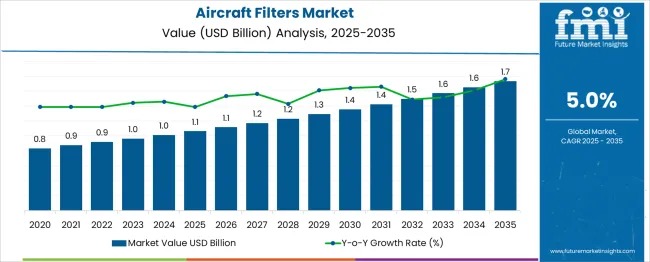
The global Aircraft Filters Market, valued at USD 1.1 billion in 2025, is set to reach USD 1.7 billion by 2035, advancing at a 5.0% CAGR over the forecast period. The market is on track to generate an absolute dollar opportunity of USD 0.6 billion, supported by rising commercial aircraft deliveries, expanding global fleets, and strict regulatory standards governing safety, emissions, and cabin air quality.
The decade-long market expansion reflects a 1.55x growth multiplier, highlighting a stable long-term demand outlook across OEM and aftermarket segments. Aviation stakeholders are increasingly prioritizing filtration technologies that enhance operational efficiency, enable cleaner cabin environments, and reduce maintenance downtime for next-generation aircraft systems.
Subscribe for Year-Round Insights → Stay ahead with quarterly and annual data updates
https://www.futuremarketinsights.com/reports/sample/rep-gb-23182
Strong Early-Phase Growth Driven by Aftermarket Replacement Cycles
During 2025-2030, the aircraft filters market is expected to grow by USD 0.3 billion, reaching USD 1.4 billion, and accounting for 50% of total incremental gains. This expansion is largely driven by higher frequency of aftermarket filter replacements, rising demand for advanced cabin air filtration, and the need to sustain optimal performance in hydraulic, fuel, pneumatic, and lubrication systems.
The latter half of the forecast period (2030-2035) is projected to deliver the remaining 50% of incremental value. Annual growth increments will average USD 0.06 billion, rising steadily as OEMs integrate lightweight and high-efficiency filtration technologies into new aircraft programs and MRO facilities upgrade fleets to meet stricter global standards.
Manufacturers focusing on weight-optimized materials, HEPA-grade cabin filters, and predictive maintenance-enabled filtration systems are well positioned to capture larger shares of the USD 0.6 billion market opportunity.
Expanding Role of Filters Across Critical Aircraft Systems
Aircraft filters account for a meaningful share across broader aviation component markets. They represent:
• 5-6% of the aerospace components market
• 8-10% of aircraft systems and parts
• 4-5% of the aviation MRO market
• 12-14% of the fluid and air filtration systems market
Their rising importance reflects the need for high-efficiency filtration to protect high-value aircraft subsystems from particulate contamination, improve fuel efficiency, and maintain compliance with safety and emissions mandates.
Air Filters Lead, Accounting for 42% of Market Revenue in 2025
The air filters segment remains dominant with a 42% share in 2025, driven by increasing demand for high-performance cabin air purification systems and the growing importance of airborne contaminant removal in sensitive avionics and engines.
Stringent global standards for cabin air quality and the heightened focus on respiratory health are further accelerating adoption. Modern environmental control systems now integrate multi-stage filters to ensure stable pressure, temperature regulation, and clean air delivery across long-haul and high-frequency commercial operations.
Commercial Aircraft Segment to Capture 51% of Market Share
With commercial aviation rebounding strongly and new aircraft production increasingly aligning with fuel-efficiency and emissions reduction goals, the commercial aircraft segment is projected to command 51% of market revenue in 2025.
Rising fleet modernization initiatives and narrow-body aircraft deliveries are further elevating demand for filtration systems designed to withstand high operating pressures, temperature extremes, and stricter environmental standards. Airlines are also prioritizing filters that extend service intervals, reduce unscheduled maintenance, and enhance long-term asset reliability.
Engine Segment Emerges as Largest Application Area with 37% Share
The engine application segment, representing 37% of market revenue, remains foundational to aircraft filter demand. Modern jet engines require precision-engineered filtration to ensure clean airflow, prevent compressor wear, and support optimal combustion efficiency. In high-dust regions and desert operations, advanced engine filters have become indispensable, reducing particulate exposure and improving flight safety.
Growing emphasis on fuel efficiency and emissions compliance is directly influencing filter selection, prompting manufacturers to develop systems capable of operating under extreme environmental and thermal conditions.
Global Drivers, Opportunities, and Restraints Shaping Market Trajectory
Key Growth Drivers
• Rising global air traffic and new aircraft deliveries
• Fleet modernization initiatives across commercial and defense aviation
• Increasing regulatory pressure for enhanced cabin air purification
• Adoption of high-efficiency filters to minimize contamination and improve engine performance
Opportunities
• Lightweight advanced composite filter materials
• Extended-life filters for reduced maintenance cycles
• Filtration systems for hybrid-electric and electric aircraft
• IoT-enabled filter monitoring for predictive maintenance
Restraints
• High certification and regulatory compliance costs
• Supply chain disruptions impacting advanced materials
• Technical challenges in developing filters for extreme aviation environments
Asia-Pacific Leads Global Growth, With China and India at the Forefront
Country-level growth analysis reveals robust momentum across emerging aviation markets:
• China: 6.8% CAGR, driven by COMAC programs, fleet expansion, and strong domestic manufacturing
• India: 6.3% CAGR supported by rising domestic air travel and growing MRO ecosystem
• Germany & France: 5.8% and 5.3% CAGR respectively, led by strong aerospace manufacturing
• United States: 4.3% CAGR reflecting stable aftermarket growth in a mature market
Asia-Pacific remains the fastest-growing region, with demand fueled by new aircraft production, regional connectivity expansions, and modernization of commercial and defense fleets.
Competitive Landscape: Innovation-Led Growth Dominates
The market is moderately consolidated, with key players including Parker Hannifin, Donaldson Company, Safran, Pall Corporation, and Eaton Corporation. These companies are strengthening their portfolios through strategic acquisitions, advanced filter media development, and adoption of smart monitoring technologies.
Recent developments include Parker Hannifin’s acquisition of Meggitt plc and Donaldson’s strategic investment in membrane filtration technology-both reinforcing capabilities across civil and defense aviation filtration systems.
Why Choose FMI: Empowering Decisions that Drive Real-World Outcomes: https://www.futuremarketinsights.com/why-fmi
About Future Market Insights (FMI)
Future Market Insights, Inc. (FMI) is an ESOMAR-certified, ISO 9001:2015 market research and consulting organization, trusted by Fortune 500 clients and global enterprises. With operations in the U.S., UK, India, and Dubai, FMI provides data-backed insights and strategic intelligence across 30+ industries and 1200 markets worldwide.