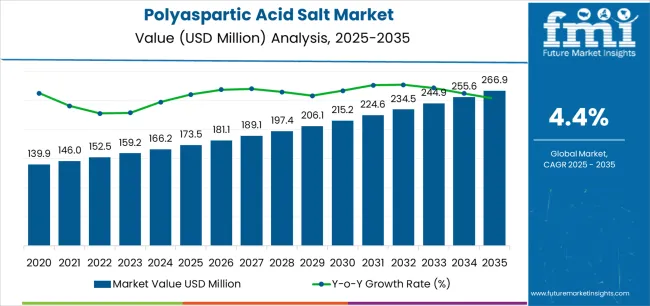
The global Polyaspartic Acid Salt Market, valued at USD 173.5 million in 2025, is on a dynamic growth path, expected to reach USD 266.9 million by 2035, expanding at a CAGR of 4.4% over the forecast period. This remarkable trajectory reflects the increasing demand for eco-conscious industrial solutions, expansion of novel technologies, and strategic growth initiatives by both long-established chemical manufacturers and emerging innovators.
With its unique properties as an effective biodegradable chelating agent, polyaspartic acid salt is rapidly gaining traction across water treatment, agriculture, personal care, and industrial applications. The market’s expansion is fueled by global trends toward greener chemistry, stringent environmental regulations, and a growing industry preference for sustainable alternatives that do not compromise performance.
Market Growth and Technological Advancement
The polyaspartic acid salt sector represents an evolving segment within the specialty chemicals industry, notable for its steady innovation and adaptability to modern industrial demands. Key growth drivers include heightened environmental compliance standards, a broadening portfolio of applications, and increased investments in R&D to develop specialty grades with superior chelating profiles and stability characteristics.
Solid polyaspartic acid salt formulations continue to dominate the market, accounting for over 64% share in 2025, due to their ease of use, handling efficiency, and consistent operational performance. Water treatment remains the largest application segment, representing nearly half of the total market demand, as municipalities and industries seek advanced chelating agents to improve water quality and operational efficiency without harming ecosystems.
Established Leaders and Emerging Players Shaping the Future
A mix of global chemical giants and innovative specialty chemical developers are shaping the competitive landscape, driving growth through expanded product offerings and cutting-edge technology integration. Leading established players such as BASF, Lanxess, and Enartis are leveraging their deep chemical expertise, global distribution networks, and strong R&D capabilities to sustain leadership positions. These companies are increasingly focusing on high-performance and regulatory-compliant solutions that meet diverse industrial needs.
Simultaneously, dynamic emerging entrants like Yuanlian Chemical, Shandong Taihe Technologies, Chibio Biotech, and Kaymossy BioChem are making significant contributions to market evolution. These newer entrants are distinguished by their agility and innovation intensity, often specializing in high-purity grades and application-specific formulations designed to address niche industrial challenges. Their participation is enhancing competition, accelerating product diversification, and fostering rapid adoption of cutting-edge synthesis techniques.
Across regions, Asia-Pacific (notably China and India) is witnessing robust growth forecasts, driven by expanding specialty chemical production, rapid industrialization, and rising environmental compliance awareness. Markets in Europe and North America continue to prioritize advanced technologies and regulatory-aligned solutions, further driving demand for premium biodegradable chelating agents.
Innovation and Sustainability as Core Pillars
Sustainability is at the heart of the polyaspartic acid salt market’s forward momentum. As industries intensify efforts to minimize environmental impact, manufacturers are advancing technologies that yield biodegradable products with excellent chelating efficacy. These efforts are not only aligned with global environmental targets but also help organizations differentiate their offerings in increasingly competitive markets.
Innovative routes in synthesis engineering, enhanced quality control systems, and advanced processing platforms are enabling manufacturers to deliver next-generation products. These technologies improve synthesis efficiency, enable precision in purity levels, and extend performance consistency across applications. From water remediation systems to agriculture and personal care formulations, polyaspartic acid salts are proving to be versatile and reliable ingredients.
Growing Market Opportunities and Future Potential
Looking ahead, numerous strategic opportunity pathways are emerging for industry participants. High-purity implementations and regulatory-compliant platforms are expected to command premium market segments, while tailored, application-specific formulations are set to attract demand from specialized industrial users. Geographical expansion, especially in high-growth regions such as Asia-Pacific, presents manufacturers with lucrative prospects to establish local processing capabilities and adapt swiftly to regional environmental standards.
Water treatment applications will continue to serve as a cornerstone of market demand, with municipal and industrial water systems increasingly relying on advanced chelating agents to maintain quality and operational efficiency. At the same time, agriculture represents a growing avenue for product application, particularly where soil treatment and nutrient program compatibility are priorities.
Collaborative Growth and Strategic Industry Alliances
The competitive landscape reflects a trend toward collaboration and consolidation, with established chemical firms partnering with or acquiring innovative specialists to broaden their technological capabilities. These alliances support integrated solutions that combine traditional chemical excellence with modern, sustainable performance attributes.
The polyaspartic acid salt market’s evolution highlights a broader industrial shift toward green chemistry solutions that align with global sustainability goals while delivering measurable technical benefits. As both established players and emerging manufacturers continue to innovate and expand, the industry is well-positioned for long-term growth, technological advancement, and impactful contributions to environmental stewardship and industrial efficiency.