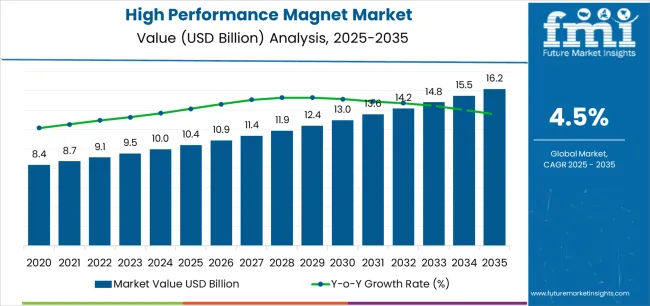
The global high performance magnet market is set to witness significant expansion over the next decade, with the market valued at USD 10,408.1 million in 2025 and projected to reach USD 16,163.5 million by 2035, representing a compound annual growth rate (CAGR) of 4.5% during the forecast period. This sustained growth underscores the rising importance of high performance magnets across key industries, driven by accelerated demand from electric vehicles, industrial automation, renewable energy, and advanced manufacturing technologies.
High performance magnets have become a cornerstone in modern engineering and industrial applications. Their ability to deliver superior magnetic strength, efficiency, and reliability is fueling widespread adoption across automotive, consumer electronics, medical equipment, and energy sectors. As both established players and new entrants leverage innovation and strategic partnerships, the competitive landscape is evolving rapidly, presenting unprecedented opportunities for expansion and technological advancement.
Industry Leaders and New Entrants Driving Market Transformation
The market continues to be anchored by influential established manufacturers with decades of experience in magnetic materials and applications. Companies such as Hitachi Metals Group, Shin-Etsu, TDK, and VAC are at the forefront, offering an extensive portfolio of high performance magnet solutions tailored to diverse industrial needs. Their deep expertise in material science, robust production infrastructure, and global distribution networks have helped set industry benchmarks for performance and quality.
Alongside these well-known players, a growing wave of new manufacturers is entering the market with innovative approaches and specialized solutions. These emerging companies focus on niche magnet technologies, custom material compositions, and industry-specific applications. They are rapidly gaining traction by addressing evolving market demands — particularly in electric mobility, precision industrial systems, and energy-efficient machinery — enhancing the dynamism of the marketplace.
Technological Advancements and Industry Trends
A defining trend in the market is the continuous advancement in magnet technology. Research and development efforts are increasingly geared toward enhancing magnetic field strength, thermal stability, and material efficiency. This push for innovation is spurring the development of next-generation magnet compositions that deliver higher performance while supporting energy-efficient designs.
Electric vehicles (EVs) remain a key driver of demand, with high performance magnets playing a crucial role in electric motor systems, powertrain components, and energy recovery systems. As the automotive industry shifts toward electrification, magnet manufacturers are scaling their production capabilities and optimizing product offerings to meet the rigorous performance criteria of EV manufacturers.
In addition to automotive applications, industrial machinery and automation systems are increasingly integrating advanced magnet solutions to improve operational precision, reduce energy consumption, and enhance overall system reliability. Renewable energy sectors, including wind turbines and power generation equipment, are also adopting high performance magnets to achieve superior efficiency and extended service life.
Regional Growth Dynamics and Market Expansion
Asia Pacific continues to lead global market growth, with strong contributions from manufacturing powerhouses and rapidly developing automotive sectors. Markets in China and India are showing notable momentum, driven by increased industrial activity, government initiatives promoting electric mobility, and expanding infrastructure development. North America and Europe remain important growth regions as well, supported by advanced manufacturing ecosystems and rising adoption of energy-efficient technologies.
Emerging regions are also beginning to play a larger role, with investment in manufacturing capabilities and magnet production facilities on the rise. These developments create new avenues for collaboration between established global firms and regional manufacturers, further broadening the market’s geographic reach.
Applications Across Leading End-Use Industries
High performance magnets are utilized in an array of applications due to their exceptional magnetic properties and versatile performance characteristics. Electric vehicle systems represent a primary application segment, capturing a substantial share of market demand as automakers push for improved efficiency and performance. Industrial machinery and factory automation are other key sectors, where magnets enhance the capabilities of precision drives, robotic systems, and automated production lines.
Consumer electronics, aerospace, medical devices, and renewable energy systems also contribute to market growth as these industries increasingly rely on compact and high-strength magnetic components to support advanced functionalities.
Challenges and Future Opportunities
While the high performance magnet market is on a strong upward trajectory, challenges such as fluctuating raw material costs and supply chain constraints persist. Companies that innovate to optimize production efficiency and material usage will be better positioned to navigate these pressures and maintain competitive pricing.
Looking ahead, opportunities abound for businesses willing to invest in R&D and expand into emerging sectors. Collaborations between magnet manufacturers, automotive OEMs, and renewable energy firms are expected to accelerate technology integrations, creating new product lines and enhancing value for end users.
Conclusion
The high performance magnet market stands at an exciting crossroads. With robust growth forecasts, a broadening set of industry applications, and active participation from both seasoned and emerging manufacturers, the stage is set for continued innovation and expansion. As manufacturers explore new technologies and deepen their market presence, the industry is poised to play a pivotal role in shaping the future of global manufacturing, energy, and mobility.