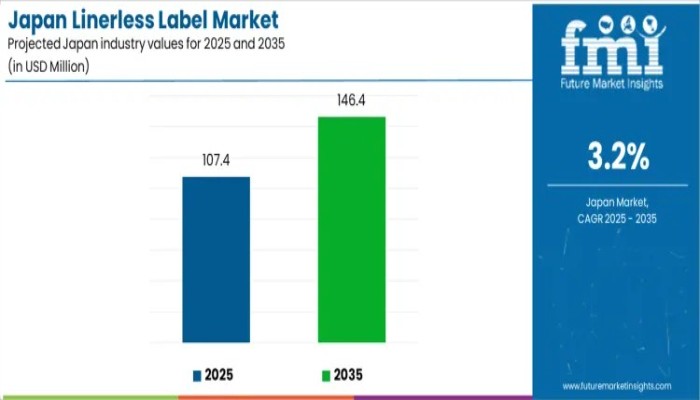
The Japanese market for linerless labels is poised for steady growth over the next decade, with demand expected to rise from USD 107.4 million in 2025 to USD 146.4 million by 2035, representing a compound annual growth rate (CAGR) of 3.2%. Linerless labels, which eliminate the need for backing paper, are rapidly gaining traction across food, beverage, retail, and logistics industries due to their eco-friendly design, cost efficiency, and operational advantages.
As sustainability continues to be a core focus in Japan, manufacturers and brand owners are increasingly seeking labeling solutions that reduce waste and align with environmental goals. Linerless labels address these needs by cutting down on packaging waste and streamlining labeling processes, offering a practical alternative to traditional pressure-sensitive labels.
Subscribe for Year-Round Insights → Stay ahead with quarterly and annual data updates – https://www.futuremarketinsights.com/reports/sample/rep-gb-29723
Technological Advancements Drive Market Expansion
Advances in adhesive formulations and digital printing capabilities are key enablers for linerless label adoption. Digital printing, which accounts for approximately 46% of the market, allows for high-quality, customizable labels with minimal waste making it ideal for short-run or variable-data applications. Permanent adhesives, holding a 40% market share, remain the preferred choice due to their durability and reliability across diverse product types, including fresh food, retail goods, and pharmaceuticals.
The combination of improved printing technology and high-performance adhesives ensures that linerless labels meet the rigorous quality and safety standards expected in Japan’s highly regulated packaging sectors.
Market Dynamics and Key Drivers
Several factors are driving the growth of linerless labels in Japan:
- Sustainability Initiatives: Rising regulatory and consumer pressure to reduce packaging waste has accelerated the shift toward eco-friendly solutions. Linerless labels minimize material usage and disposal requirements.
- Operational Efficiency: Linerless labels reduce downtime in printing and labeling operations, optimize storage and transport space, and simplify roll changes, supporting high-volume production environments.
- Integration with Automation: Retailers and logistics providers increasingly integrate linerless labeling systems with thermal printing, weigh scale systems, and automated packaging lines for precision, traceability, and efficiency.
- Rising Demand in Food, Beverage, and E-Commerce: As packaged food, fresh produce, and online retail sectors expand, the demand for hygienic, cost-effective, and waste-minimizing labels continues to rise.
Regional Outlook Across Japan
The demand for linerless labels varies across regions, reflecting differences in industrial activity, sustainability adoption, and consumer behavior:
- Kyushu & Okinawa: Expected to lead with a CAGR of 3.9%, driven by strong local sustainability initiatives and the growing adoption of efficient labeling methods.
- Kanto: Home to Tokyo and Japan’s major industrial hubs, projected CAGR of 3.6%, supported by high consumer demand for innovative and eco-conscious packaging solutions.
- Kansai: CAGR of 3.2%, with manufacturers focusing on reducing environmental impact and improving production efficiency.
- Chubu: CAGR of 2.8%, reflecting growing interest in sustainable manufacturing practices.
- Tohoku & Rest of Japan: More moderate growth with CAGRs of 2.5% and 2.3%, respectively, yet increasing adoption of eco-friendly labels is evident.
Competitive Landscape
The Japanese linerless label market is characterized by strong competition among global and regional players who provide not only label materials but also printing and application solutions. Leading companies include:
- Zebra Technologies Corp. – Holding a leading market share of around 26%, offering integrated labeling solutions.
- SATO Holdings Corporation – Focused on sustainable and high-efficiency labeling systems.
- Coveris – Providing innovative linerless label materials and printing support.
- Ravenwood Packaging – Specializes in operationally efficient labeling solutions for high-volume applications.
- Yupo Corporation – Known for advanced linerless label materials compatible with diverse packaging surfaces.
Competition among these players centers on material quality, adhesive performance, integration with automated systems, and the ability to support manufacturers’ sustainability initiatives. Companies offering comprehensive support for transitioning from traditional labels to linerless systems are well-positioned to capture the growing market.
Outlook 2025 to 2035
With steady adoption across food, beverage, retail, logistics, and consumer goods sectors, the Japanese linerless label market is expected to maintain a consistent upward trajectory. The combination of sustainability demands, technological improvements, and operational efficiency requirements will continue to drive growth. By 2035, the market is forecasted to reach USD 146.4 million, solidifying linerless labels as a key component of Japan’s packaging landscape.
Why FMI: https://www.futuremarketinsights.com/why-fmi
About Future Market Insights (FMI)
Future Market Insights, Inc. (FMI) is an ESOMAR-certified, ISO 9001:2015 market research and consulting organization, trusted by Fortune 500 clients and global enterprises. With operations in the U.S., UK, India, and Dubai, FMI provides data-backed insights and strategic intelligence across 30+ industries and 1200 markets worldwide.
Contact Us:
Future Market Insights Inc.
Christiana Corporate, 200 Continental Drive,
Suite 401, Newark, Delaware – 19713, USA
T: +1-347-918-3531
For Sales Enquiries: sales@futuremarketinsights.com
Website: https://www.futuremarketinsights.com
LinkedIn| Twitter| Blogs | YouTube