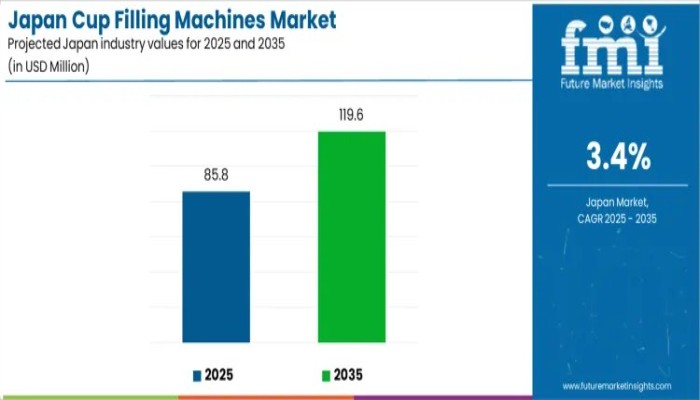
The demand for cup filling machines in Japan is projected to grow steadily from USD 85.8 million in 2025 to USD 119.6 million by 2035, reflecting a CAGR of 3.4%. These machines, crucial for filling liquids, powders, and other products into cups, are indispensable across the food and beverage, cosmetics, and pharmaceutical industries. The market growth is being fueled by a combination of rising consumer demand for pre-packaged foods, technological innovations, and an increased focus on hygiene and automation in production processes.
Rising Demand Driven by Convenience and Efficiency
The Japanese market is witnessing a shift toward ready-to-eat meals, portion-controlled beverages, and single-serve products, driving food and beverage producers to invest in automated cup filling machines. These machines provide high-speed, accurate, and hygienic filling processes, which are essential to meet the stringent safety standards and consumer expectations prevalent in Japan.
Subscribe for Year-Round Insights → Stay ahead with quarterly and annual data updates – https://www.futuremarketinsights.com/reports/sample/rep-gb-29721
Key factors influencing market growth include:
- Rising consumption of packaged and ready-to-eat foods.
- Increasing adoption of automated and flexible machines for multiple cup sizes and product types.
- Emphasis on hygienic, precise, and consistent filling in food processing operations.
- Growing integration of eco-friendly and sustainable packaging solutions.
Segmentation by Machine Type and Technology
Machine Type:
Rotary machines dominate the Japanese market, accounting for 63% of market share, primarily due to their high-speed production capabilities. These machines are ideal for large-scale operations, allowing manufacturers to fill and seal cups efficiently, reduce labor costs, and maintain consistency across products. Linear machines are used as well, but their adoption is comparatively limited.
Technology:
Fill seal technology leads the market, capturing 94% share, as it allows cups to be filled and immediately sealed. This ensures product freshness, safety, and extended shelf life, making it particularly suitable for dairy, sauces, soups, desserts, and beverages. While other technologies such as form-fill-seal exist, fill seal remains the most preferred due to its efficiency, reliability, and suitability for diverse products.
Regional Demand Outlook
The adoption of cup filling machines varies across Japan’s regions, reflecting industrial focus, consumer demand, and infrastructure development:
- Kyushu & Okinawa: CAGR of 4.2% – The fastest-growing region due to increasing automation in food and beverage production and a rising demand for packaged consumables.
- Kanto: CAGR of 3.9% – Home to Tokyo and major manufacturing hubs, Kanto sees strong growth driven by consumer demand for convenience foods and beverages.
- Kansai: CAGR of 3.4% – Osaka and Kyoto’s food processing sector fuels demand for automated, high-throughput machines.
- Chubu: CAGR of 3.0% – Nagoya and surrounding areas focus on efficiency and scaling operations with modern filling equipment.
- Tohoku: CAGR of 2.6% – Moderate growth, primarily driven by agriculture and dairy industries adopting automated solutions.
- Rest of Japan: CAGR of 2.5% – Steady adoption in smaller or rural regions as manufacturers upgrade to efficient, hygienic packaging equipment.
Key Drivers and Restraints
Drivers:
- Increasing ready-to-eat and portion-controlled food consumption.
- Rising adoption of automation and smart manufacturing technologies.
- Emphasis on product consistency, hygiene, and shelf life.
Restraints:
- High upfront costs for advanced machinery, particularly challenging for small and medium enterprises.
- Space constraints in manufacturing facilities, limiting installation of large automated equipment.
- Compatibility challenges with older production lines requiring retrofitting.
- Regulatory and material variability posing hurdles for standardization.
Emerging Trends
The Japanese cup filling machines market is embracing smart automation, high-speed rotary machines, and hygiene-oriented innovations. Manufacturers are increasingly opting for multi-format filling solutions capable of handling a variety of cup sizes and batch formats. There is also a notable trend toward eco-friendly packaging integration, aligning with Japan’s sustainability goals and growing consumer awareness.
Competitive Landscape
Japan’s cup filling machine market is highly competitive, with global and specialized manufacturers striving to meet the demand for efficient, hygienic, and automated filling solutions. Key players include:
- I.M.A. Industria Macchine Automatiche S.p.A
- R.A Jones
- Serac Group
- Paxiom
- Cemre Cup Filling Machines
These companies focus on machine throughput, flexibility, hygiene compliance, and integration with Japanese food safety standards, positioning themselves to capitalize on growing market opportunities.
Why FMI: https://www.futuremarketinsights.com/why-fmi
About Future Market Insights (FMI)
Future Market Insights, Inc. (FMI) is an ESOMAR-certified, ISO 9001:2015 market research and consulting organization, trusted by Fortune 500 clients and global enterprises. With operations in the U.S., UK, India, and Dubai, FMI provides data-backed insights and strategic intelligence across 30+ industries and 1200 markets worldwide.
Contact Us:
Future Market Insights Inc.
Christiana Corporate, 200 Continental Drive,
Suite 401, Newark, Delaware – 19713, USA
T: +1-347-918-3531
For Sales Enquiries: sales@futuremarketinsights.com
Website: https://www.futuremarketinsights.com
LinkedIn| Twitter| Blogs | YouTube