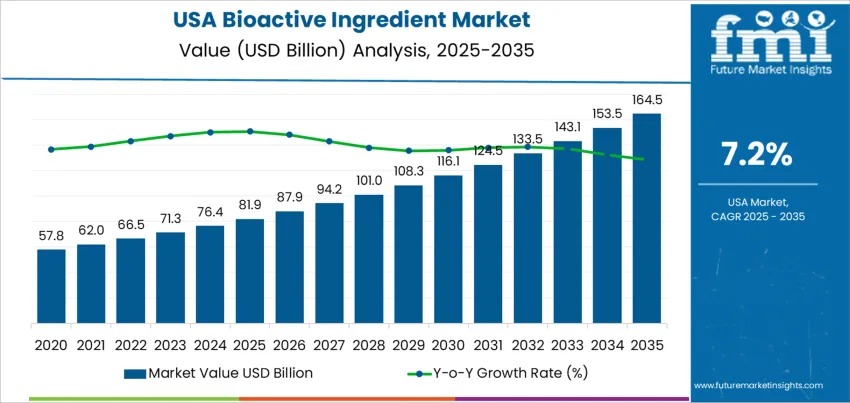
The demand for bioactive ingredients in the USA is entering a decade of sustained expansion, driven by a fundamental shift in how consumers approach health, nutrition, and disease prevention. Valued at USD 81.9 billion in 2025, the market is projected to more than double, reaching USD 164.5 billion by 2035. This growth reflects rising consumer awareness of functional nutrition, increased adoption of dietary supplements, and expanding applications of bioactive compounds across food, pharmaceutical, and cosmetic industries.
Bioactive ingredients—including probiotics, omega-3 fatty acids, antioxidants, plant extracts, fibers, vitamins, and minerals—are increasingly positioned as essential components in modern health solutions. Rather than serving as optional enhancements, these compounds are now integral to product formulations designed to support immunity, digestive health, metabolic balance, skin health, and overall well-being.
Explore trends before investing – request a sample report today! https://www.futuremarketinsights.com/reports/sample/rep-gb-29554
Market growth is expected to remain steady year over year. From USD 81.9 billion in 2025, demand is forecast to rise to USD 87.9 billion in 2026, USD 94.2 billion in 2027, and USD 101.0 billion in 2028. By 2029, the market is projected to reach USD 108.3 billion, continuing its upward trajectory throughout the 2030s. The decade will ultimately deliver an absolute dollar opportunity of USD 82.6 billion, highlighting strong long-term potential for manufacturers, ingredient suppliers, and formulation specialists.
Functional nutrition drives mainstream adoption
A key factor fueling demand is the rapid mainstreaming of functional foods and beverages, which account for 34% of total bioactive ingredient usage in the U.S. Consumers are increasingly choosing foods and drinks that provide health benefits beyond basic nutrition. Fortified snacks, nutrition bars, functional beverages, and meal replacements now routinely include bioactive compounds to support immune health, gut balance, heart health, and weight management.
This shift aligns with broader lifestyle trends. Rising rates of obesity, cardiovascular disease, diabetes, and digestive disorders have intensified consumer focus on preventive healthcare. Rather than relying solely on pharmaceutical interventions, many consumers are proactively managing health through daily dietary choices enriched with scientifically supported bioactive compounds.
Probiotics and prebiotics lead by product type
By product type, probiotics and prebiotics represent the largest segment, accounting for 29% of total demand. Growing awareness of the gut-brain axis and the role of microbiome health in immunity, mental well-being, and metabolic function has accelerated adoption. These ingredients are widely incorporated into yogurts, beverages, capsules, powders, and fortified foods, reinforcing their leadership position in the market.
Advances in formulation technologies—such as micro-encapsulation and improved stabilization techniques—have further supported growth. These innovations allow sensitive bioactive compounds to maintain efficacy, shelf life, and sensory appeal, expanding their use across diverse applications.
Demand dynamics shaped by clean-label and plant-based preferences
Consumer preference for clean-label, plant-based, and naturally sourced ingredients continues to reshape the bioactive ingredient landscape. Manufacturers are increasingly prioritizing botanical extracts, plant fibers, algae-derived omega-3s, and naturally fermented probiotics to meet evolving expectations. Regulatory familiarity with many established bioactive ingredients also supports broader commercial adoption across food, nutraceutical, and personal-care sectors.
At the same time, rising interest in personalized nutrition is influencing product development. Bioactive ingredients are increasingly tailored to specific health needs, such as cognitive function, joint support, skin vitality, and healthy aging.
Regional outlook highlights innovation hubs
Demand growth varies across U.S. regions, reflecting differences in consumer behavior, industry presence, and wellness culture. The West leads the market with a projected CAGR of 8.3%, driven by high concentrations of health-conscious consumers and strong innovation in natural and functional products. The South follows with 7.4%, supported by a large population base and expanding functional food and supplement industries. The Northeast is expected to grow at 6.6%, while the Midwest records a steady 5.8%, supported by its strong agricultural foundation.
Competitive landscape remains innovation-driven
The U.S. bioactive ingredient market is highly competitive, with leading players focusing on quality, regulatory compliance, and portfolio diversification. Key companies shaping the market include BASF SE, DuPont (IFF), Cargill, Inc., Archer Daniels Midland (ADM), and DSM-Firmenich. These suppliers compete through advanced ingredient technologies, sustainable sourcing, and the ability to support customized formulations across multiple end-use sectors.
As preventive healthcare, functional nutrition, and wellness-oriented lifestyles continue to gain momentum, bioactive ingredients are set to remain at the center of product innovation. Companies that align scientific validation with consumer trust and scalable supply chains will be best positioned to capitalize on the USA’s rapidly expanding bioactive ingredient market.