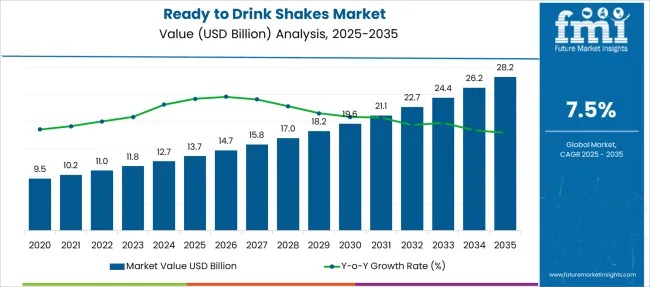
The global Ready to Drink (RTD) Shakes Market is entering a decade of sustained expansion as convenience-led nutrition reshapes daily consumption habits. Valued at USD 13.7 billion in 2025, the market is projected to nearly double to USD 28.2 billion by 2035, registering a robust CAGR of 7.5% over the forecast period. Growth is being fueled by fast-paced lifestyles, rising health awareness, and increasing acceptance of meal replacement and functional beverages across both developed and emerging economies.
RTD shakes have evolved from niche sports nutrition products into mainstream lifestyle beverages. Consumers now view these products as practical solutions for balanced nutrition, energy replenishment, and hunger management—without the time investment of traditional meal preparation. This shift is particularly evident among working professionals, urban millennials, and fitness-conscious consumers seeking portable nutrition with consistent quality.
Explore trends before investing – request a sample report today! https://www.futuremarketinsights.com/reports/sample/rep-gb-11120
Market momentum is further strengthened by continuous innovation in formulations, flavors, and packaging. Manufacturers are focusing on cleaner labels, fortified nutrition, and indulgent taste profiles to widen their consumer base. At the same time, improvements in packaging technology—especially resealable bottles—are enhancing product shelf life and portability, supporting wider retail and online penetration.
Market Snapshot: Data at a Glance
- Market value (2025): USD 13.7 billion
- Forecast value (2035): USD 28.2 billion
- Forecast CAGR (2025–2035): 7.5%
- Leading nature segment (2025): Conventional (58.3%)
- Key growth regions: North America, Asia-Pacific, Europe
What’s Driving Segmental Growth
The RTD shakes market is expanding steadily due to changing lifestyle patterns that prioritize convenience without compromising nutrition. Consumers increasingly prefer packaged shakes that deliver protein, vitamins, and energy in a ready format, particularly for breakfast replacement, post-workout recovery, or on-the-go snacking.
Product innovation remains a cornerstone of growth. Brands are investing in taste optimization and functional benefits while maintaining affordability. Retail expansion—both offline and through e-commerce—has significantly improved accessibility, even in semi-urban and rural areas. Looking ahead, fortified and function-specific shakes targeting weight management, muscle recovery, and plant-based nutrition are expected to unlock new demand.
Conventional Segment Anchors Market Stability
By nature, the Conventional segment is expected to account for 58.3% of global revenue in 2025, maintaining its leadership position. Consumers continue to trust traditional formulations that offer familiar taste profiles and reliable nutritional value. These products are widely perceived as cost-effective and easier to understand compared to newer functional blends.
From a supply-side perspective, conventional RTD shakes benefit from smoother regulatory pathways and broader distribution acceptance. Their balance of taste, nutrition, and price has positioned them as the backbone of the global RTD shakes market.
Bottles Dominate Packaging Preferences
In terms of packaging, bottles are projected to contribute 49.2% of market revenue in 2025, making them the dominant format. Resealability, portability, and freshness retention have made bottled shakes the preferred choice for busy consumers.
Advances in lightweight, recyclable, and partially recycled bottle materials are also improving sustainability credentials. Retailers continue to allocate prime shelf space to bottled RTD beverages, especially in refrigerated sections, reinforcing visibility and impulse purchases.
Chocolate Leads Flavor Innovation
Flavor remains a critical differentiator, with chocolate expected to hold 33.7% of market revenue in 2025. Its universal appeal across age groups, combined with indulgence and familiarity, has driven strong repeat purchases and brand loyalty.
Brands are refreshing chocolate variants through premium positioning, reduced sugar formulations, and limited-edition launches. This balance of comfort and innovation ensures chocolate’s continued dominance within the RTD shakes flavor landscape.
Market Performance and Recent Developments
The global RTD shakes market grew at 7.4% in H1 2024, with projected growth of 7.5% in H1 2025 and an outlook reaching 8.3%, reflecting accelerating momentum. Recent product launches by leading players such as Coca-Cola and PepsiCo highlight strong competition and innovation intensity.
The rise of plant-based and vegan RTD shakes is another growth catalyst. Proteins derived from pea, soy, hemp, and pumpkin seed are gaining popularity, aligning with ethical consumption trends and lactose-free demand.
Regional and Country-Level Outlook
North America remains a mature yet high-value market, driven by health spending and meal replacement adoption. In the UK, RTD shakes are increasingly used for weight management amid rising obesity concerns. Meanwhile, Asia-Pacific—particularly China—represents a long-term growth opportunity, although price sensitivity currently limits penetration.
Competitive Landscape
The market features strong participation from global food and beverage leaders, including Nestlé S.A., Starbucks Corporation, PepsiCo Inc., Monster Beverage Co., Lotte Chilsung Beverage Co., The Coca-Cola Company, The J.M. Smucker Company, Bolthouse Farms, Arla Foods amba, Atkin Nutritionals Inc., and others. Competition centers on innovation, brand positioning, sustainability, and omnichannel distribution.
As consumers continue to seek fast, functional, and flavorful nutrition, the ready to drink shakes market is poised for resilient growth through 2035, offering attractive opportunities for manufacturers, retailers, and investors alike.