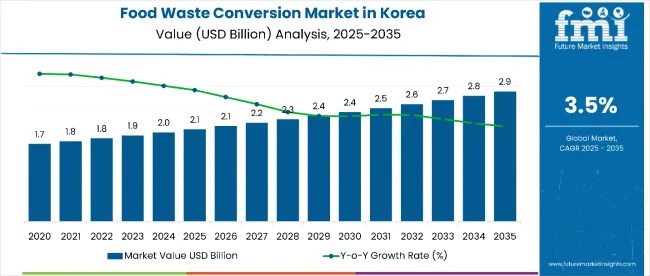
Sales of products derived from food waste in Korea are entering a steady expansion phase, supported by regulation-driven sustainability goals, advancing processing technologies, and rising demand for upcycled ingredients across food, feed, and non-food industries. The market is estimated at USD 2.1 billion in 2025 and is projected to reach USD 2.9 billion by 2035, reflecting a compound annual growth rate (CAGR) of approximately 3.5% over the forecast period.
This growth underscores Korea’s transition from conventional waste disposal toward a circular economy model. Government-backed food waste recycling laws, combined with corporate investment in biorefining, fermentation, and extraction technologies, are transforming food byproducts into commercially viable inputs. Increasing consumer awareness around environmental responsibility is further accelerating adoption across multiple end-use industries.
Explore trends before investing – request a sample report today! https://www.futuremarketinsights.com/reports/sample/rep-gb-18280
At a structural level, products from food waste are no longer niche sustainability initiatives. They are becoming integrated into mainstream processing strategies, driven by cost efficiency, compliance requirements, and the opportunity to differentiate products using responsibly sourced ingredients. Korea’s strong policy alignment and innovation ecosystem position the country as one of Asia’s most organized markets for food waste valorization.
Food Processing Dominates Demand, Citrus Waste Drives Value
In 2025, food processing applications account for the largest share of demand at 19%, reflecting their central role in meeting regulatory compliance and reducing raw material costs. Manufacturers are increasingly incorporating food-waste-derived ingredients into formulations to enhance functionality while meeting sustainability benchmarks.
By source material, citrus fruits represent the leading value-generating segment with an estimated 8% share. Korea’s citrus processing industry, particularly linked to juice and concentrate production, generates abundant peels and pulps rich in antioxidants, essential oils, and dietary fiber. These compounds are widely used in functional foods, cosmetics, and natural additives, reinforcing citrus waste as a high-value input.
Other sources are developing steadily. Mango waste is gaining traction in dietary fiber and antioxidant extraction, apple pomace is supporting pectin production and animal feed formulations, and vegetable waste such as carrots and beetroot is expanding into organic fertilizers and natural pigment applications. While still emerging, these segments provide alternatives to synthetic inputs across agriculture and food manufacturing.
Expanding End-Use Applications Support Market Stability
Beyond food processing, diversified end-user demand is strengthening market resilience. Key application areas include:
- Animal feed, where food waste offers cost-effective and nutritionally viable alternatives for livestock and pet nutrition
- Beverage processing, leveraging fermentation substrates and natural flavor compounds for functional and specialty drinks
- Cosmetics and personal care, using citrus oils and extracts for fragrance and skin-benefit formulations
- Dietary supplements and nutraceuticals, focused on bioactive compound recovery for premium health products
This breadth of applications ensures consistent demand even as processing economics and technology costs continue to evolve.
Regional Growth Led by South Gyeongsang
Market expansion is not uniform across Korea. South Gyeongsang is projected to post the highest CAGR of 6.3% between 2025 and 2035, driven by strong agricultural and fisheries infrastructure, large-scale byproduct availability, and government-backed recycling initiatives. The region has emerged as a hub for agricultural and seafood waste conversion.
North Jeolla, growing at 5.8%, follows closely, benefiting from structured farmer–processor collaboration models and waste-to-energy projects. South Jeolla, at 5.7%, emphasizes integrated agricultural processing and community-based economic development aligned with circular economy goals. Jeju, with a CAGR of 5.2%, stands out for tourism-linked environmental programs that combine waste processing with visible sustainability initiatives in hospitality and eco-entrepreneurship.
Competitive Landscape Anchored by Scale and Technology
The competitive environment is defined by large conglomerates, technology developers, and research-driven institutions. Processing scale and technological efficiency remain decisive success factors. Major participants such as CJ Group, Samsung C&T, Hyundai Green Food, Lotte Group, and SK Group are investing in infrastructure, technology integration, and cross-sector partnerships to strengthen waste-to-product conversion capabilities.
Supporting this ecosystem, organizations including KIFST, KEITI, and KAIST play a critical role in advancing extraction technologies, improving efficiency, and developing new applications. These academic and public-sector collaborations continue to push innovation while reinforcing Korea’s regulatory and technological leadership.
Outlook
With steady CAGR growth, diversified applications, and regionally specialized development models, Korea’s products from food waste market is set for sustainable long-term expansion. As processing costs decline and innovation accelerates, food waste is increasingly viewed not as a liability, but as a strategic resource supporting environmental goals and economic value creation.