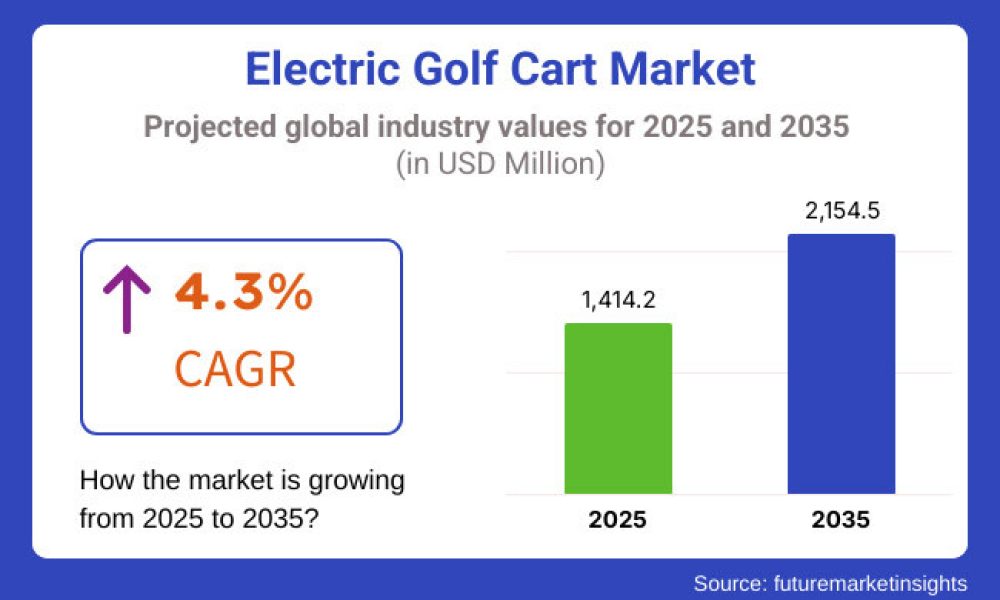
The Electric Golf Cart Market is poised for steady expansion between 2025 and 2035, driven by the rising demand for eco-friendly, low-emission mobility solutions across golf courses, resorts, gated communities, and commercial zones. The market is projected to grow from USD 1,414.2 million in 2025 to USD 2,154.5 million by 2035, reflecting a CAGR of 4.3% during the forecast period.
The shift toward sustainable mobility and the emergence of smart, battery-powered golf carts are reshaping recreational and commercial transportation globally. With advancements in battery life, charging efficiency, and AI-powered automation, electric golf carts are evolving from niche utility vehicles into versatile, cost-effective, and environmentally conscious transport options.
Market Drivers
- Sustainability and Energy Efficiency
- Growing environmental awareness and rising fuel costs have accelerated the transition toward electric-powered vehicles, particularly in recreational and hospitality sectors.
- Golf courses, airports, and gated communities are replacing gasoline models with electric carts to reduce carbon footprints and maintenance costs.
- Technological Advancements in Batteries
- Continuous improvements in lithium-ion batteries, fast charging systems, and regenerative braking are enhancing performance and reducing downtime.
- These innovations make electric golf carts ideal for long-term commercial and residential use.
- Growth of Golf Tourism and Resort Infrastructure
- The global rise in golf tourism and luxury resort development is creating steady demand for advanced electric carts equipped with GPS navigation, AI-assisted driving, and fleet monitoring systems.
- Emergence of Smart Fleet Solutions
- Integration of IoT, AI-based route planning, and real-time diagnostics enhances fleet management efficiency and operational cost savings, particularly for large-scale commercial operators.
Subscribe for Year-Round Insights → Stay ahead with quarterly and annual data updates https://www.futuremarketinsights.com/reports/sample/rep-gb-10910
Challenges and Opportunities
Challenges:
- High Initial Costs: Electric golf carts, particularly those powered by advanced lithium-ion batteries, come at a higher upfront cost compared to gasoline models.
- Battery Limitations: Frequent charging and limited range remain concerns for continuous-use scenarios in industrial or tourism applications.
Opportunities:
- Expansion in Urban and Commercial Mobility: Electric golf carts are increasingly being adopted for airport transfers, industrial parks, hospitals, and urban last-mile transport.
- Smart and Solar-Powered Models: Integration of solar charging panels, AI navigation, and connected systems presents vast opportunities for manufacturers to diversify offerings.
Regional Outlook
North America:
The U.S. remains a leading market, supported by the growing popularity of golf, sustainable mobility policies, and widespread adoption of electric carts across retirement communities, campuses, and resorts. Technological advancements such as GPS tracking and regenerative braking are propelling growth.
Europe:
Driven by strict EU emission standards, Europe is seeing robust adoption across Germany, the UK, and France, where golf courses and leisure parks prefer quieter, zero-emission carts. Expansion into city tourism and pedestrian zones further strengthens market momentum.
Asia-Pacific:
The fastest-growing region globally, led by China, Japan, India, and South Korea. Rapid urbanization, golf tourism, and government incentives for EV adoption are propelling regional demand. Compact mobility programs for urban and elderly populations in Japan also fuel growth.
Middle East (Saudi Arabia):
Saudi Arabia is emerging as a key regional market, with investments in tourism megaprojects like NEOM and Qiddiya. The use of luxury electric golf carts in resorts and recreational zones aligns with the nation’s Vision 2030 sustainability initiatives.
Segmentation Insights
By Application:
- Golf Courses – Largest segment, accounting for the majority of global demand.
- Rental Services – Gaining traction due to flexible mobility needs and short-term leasing options.
- Personal & Industrial Use – Growing among gated communities, resorts, and corporate campuses.
By Ownership:
- Rented: Increasing adoption in tourism and events for cost-effective, short-term mobility.
- Fully Owned: Preferred by private course owners and commercial facilities for long-term investment benefits.
By Seating Capacity:
- 4-Seater
- 6-Seater
- 8-Seater
- Above 8-Seater
Checkout Now to Access Industry Insights: https://www.futuremarketinsights.com/checkout/10910
Competitive Landscape
The Electric Golf Cart Market is moderately consolidated, featuring both global manufacturers and emerging regional players. Companies are emphasizing battery performance, connectivity, and lightweight design innovations.
- Textron Specialized Vehicles Inc. (20–25%) – Leader in premium golf carts and utility vehicles (E-Z-GO, Cushman).
- Xiamen Dalle Electric Car Co., Ltd. (15–20%) – Offers customizable carts for commercial and leisure applications.
- Speedways Electric (12–16%) – Focuses on affordable, energy-efficient models with extended battery life.
- Cruise Car, Inc. (8–12%) – Pioneer in solar-powered electric golf carts for eco-conscious consumers.
- Autopower (6–10%) – Specializes in smart, IoT-connected golf carts with advanced energy-efficient motors.
Other notable players include Club Car, Yamaha Golf-Car Company, LVTong Electric Vehicle, Bintelli Electric Vehicles, and Columbia Vehicle Group—all contributing to market diversification through innovation and sustainability-driven strategies.
Future Outlook (2025–2035)
The next decade will redefine the electric golf cart industry with advancements in AI-powered navigation, autonomous operation, and hydrogen-powered systems.
As cities embrace smart mobility infrastructure and consumers prioritize green transport, electric golf carts will evolve into key components of eco-friendly, short-distance mobility ecosystems across APAC, Europe, the USA, and Saudi Arabia.
Why Choose FMI: Empowering Decisions that Drive Real-World Outcomes: https://www.futuremarketinsights.com/why-fmi
About Future Market Insights (FMI)
Future Market Insights, Inc. (FMI) is an ESOMAR-certified, ISO 9001:2015 market research and consulting organization, trusted by Fortune 500 clients and global enterprises. With operations in the U.S., UK, India, and Dubai, FMI provides data-backed insights and strategic intelligence across 30+ industries and 1200 markets worldwide.