As Japan’s industrial and scientific sectors continue to evolve, the filter paper market is charting a dynamic trajectory of growth, innovation, and diversification. Forecasts indicate a robust expansion over the next decade, driven by broadening demand across laboratory, industrial, and beverage applications. The sector’s outlook is shaped not only by steady demand from traditional users but also by transformative advancements from both established manufacturers and emerging innovators looking to expand their business footprints.
Market Landscape and Growth Dynamics
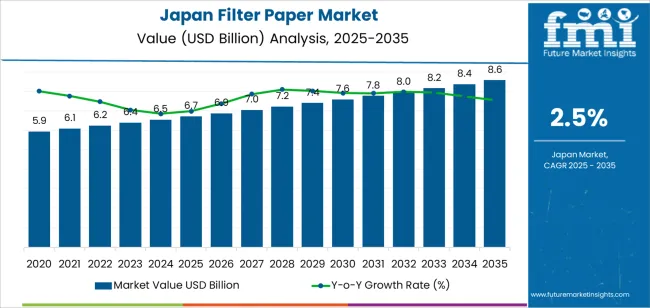
In 2025, Japan’s filter paper market is valued at approximately USD 6.7 billion, with projections showing a rise to an estimated USD 8.6 billion by 2035. This steady growth reflects compound annual gains driven by the critical role filter paper plays in quality control, analytical testing, and filtration across multiple industries. While historically the category has been synonymous with conventional laboratory and beverage filtration, the need for enhanced performance attributes such as higher porosity consistency and specialized thickness grades is gaining momentum.
The demand profile has diversified significantly: shape and thickness variants, such as cone and basket formats, cater to specific applications ranging from specialty coffee brewing to high-precision laboratory separations. In particular, cone filters and lightweight grades have remained popular for their versatility in both commercial and household contexts, underscoring how consumer preferences influence market emphasis alongside industrial needs.
Drivers Supporting Market Expansion
Several key drivers are shaping this evolving market:
-
Industrial & Laboratory Demand: Japan’s advanced manufacturing sectors — including automotive, chemical, pharmaceutical, and electronics — rely on filter paper for analytical accuracy and process refinement. As production standards and environmental regulations tighten, the need for consistent, high-quality filtration media deepens.
-
Beverage & Consumer Trends: The nation’s deep-rooted coffee culture and specialty brewing techniques continue to fuel sustained uptake of filter paper products designed to preserve flavor and clarity. Innovations tailored to consumer preferences, including biodegradable and eco-friendly options, are adding new growth layers to the market.
-
Advanced R&D and Specialty Applications: Emerging analytical fields such as environmental monitoring, genomics, and precision diagnostics are driving demand for high-performance filter paper grades. These segments favor materials with specific porosity and chemical compatibility profiles, catalyzing innovation among manufacturers.
-
Quality Standards & Regulatory Influence: Stricter quality control procedures across healthcare, food safety, and environmental testing reinforce the indispensability of reliable filter paper solutions. Organizations seeking regulatory compliance increasingly invest in proven filtration media.
Established Leaders Driving the Market Forward
Japan’s filter paper landscape features a blend of seasoned global leaders and influential regional players. Established companies continue to anchor market reliability while pushing performance boundaries:
-
Ahlstrom-Munksjö: A globally recognized manufacturer known for a broad spectrum of filtration paper products that serve both industrial and laboratory needs. Their deep product breadth and strong distribution networks help maintain continuity of supply and technical support.
-
Hollingsworth & Vose: Renowned for their extensive filtration media portfolio, this company remains at the forefront of product consistency and material strength, catering to industrial users with rigorous performance demands.
-
Thermo Fisher Scientific and Merck KGaA: These international science-service powerhouses support laboratory and life sciences filtration with specialized grades designed for reproducible results in analytical workflows.
-
Azumi Co Ltd: As a prominent regional supplier, this company blends local market insights with customization capabilities, responding directly to the nuanced needs of Japanese industrial and research customers.
Each of these industry incumbents continues to refine product lines, enhance distribution channels, and bolster technical service support — collectively enhancing market depth and reliability.
Emerging Innovators and New Technology Frontiers
While established firms provide market stability, newer entrants and smaller manufacturers are carving out opportunities by focusing on specialization and innovation. These emerging players are redefining niche segments by introducing filter papers that emphasize biodegradability, sustainability, and performance customization.
Innovative formats tailored for specialty beverage applications, including designs with optimized pore structures and environmentally friendly fibers, are gaining traction among discerning consumers and businesses alike. Moreover, startups deploying digital or IoT-enabled quality monitoring systems for filtration processes highlight how technology integration can elevate traditional products into smart filtration solutions.
This emphasis on new technologies not only introduces fresh product lines but also invites partnerships across research institutions, equipment manufacturers, and environmental agencies, ultimately broadening the filter paper ecosystem.
Outlook and Opportunities
Looking ahead, the Japan filter paper market is well positioned for continued resilience and expansion. With a blend of traditional demand and growth in specialized applications, market players have opportunities to scale operations, invest in R&D, and form strategic collaborations that enrich product portfolios. Manufacturers focused on differentiation through performance, sustainability, and customer support are likely to capture significant share as industries across Japan seek reliable filtration solutions.
As both established manufacturers and new entrants innovate and diversify, the filter paper market exemplifies how legacy industries can adapt to evolving technological and societal needs while maintaining their core value propositions.