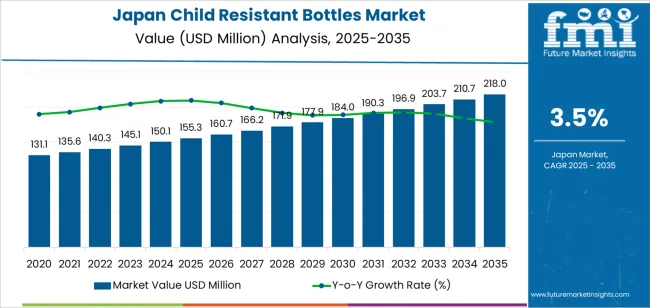
The child-resistant bottles market in Japan is poised for dynamic growth over the next decade as safety concerns, stringent regulations, and evolving consumer expectations accelerate demand for secure packaging solutions across industries. From household chemicals to pharmaceuticals, manufacturers are rethinking packaging design and technology to ensure both child safety and adult usability, creating new avenues for established players and emerging innovators alike.
Forecasts reveal a steady uptick in demand, with market value anticipated to rise significantly between 2025 and 2035. This growth trajectory reflects broader shifts in regulatory standards, consumer awareness, and technological advancements in closure mechanisms and materials. As businesses aim to balance product accessibility with stringent safety standards, the Japanese market represents a fertile ground for expansion and differentiation.
Market Growth Driven by Safety, Regulation, and Consumer Awareness
Child-resistant packaging is becoming a non-negotiable standard in sectors where accidental ingestion can have serious consequences. In Japan, the pharmaceutical industry remains a core driver of demand, as medications — particularly liquid formulations — increasingly require packaging that prevents unsupervised access by children while remaining accessible to adult users.
Equally, as household cleaning products and specialty chemicals continue to penetrate homes and e-commerce platforms, the need for secure packaging to lower the risk of accidental exposure is rising. An aging population, greater emphasis on health and safety in family settings, and heightened regulatory focus across consumer goods sectors are reinforcing the market’s expansion.
As a result, manufacturers are exploring innovative materials and ergonomic designs that meet regulatory certification yet maintain ease of use for adult consumers. This trend not only supports public safety but also opens opportunities for brands to distinguish their products in competitive spaces.
Material and Design Innovations Take Center Stage
The material composition of child-resistant bottles is a critical factor shaping market performance. Japan’s market reflects a unique material preference, with a prominent share attributed to durable components that ensure tamper-evident performance and packaging integrity under stress.
Manufacturers are also expanding their portfolios to include both traditional and novel materials. Advanced plastic polymers that combine strength, lighter weight, and recyclability are gaining traction alongside conventional metal counterparts. These material innovations support manufacturers in meeting sustainability commitments while delivering secure packaging solutions.
On the design front, closure technologies such as push-and-turn, squeeze-and-turn, and snap-lock mechanisms are increasingly adopted for their balance of child-resistance and adult accessibility. Such advancements enhance usability for diverse demographic groups, including seniors who may struggle with overly complex closures.
Established Leaders and Emerging Innovators Shape Competitive Landscape
Several key players have already established strong footholds in Japan’s child-resistant bottles market. These industry leaders continue to invest in expanding product lines, streamlining production, and reinforcing relationships with major pharmaceutical and consumer goods brands.
At the same time, emerging manufacturers and technology-focused ventures are making inroads by offering specialized solutions and niche capabilities. These new entrants are particularly active in developing cutting-edge closure mechanisms, lightweight and sustainable materials, and customizable packaging formats which appeal to both global and local clientele.
This competitive dynamic fosters an environment where collaboration and differentiation intersect. Established manufacturers benefit from scale, experience, and broader distribution networks, while newer players inject agility, innovation, and focused expertise — all of which are essential to meeting evolving market demands.
Strategic Opportunities Across Regions and Segments
While metropolitan regions with dense populations naturally account for a major portion of demand, secondary markets in regions with growing industrial activity are emerging as attractive investment destinations. Across Japan, forecasts indicate a healthy adoption rate of child-resistant packaging across diverse sectors, from high-volume pharmaceuticals to household products and specialty chemicals.
End-use segments also continue to diversify. Pharmaceuticals, unsurprisingly, remain a core revenue contributor, but sectors such as consumer chemicals, nutraceuticals, and even regulated products like cannabis are showing increased interest in certified child-resistant formats. This opens doors for manufacturers and technology providers to develop tailored solutions that meet specific performance and compliance needs.
Meeting Challenges with Innovation and Collaboration
Despite the strong outlook, the industry faces certain challenges that require innovative problem-solving. Certification and testing for child-resistant formats are rigorous and can add costs, particularly for smaller manufacturers looking to scale. Balancing affordability with high safety standards is a continuing priority, as is advancing user-friendly designs that do not compromise on security.
Moreover, as sustainability becomes a central focus across Japan’s industrial landscape, manufacturers are exploring eco-friendly materials and processes that align with environmental commitments without undermining child safety protocols.
Looking Ahead
The Japanese child-resistant bottles market reflects a broader transformation in packaging — one where safety, regulatory compliance, consumer trust, and innovation converge. For established manufacturers and new entrants alike, this evolution presents not just a challenge but a significant opportunity to lead, adapt, and grow.
By embracing advanced technologies, fostering cross-industry collaborations, and maintaining an unwavering focus on safety and usability, companies operating in this space are well-positioned to shape the next chapter of secure packaging solutions in Japan and beyond.