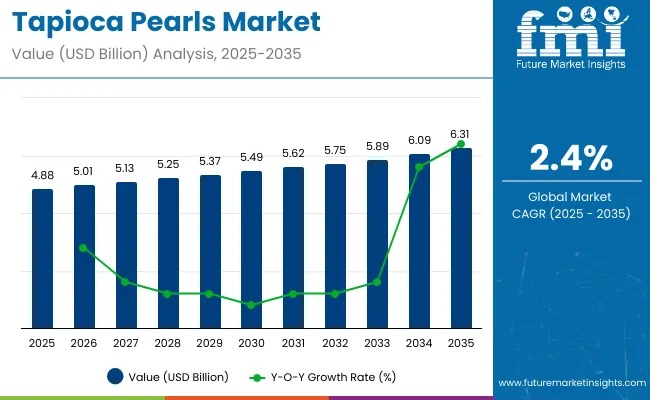
The global tapioca pearls market is witnessing sustained growth, driven by rising consumption of bubble tea and expanding applications in food, beverages, textiles, and cosmetics. The market is projected to reach USD 6.31 billion by 2035, up from USD 4.88 billion in 2025, reflecting a CAGR of 2.4% from 2025 to 2035, following a CAGR of 1.8% between 2020 and 2025. Increasing consumer interest in nutritional beverages and tapioca’s versatility will play a key role in market expansion.
Growing popularity of tapioca in pudding mixes, stabilizers in food and drink formulations, and cosmetics ingredients is broadening product penetration. Tapioca pearls, rich in folate, iron, calcium, and magnesium, are additionally recommended for pregnant women. With health awareness surging globally, nutritionally driven purchases are expected to positively influence demand dynamics.
Explore trends before investing – request a sample report today! https://www.futuremarketinsights.com/reports/sample/rep-gb-9345
Bubble Tea Culture Sparks Global Consumption Wave
The influence of Taiwanese bubble tea-popularly known as boba tea-has reshaped beverage menus worldwide. From McDonald’s outlets in Europe to large chains in the United States, tapioca pearl-infused dessert drinks are gaining prominence. Per capita spending is increasing rapidly, especially among urban youth inclined toward premium, customizable beverages. Flavored pearl variants-brown sugar, crystal, and fruit-infused pearls-are pushing premium pricing and boosting retail and foodservice uptake.
In developed markets such as the U.S., U.K., Germany, and Australia, spending has surged due to strong café penetration and availability of DIY retail packs. In emerging markets like India, Brazil, Indonesia, and South Africa, rising middle-class income and exposure to global food trends are driving incremental growth.
Strong Trade Relations Strengthen Supply Outlook
The global trade for tapioca pearls is expanding as countries leverage agricultural advantages and scalable processing. Key exporters include Thailand, Vietnam, Taiwan, China, and Indonesia, while top importers are the United States, Canada, U.K., Japan, and South Korea. Taiwan specializes in premium and flavored pearls for high-end chains, whereas Thailand and Vietnam supply mass-market pearls competitively due to abundant cassava production.
High-Growth Investment Segments
Medium-Sized Tapioca Pearls Dominate
Medium pearls (5-8 mm) are the preferred size globally due to optimal chewiness and quick-cooking properties, making them ideal for bubble tea. Brands such as WuFuYuan and Bob’s Red Mill report strong retail demand supported by rising home preparation trends.
Beverages Lead as Primary End-Use
The beverage industry remains the largest end-user, driven by menu diversification across specialty cafés, tea shops, and smoothie chains. Tapioca pearls’ neutral taste and gelling attributes support innovations in vegan, low-sugar, and functional beverages.
Key Industry Drivers
• Bubble Tea as a Functional Beverage: Students and professionals increasingly choose tea and coffee for cognitive support, fueling demand for pearl-infused low-calorie beverages.
• Cassava as a Cost-Efficient Raw Ingredient: Tapioca starch substitutes potato and corn starch economically, expanding applications in food, packaging, and infant nutrition.
• Product Innovation and Clean-Label Demand: Brands are introducing clean-label variants, eco-friendly packaging, and niche snacks to meet ingredient-conscious consumer preferences.
• Infant Nutrition: Gluten-free tapioca starch is widely used in organic baby products, supported by celiac dietary needs and working-parent demographics.
Regional Market Insights
The United States continues to dominate North America, fueled by widespread café expansion and initiatives by major chains testing boba-style beverages. India leads Asia-Pacific, with innovative flavored and alcohol-infused boba drinks attracting new consumers. The U.K. drives Europe’s market growth as healthy starch alternatives gain popularity among lifestyle-conscious consumers.
Competitive Landscape
Tier-1 companies control approximately 30% of the global market through high-volume production, advanced technology, and international distribution networks. Tier-2 and Tier-3 companies account for 20% and 50%, respectively, with Tier-3 representing local and niche market players.
Leading Manufacturers:
Universal Thai International Enterprise Co. Ltd., Reese Finer Foods Inc., USA Boba Company, Thai Wah Public Company Limited, Lollicup USA Inc., American Key Food Products, INDEMIL LTDA