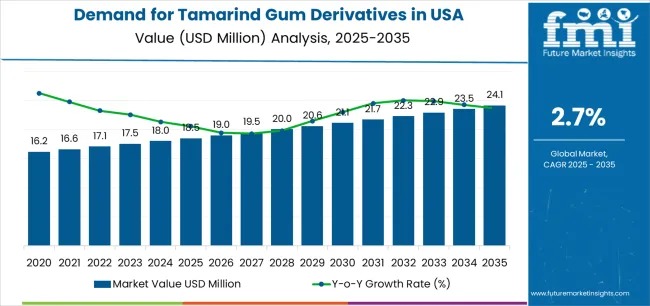
Demand for tamarind gum derivatives in the USA is entering a decade of steady expansion, rising from USD 18.5 million in 2025 to approximately USD 23.9 million by 2035, according to new market intelligence. This reflects an absolute increase of USD 5.4 million, translating into 29.2% total growth at a 2.7% CAGR over the forecast period.
Companies across food, beverage, cosmetics, and industrial processing are increasingly integrating tamarind gum derivatives to improve product consistency, optimize viscosity control, and enable compliant clean-label ingredient reformulations. Reinforced federal and state food safety guidelines are accelerating the shift toward naturally derived, plant-based systems, leading manufacturers to prioritize tamarind gum derivatives for reliable, predictable performance.
Explore trends before investing – request a sample report today! https://www.futuremarketinsights.com/reports/sample/rep-gb-28334
Clean-Label Expansion and Performance Requirements Fuel Adoption
Food manufacturers and processing facilities are adopting tamarind gum derivatives to enhance functional stability, improve solubility and dispersion, and reduce dependence on synthetic thickeners. Between 2025 and 2030, demand is projected to rise from USD 18.5 million to USD 20.9 million, contributing 44.4% of the decade’s growth.
The United States remains a global leader in food processing capabilities, enabling rapid integration of natural hydrocolloids across large-scale production lines. Growing consumer preference for clean-label, minimally processed products is further strengthening market prospects.
Sales of tamarind gum are expected to grow 1.29X during the assessment period, supported by clean-label reformulations, strong food infrastructure, and expanding industrial applications.
Quick Market Statistics – USA Tamarind Gum Derivatives
- Market Value, 2025: USD 18.5 million
- Forecast Value, 2035: USD 23.9 million
- CAGR (2025–2035): 2.7%
- Leading Type: Carboxymethyl Tamarind Gum – 48.3% share
- Top Regions: West, Northeast, Midwest, South
- Regional Leader: West
- Key Companies: JD Gums & Chemicals, Chemtotal Labs, Lucid Colloids, Indian Hydrocolloids, Socius Ingredients, Altrafine Gums
Growth Outlook: 2030–2035 to Deliver 55.6% of Total Decade Expansion
From 2030 to 2035, market value is projected to increase from USD 20.9 million to USD 23.9 million, adding another USD 3.0 million—representing 55.6% of total forecast-period growth.
This phase will be shaped by:
- advanced chemical modification technologies,
- improved solubility and performance attributes, and
- deeper integration into food, commercial, and industrial processing lines.
West Coast and Northeast processors are expected to lead adoption as they continue transitioning to high-efficiency natural ingredient platforms.
Why Demand Is Growing: Clean Label Meets Functional Precision
USA demand is accelerating due to:
- heightened FDA compliance requirements,
- stronger state-level food safety enforcement,
- the need for high-performing natural thickening systems, and
- increasing emphasis on plant-based ingredient architectures.
Modern production facilities rely on tamarind gum derivatives for viscosity management, texture enhancement, and reliable functional behavior under diverse processing conditions. As clean-label manufacturing becomes standard, natural derivatives are emerging as essential formulation tools.
Opportunity Pathways Driving Market Revenues
The U.S. market offers multiple expansion avenues:
- Food-Grade Functional Systems: USD 3.2–4.9 million
- Chemical Modification & Enhanced Functional Solutions: USD 2.7–4.1 million
- Carboxymethyl Tamarind Gum (CMTG) Systems: USD 2.9–4.4 million
- Industrial & Textile Applications: USD 2.1–3.2 million
- Cosmetics & Personal Care: USD 1.7–2.5 million
- Technical Service Ecosystems: USD 1.4–2.1 million
These pathways reflect rising demand for high-performance natural ingredient systems, advanced processing compatibility, and specialized application support.
Segmental Highlights
By Type – Carboxymethyl Tamarind Gum Dominates (48.3%)
Carboxymethyl derivatives offer superior solubility and functional reliability, making them the preferred choice for large-scale food manufacturing and processing optimization.
By Application – Food Segment Leads with 52.7% Share
Food processors—including major beverage, bakery, and packaged goods manufacturers—continue to adopt tamarind gum derivatives to strengthen clean-label reformulation strategies and improve product consistency.
Regional Outlook: West Leads at 3.1% CAGR
West (3.1% CAGR)
Home to progressive food innovation hubs, advanced ingredient R&D, and high clean-label adoption.
Northeast (2.8% CAGR)
Strong food infrastructure and dense concentration of processing facilities fuel natural ingredient integration.
Midwest (2.6% CAGR)
Modernization of food plants and regional manufacturing expansion support sustained growth.
South (2.4% CAGR)
Rising processing diversification and growing food manufacturing footprints enable steady adoption.
Competitive Landscape
The U.S. market is characterized by specialized natural ingredient developers, advanced hydrocolloid suppliers, and innovation-driven manufacturers. Key participants include:
- JD Gums & Chemicals
- Chemtotal Labs
- Lucid Colloids
- Indian Hydrocolloids
- Socius Ingredients
- Altrafine Gums
- Meckoni Impex
- Shree Krishna Industries
- Wonyoung Industrial
- Adachi Group
Companies are investing in modification technologies, application support networks, and advanced natural ingredient solutions to strengthen market presence.