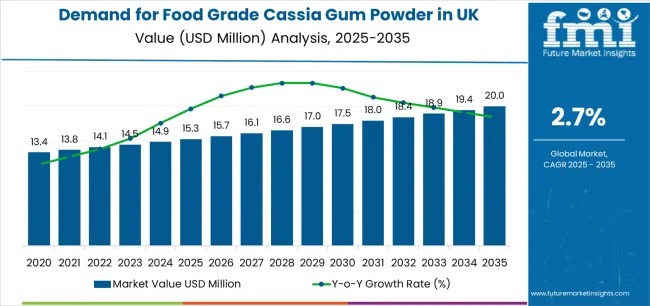
The demand for food grade cassia gum powder in the United Kingdom is projected to rise from USD 15.3 million in 2025 to approximately USD 20.1 million by 2035, generating an absolute value increase of USD 4.8 million. This reflects a steady CAGR of 2.7%, supported by expanding natural ingredient usage, tightening clean-label regulations, and the growing role of hydrocolloids in frozen desserts, dairy, and food manufacturing sectors.
The decade’s growth momentum is split into two distinct phases. Between 2025 and 2030, demand is forecast to climb from USD 15.3 million to USD 17.4 million, a rise of USD 2.1 million, accounting for 43.8% of total projected expansion. Between 2030 and 2035, the market is expected to add USD 2.7 million, representing 56.3% of the decade’s absolute growth as premium-grade variants and advanced processing systems accelerate adoption.
Explore trends before investing – request a sample report today! https://www.futuremarketinsights.com/reports/sample/rep-gb-28342
Refined Cassia Gum Holds a 58.4% Share – Ice Creams Represent 48.7% of Demand
By type, refined cassia gum remains the dominant category with a 58.4% share in 2025, driven by superior solubility, high compatibility with existing UK processing infrastructure, and its reliability in texture management.
By application, ice creams represent 48.7% of total UK demand, reflecting the sector’s strict texture stability requirements, expansion of artisanal and premium frozen dessert categories, and a rising preference for natural hydrocolloid-based stabilizers.
Key application drivers include:
• Improved stabilization performance in frozen systems
• Reduced product risks and texture inconsistencies
• Superior economic and operational efficiency versus conventional thickeners
England Leads Regional Growth with a 2.9% CAGR Through 2035
Growth varies meaningfully across the UK’s food manufacturing regions. England leads with a 2.9% CAGR, followed by:
• Scotland: 2.7%
• Wales: 2.5%
• Northern Ireland: 2.3%
England’s leadership is supported by large-scale food processing clusters, high investment readiness, and early adoption of premium natural ingredient systems. Scotland’s strong dairy and ice cream processing base positions it as a high-potential growth arena, while Wales and Northern Ireland continue modernizing food manufacturing systems and integrating natural thickening technologies.
Drivers Strengthening Demand Across the UK Market
Several structural forces are shaping the direction of cassia gum powder adoption:
- Rising Clean-Label Standards
UK processors are prioritizing plant-based, minimally processed, and naturally derived ingredients to meet evolving consumer expectations and comply with stringent food safety frameworks. - Advanced Processing Requirements
Manufacturers are integrating natural hydrocolloids to maintain product consistency, reduce formulation risks, and improve production efficiency. - Growth of Frozen Dessert and Dairy Manufacturing
Premium ice creams, frozen confections, and functional dairy categories continue to rely heavily on natural stabilizer systems.
Competitive Landscape: Established Hydrocolloid Leaders Drive Market Structure
The UK market is shaped by globally recognized hydrocolloid suppliers with strong distribution and application integration capabilities. Key players include:
- Lubi Gel
- Indian Hydrocolloids
- Agro Gums
- Bharat Agro Industries
- Avlast Hydrocolloids
- Altrafine Gums
- Supreme Gums
- Hindustan Gum
- Premcem Gums
- Vikas WSP
These companies are advancing innovation through improved solubility, better gel-strength profiles, higher purity levels, and quality monitoring technologies. Strategic focus areas include application diversification, supply chain optimization, and technical advisory for UK food manufacturers adopting natural thickening and stabilization systems.
Opportunities for Stakeholders Across the Value Chain
Stakeholder engagement continues to unlock growth opportunities:
- Government & Regulators:
Standardization of hydrocolloid quality, import specifications, and ingredient certification can accelerate safe and consistent deployment. - Industry Bodies:
Development of best-practice guidelines, training programs, and performance evaluation systems can strengthen end-user confidence. - Suppliers:
Investments in advanced natural ingredient technologies, specification harmonization, and integrated supply coordination offer clear value pathways. - Food Manufacturers:
Pilot testing, phased adoption, and long-term sourcing partnerships support stable integration into existing operations. - Researchers & Innovators:
New solubility optimization, texture enhancement, and stability improvement research can drive the next wave of high-performance hydrocolloids.