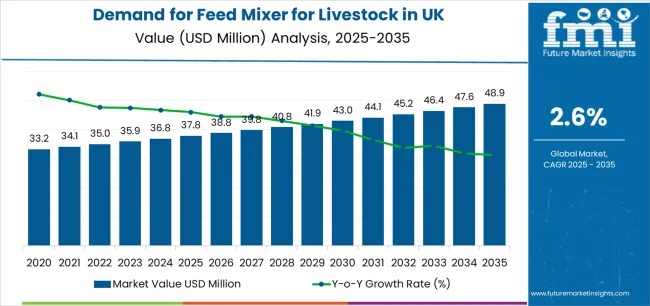
Demand for feed mixers for livestock in the United Kingdom continues to rise steadily, fueled by expanding mechanization, the modernization of dairy infrastructure, and increasing adoption of precision feeding systems. The market is projected to grow from USD 37.8 million in 2025 to USD 48.9 million by 2035, marking an absolute increase of USD 11.8 million and a 2.6% CAGR this decade.
The market remains defined by the dominance of pull-type mixers, which are expected to account for 61.4% of all demand in 2025. These mixers have become the preferred choice across dairy, beef, sheep, and mixed livestock farms due to their mobility, compatibility with existing equipment fleets, and the ability to integrate seamlessly into established feeding operations without structural adjustments. Continuous improvements in auger performance, weighing accuracy, and mixing efficiency further reinforce their leadership across England, Scotland, Wales, and Northern Ireland.
Explore trends before investing – request a sample report today! https://www.futuremarketinsights.com/reports/sample/rep-gb-28332
Dairy Cattle Farms Remain the Largest Adopter Segment
Dairy operations account for 58.9% of all feed mixer demand in 2025, making them the strongest contributor to market growth. The increasing adoption of total mixed ration (TMR) systems, which require consistent, high-quality mixing, has made reliable feed mixers indispensable in modern dairy management. As farms push for higher nutritional accuracy, better herd behavior predictability, and improved milk output consistency, demand is expected to rise steadily through 2035.
This dominance is further supported by:
- High concentration of commercial dairy farms in England and Scotland
- A shift toward automation and nutrition-based herd management
- Growth in integrated feeding systems across medium and large dairy establishments
Growth Outlook: 2025–2035
The first half of the forecast period—from 2025 to 2030—is expected to deliver a value rise of USD 6.1 million, representing over 51% of the decade’s total expansion. This phase is primarily associated with widespread mechanization, growing awareness of mixing benefits, and the increasing integration of precision-feeding strategies.
Between 2030 and 2035, the market is set to add another USD 5.7 million, driven by:
- Adoption of automated weighing and real-time monitoring systems
- Evolution of species-specific feeding strategies
- Expansion of data-driven livestock nutrition programs
- Increased mechanization in emerging commercial livestock clusters
Overall, the transition toward advanced feeding technologies and consistent livestock performance benchmarks will continue to stimulate equipment upgrades and new installations.
Regional Growth Momentum Led by England
Across the UK, growth is shaped by livestock concentration and farm modernization priorities. England remains the dominant regional market, posting the strongest projected CAGR of 2.8% through 2035, backed by advanced farming corridors and early adoption of premium mechanized feeding equipment.
Scotland follows closely, driven by its extensive dairy infrastructure and established livestock operations that increasingly rely on reliable feed processing systems. Wales and Northern Ireland also show healthy expansion, supported by agricultural modernization programs and the integration of efficiency-oriented livestock management practices.
Key Demand Drivers
The UK feed mixer market is advancing due to several structural, operational, and regulatory catalysts:
- Emphasis on precision farming: Farms are moving toward feeding accuracy standards that require advanced mixers with consistent homogenization capabilities.
- Need for operational efficiency: Automated and precisely controlled feeding processes reduce labor intensity and improve herd outcomes.
- Regulatory expectations: Mechanization-aligned agricultural guidelines continue to drive farm investments in reliable mixing equipment.
- Rising complexity in livestock diets: Data-driven nutritional strategies require systems capable of uniform, high-quality feed preparation.
Together, these factors ensure that feed mixers remain a critical component of the UK’s livestock technology ecosystem.
Segment Highlights
By Type
Pull-type mixers remain the preferred configuration due to their mobility, flexible integration with tractors and farm vehicles, and lower implementation complexity. Their suitability for both small and large farms ensures sustained long-term adoption.
By Application
Dairy cattle farms dominate demand due to their dependence on TMR processes and large-scale mechanization. Beef, sheep, and mixed livestock operations also rely on mixer systems, though at smaller and more farm-specific scales.
Competitive Landscape
The UK feed mixer market is shaped by global and regional equipment suppliers that focus on performance reliability, technology enhancement, and feeding system integration. Companies are increasingly investing in innovation, distribution network expansion, and end-to-end service models.
Leading players include:
KUHN, Supreme International, Triolet, Highline Manufacturing, Jaylor International, Groupe Anderson, DuraTech Industries, Harsh International, Vermeer Corporation, and NDEco.
These manufacturers are strengthening their presence through upgraded mixing technologies, automated monitoring capabilities, and enhanced customer support structures.
Outlook
With a steadily expanding livestock sector, a strong shift toward mechanization, and rising adoption of nutritional optimization technologies, the UK feed mixer for livestock market is set to maintain a positive growth trajectory through 2035. As farms continue to modernize and embrace precision-feeding infrastructure, demand for advanced mixer systems will remain robust across all major regions.