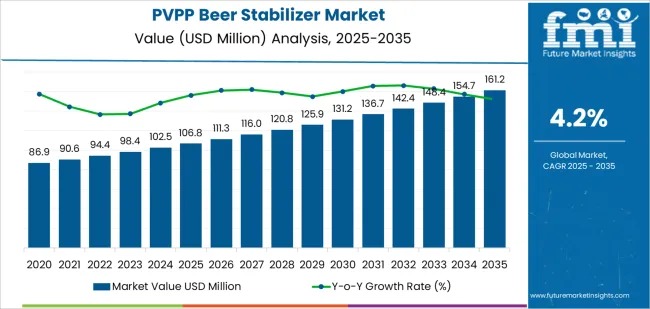
The global PVPP beer stabilizer market is set for steady, long-term expansion as breweries worldwide intensify their focus on clarity enhancement, flavor stability, and extended shelf life. Valued at USD 106.8 million in 2025, the market is forecast to reach USD 161.1 million by 2035, marking 50.8% cumulative growth and a CAGR of 4.2%. Increasing adoption of polyvinylpolypyrrolidone (PVPP) technology across craft breweries, commercial beer producers, and specialty beer facilities continues to reshape quality enhancement standards across the brewing landscape.
Between 2025 and 2030, the market is projected to grow from USD 106.8 million to USD 131.2 million, contributing 44.9% of total decade-long growth. This early-stage expansion is being shaped by the rapid rise of craft beer production, premium beer category momentum, and the adoption of advanced filtration and natural stabilization technologies. Breweries are increasingly incorporating PVPP into quality control programs to meet consumer expectations for haze-free, visually appealing beers with balanced sensory profiles.
Explore trends before investing – request a sample report today! https://www.futuremarketinsights.com/reports/sample/rep-gb-28343
Market Momentum Strengthens Through 2035
From 2030 to 2035, the industry will add another USD 29.9 million, driven by specialty beer diversification, export-oriented brewing operations, and advanced PVPP formulations that offer enhanced performance and improved batch consistency. As global brewing standards strengthen, breweries are investing in stabilizers that guarantee reliable polyphenol removal and haze prevention across multiple beer styles.
Quick Statistics
- Market Value (2025): USD 106.8 million
- Market Value (2035): USD 161.1 million
- CAGR (2025–2035): 4.2%
- Top Regions: East Asia, Europe, South Asia
- Leading Product Type: Pure PVPP
- Key Players: Ashland, BASF, AEB Group, Erbslöh Geisenheim, Lallemand
Why Demand Is Rising
Global breweries are prioritizing clarity, stability, and flavor neutrality to capture growing consumer interest in premium and craft beer categories. PVPP stabilizers offer unmatched consistency in reducing chill haze, eliminating excess polyphenols, and preserving flavor integrity—making them indispensable for brewers aiming to enhance product quality without compromising brewing tradition.
Key growth drivers include:
- Rising demand for haze-free, visually appealing beer
- Expansion of the premium and craft beer segments
- Adoption of automated stabilization systems and PVPP regeneration technology
- Increased brewing volumes across emerging markets
Segmental Insights
By Product Type – Pure PVPP Leads the Market
Pure PVPP remains the preferred stabilizer due to its superior adsorption capacity and flavor-neutral performance. Its reliable efficiency in removing tannins and polyphenols makes it integral to modern stabilization workflows across lagers, ales, and specialty beer categories.
By Application – Original Beer Holds Dominant Share
The original beer segment continues to generate the highest PVPP demand, supported by large-scale production volumes and stringent clarity requirements for mainstream beer varieties. Breweries rely on PVPP to achieve consistent haze control while maintaining product freshness and distribution stability.
Country-Level Market Performance (CAGR 2025–2035)
- China – 5.7%: Strong brewing infrastructure and rapid craft expansion
- India – 5.3%: Rising urban beer consumption and modern brewery investments
- Germany – 4.8%: Brewing excellence and craft beer innovation
- Brazil – 4.4%: Premium beer momentum and growing quality awareness
- U.S. – 4%: Craft brewery proliferation and premiumization
- U.K. – 3.6%: Tradition-driven brewing supported by modern stabilization
- Japan – 3.2%: Premium beer preference and precision brewing
Europe: A Stable Growth Hub
The European PVPP market will increase from USD 38.2 million in 2025 to USD 56.5 million by 2035 (4% CAGR). Germany leads with over 32% share due to strict quality standards, followed by the U.K., France, Italy, and Spain—each strengthening investments in clarity technologies and brewing modernization.
Competitive Landscape
The market is moderately consolidated, with global and regional players focusing on technological advancement, application support, and high-purity product development. Companies like Ashland, BASF, and AEB Group are enhancing PVPP performance through optimized particle engineering and improved regeneration systems designed to lower costs and boost operational efficiency.
What’s Ahead for the Industry
The next decade will see stabilizer technology becoming central to brewery quality strategies. Key trends shaping future demand include:
- Development of PVPP formulations tailored for flavored, low-alcohol, and specialty beers
- Greater adoption of multi-cycle PVPP regeneration systems
- Strengthening global brewing standards and quality benchmarks
- Expansion of technical training and knowledge-sharing initiatives across brewing communities