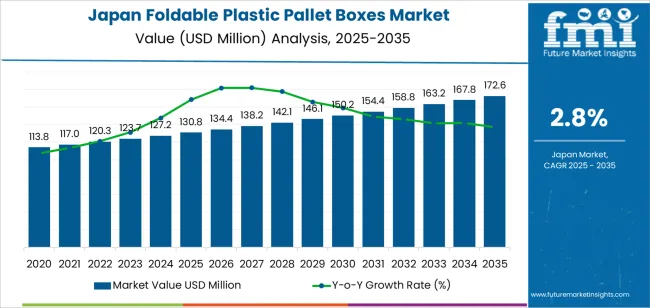
The market for foldable plastic pallet boxes in Japan is experiencing steady expansion as both established manufacturers and emerging innovators ramp up efforts to meet rising demand from logistics, manufacturing, and supply chain sectors. With a strong emphasis on space-efficient design, durability, and sustainability, the industry is poised for continued growth through the next decade.
Forecasts indicate that the market value of foldable plastic pallet boxes in Japan is projected to rise significantly over the next ten years, driven by increased adoption across key industries such as automotive, logistics, consumer goods, food and beverage, and pharmaceuticals. These boxes — known for their collapsible structure and reusable attributes — are becoming essential tools for companies looking to streamline operations, reduce return logistics costs, and optimize warehouse space.
Growing Demand Across Multiple Industries
Japan’s unique logistical challenges — including high land costs, limited warehouse space, and a strong focus on precision workflows — are accelerating the shift toward efficient bulk handling solutions. Foldable plastic pallet boxes offer a compelling alternative to traditional wooden or rigid containers, reducing return-trip volume when empty and improving operational flexibility across supply chains.
Automotive manufacturers have emerged as some of the most active adopters of foldable pallet technology. These containers support the intricate movement of parts across plant networks, ensuring components can be transported reliably between suppliers and assembly centers. Logistics and shipping companies are also increasing their use of foldable pallets to reduce the space required for empty returns and to improve turnaround times within warehouse environments.
Beyond heavy industry, sectors such as consumer goods, food and beverage, and pharmaceutical distribution are adopting these pallet boxes for their hygienic properties, structural integrity, and adaptability to different load types. These solutions are increasingly integrated into cold-chain and temperature-controlled logistics, where sanitation and product protection are critical.
Technology and Material Innovation Drive Competitive Advantage
Manufacturers are not only responding to demand; they are proactively enhancing product performance through material science and smart design. Polypropylene (PP) continues to hold a leading position as the preferred material due to its resilience, lightweight nature, and resistance to repeated folding cycles. High-density polyethylene (HDPE) and polyethylene (PE) options also serve niche applications, offering impact resistance and flexibility where required.
On the technology front, next-generation foldable pallet boxes are being engineered with modular wall panels, reinforced corner structures, and compatibility with automated storage and retrieval systems used in modern warehouses. Some manufacturers are exploring smart tracking capabilities, such as RFID integration, to enable real-time inventory visibility — a feature that appeals particularly to high-tech supply chains and e-commerce operators.
These technological advances are widening the competitive landscape, giving both established producers and innovative newcomers opportunities to differentiate their offerings. Leaders in the field are extending product lines to include heavy-duty designs for industrial users, hygienic food-grade containers for regulated environments, and lightweight alternatives tailored for rapid handling and efficient transport.
Established Players and Fresh Entrants Shape Market Dynamics
A diverse roster of companies is contributing to the robust ecosystem behind Japan’s foldable plastic pallet box market. Well-recognized manufacturers continue to build on decades of expertise in material handling equipment, delivering reliable and highly engineered solutions to a broad set of clients. Meanwhile, new and mid-sized players are injecting dynamism into the market by introducing specialized products, flexible design options, and technology-enhanced features that meet specific customer needs.
This dual momentum — blending longstanding manufacturing capability with agile innovation — is helping the market adapt to evolving supply chain requirements. Collaboration across sectors, and a willingness to experiment with next-generation solutions, has encouraged businesses of all sizes to view foldable pallet boxes not just as a commodity, but as a strategic asset in their logistics toolkit.
Regional Adoption and Future Outlook
Adoption of foldable pallet boxes is not uniform across Japan. Industrial and logistics hubs in regions such as Kanto, Kyushu & Okinawa, and Kinki are recording especially strong uptake, supported by their dense networks of manufacturing sites and distribution centers. These areas also benefit from the presence of sophisticated logistics infrastructure and a high concentration of automotive, electronics, and consumer goods manufacturers.
Smaller and more rural regions are also participating in this growth story, with agricultural cooperatives and regional warehouses turning to collapsible containers to handle seasonal produce and manage seasonal inventory flows more effectively.
Looking ahead, the market’s trajectory suggests a transition from early operational upgrades to widespread, long-term integration of foldable pallet solutions. While initial investments in reusable systems remain a consideration, the cumulative benefits — including improved warehouse space utilization, reduced transport inefficiency, and compatibility with automation — are proving compelling for forward-looking businesses.
A Sustainable and Efficient Future for Japan’s Supply Chains
As the Japanese economy continues to embrace sustainability and logistics optimization, foldable plastic pallet boxes are gaining recognition as a core enabler of leaner, greener supply chains. By offering durability, space savings, and enhanced operational performance, these solutions are helping manufacturers and logistics service providers alike transform how goods move from production to delivery.
With both established leaders and innovative newcomers pushing the boundaries of design and technology, Japan’s foldable pallet box market stands as a testament to how industrial evolution and strategic ingenuity can create meaningful value for businesses of all scales.