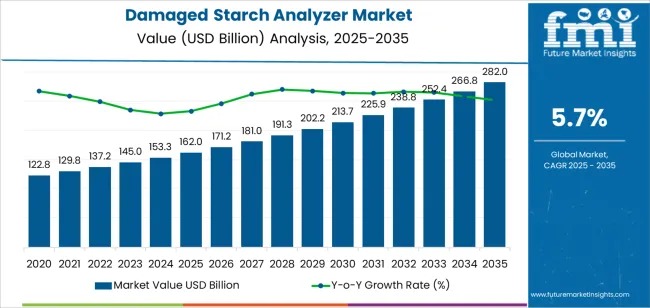
The global damaged starch analyzers market is on track to grow from USD 162 billion in 2025 to USD 282.0 billion by 2035, registering a 5.7% CAGR, according to the latest industry assessment. Demand is accelerating across flour milling, industrial baking, pharmaceutical excipient testing, and agricultural research, as manufacturers tighten quality protocols and shift toward automated, audit-ready lab systems.
A major structural driver behind this surge is the rising need for consistent starch damage measurement, which directly affects dough absorption, fermentation dynamics, crumb uniformity, and tablet performance. Automated analyzers integrating LIMS connectivity, multi-method testing, and on-instrument calibration have moved to the forefront as producers face stricter documentation and traceability requirements.
Explore trends before investing – request a sample report today! https://www.futuremarketinsights.com/reports/sample/rep-gb-28148
Market Snapshot
- Market Value (2025): USD 162 billion
- Projected Value (2035): USD 282.0 billion
- CAGR (2025–2035): 5.7%
- Top Analysis Method: Ampere Method (42.3%)
- Leading Application: Food Processing (58.6%)
- Primary Distribution Channel: Direct Sales (67.4%)
- High-Growth Regions: Asia Pacific, Europe, North America
What’s Powering Market Growth?
- Flour Milling Modernization
Mills are adopting advanced laboratory instruments to meet tightening quality specifications. The Ampere method, valued for speed and cost-efficiency, continues to dominate due to standardized protocols embedded across mill workflows. - Pharmaceutical Excipient Control
Tablet hardness, dissolution, and release behavior hinge on accurately characterized starch fractions. The enzymatic method—known for its specificity—is gaining traction in pharma manufacturing and R&D environments. - Automation & Digitalization
Procurement trends reflect a definitive pivot toward:
- automated sample handling
- cloud-enabled remote monitoring
- LIMS-integrated data capture
- validated multi-method platforms
These upgrades reduce operator variability, enhance compliance documentation, and enable audit-ready traceability.
Regional Growth Outlook
Asia Pacific is projected to deliver the fastest CAGR, fueled by large-scale milling capacity growth and regulatory tightening in China and India. China’s market is forecast to reach USD 76.9 million by 2035, supported by food processing modernization and expanding pharmaceutical production.
India is set to reach USD 61.4 million, driven by flour mill expansions, agricultural research investments, and strong growth in generic pharmaceutical manufacturing.
Europe maintains steady momentum with a projected rise from USD 38.7 million in 2025 to USD 67.4 million by 2035. Germany retains leadership with nearly 28% share, anchored by precision manufacturing and stringent quality validation frameworks.
North America remains a high-value market emphasizing throughput, digital connectivity, and compliance documentation. U.S. demand is expected to reach USD 19.8 million by 2035, supported by rapid automation adoption in milling and pharma labs.
Segment-Level Highlights
By Analysis Method
- Ampere Method (42.3% share): Maintains leadership through standardized use in milling and baking.
- Enzymatic Method (36.8% share): Growing fastest due to pharma-grade specificity and research adoption.
- Others (20.9% share): Encompasses niche and emerging technologies used primarily by research institutions.
By Application
- Food Processing (58.6% share): Remains the backbone of demand due to high-volume milling and ingredient testing.
- Agriculture (23.4%): Driven by breeding programs and grain quality assessments.
- Pharmaceuticals (12.7%): Strong growth fueled by excipient standardization and GMP validation needs.
Key Market Drivers, Restraints & Trends
Drivers
- Expanding quality standards in food and pharma
- Rising adoption of automated testing platforms
- Increasing regulatory pressure for documented, traceable data
Restraints
- High equipment and calibration costs
- Limited technical expertise in smaller facilities
- Standardization challenges across test methodologies
Key Trends
- Integration with LIMS and digital lab systems
- Development of multiparameter platforms
- Predictive maintenance and cloud connectivity
Competitive Landscape
The market continues to favor vendors delivering validated, multi-method platforms backed by robust service networks. High switching costs—including operator training, GMP revalidation, and workflow reconfiguration—create strong incumbency advantages for established players.
Three competitive archetypes dominate the landscape:
- Global analytical equipment companies with broad portfolios
- Specialized starch testing vendors focused on flour milling and grain quality
- Regional suppliers offering localized support and cost-efficient systems
Consolidation is increasing as large analytical firms acquire niche manufacturers to expand their presence across food and pharmaceutical markets.
Key Companies Profiled
- KPM Analytics
- Nanosens
- Erkaya
- Metron Group
- SAYTEK
- Yucebas Machinery Analytical Equipment Industry