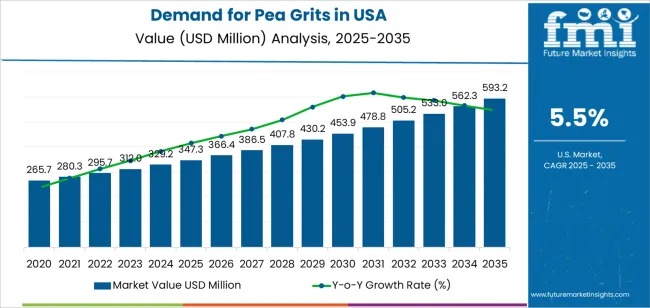
The demand for pea grits in the USA is gaining strong traction, supported by consumers’ preference for clean-label, gluten-free, and high-protein food ingredients. According to latest industry projections, the U.S. pea grits market—valued at USD 347.3 million in 2025—is forecast to reach USD 593.8 million by 2035, reflecting an absolute increase of USD 246.5 million at a CAGR of 5.5%.
Growing adoption of plant-based diets, increased reliance on alternative protein sources, and rapid advancements in food formulation technologies are driving the sector’s expansion. As pea-based ingredients gain shelf space across mainstream categories, demand is expected to accelerate sharply, especially from 2030 onward.
Explore trends before investing – request a sample report today! https://www.futuremarketinsights.com/reports/sample/rep-gb-28709
Demand Outlook Strengthens with Market Transition Toward Plant-Based Innovation
Between 2025 and 2030, demand is set to grow from USD 347.3 million to USD 366.4 million, adding USD 19.1 million—driven by stable consumer preference for healthier, plant-derived ingredients.
From 2030 to 2035, demand is projected to surge from USD 366.4 million to USD 593.8 million, accounting for over 92% of total growth during the decade. This acceleration corresponds with a rising number of new product launches in plant-based snacks, dairy alternatives, and protein-fortified foods.
A dynamic growth-rate volatility index signals steady performance early in the decade followed by sharper upward momentum as food tech companies introduce more sophisticated pea-based products.
Why Demand for Pea Grits Continues Rising in the USA
Pea grits—coarse, nutrient-rich fragments of dried peas—are becoming a preferred functional ingredient for manufacturers. They offer high protein, fiber, and clean-label appeal, meeting the needs of consumers seeking gluten-free, non-GMO, allergen-friendly alternatives.
Key demand drivers include:
- Rising flexitarian, vegan, and protein-focused dietary habits
- Environmental advantages of pulse crops vs. traditional animal proteins
- Increased use of pea grits in snacks, cereals, bakery, and meat analogues
- Shift toward sustainable ingredients in food manufacturing
Despite competition from other pulse-based ingredients, pea grits remain attractive due to their versatility, mild flavor, and formulation benefits that enhance texture and binding in processed foods.
Segment-Wise Highlights: Yellow Pea Grits and Food Processing Lead
Yellow pea grits dominate with a 62% share, supported by their neutral flavor profile and strong domestic availability. These attributes make them integral to plant-based protein products, baked goods, cereals, and snack formulations.
Food processing represents 47% of total demand, as manufacturers increasingly incorporate pea grits to boost protein density and improve product texture. Their role as natural thickeners and binders strengthens their application across multiple product categories.
Sweet flavor accounts for 68% of demand, thanks to its prominence in cereals, bars, and plant-based dairy alternatives.
The B2B channel controls 72% of distribution, underscoring the industrial-scale use of pea grits in large-volume food production.
Regional Growth Outlook: West Remains the Largest and Fastest-Growing Market
Regional CAGR (2025–2035):
- West: 6.3% (market leader)
- South: 5.7%
- Northeast: 5.1%
- Midwest: 4.4%
The West leads due to its health-forward consumer base, robust plant-based food ecosystem, and focus on sustainable nutrition. States such as California and Washington are key innovation hubs for plant-based food manufacturing.
The South is benefitting from a rapidly expanding food processing industry, while the Northeast is influenced by strong health-conscious consumer behavior. The Midwest, home to large manufacturing clusters, continues to adopt pea-based ingredients as companies reformulate products for higher nutrition and cleaner labels.
Innovation & Technology: Unlocking Greater Product Adoption
Processing advancements are enhancing the flavor, texture, and solubility of pea grits, reducing formulation barriers. Innovations include:
- Precision milling for improved particle size control
- Flavor-reduction technologies removing earthy pea notes
- Pre-blended grits incorporating fibers or carriers for easier formulation
- Enhanced separation and fractionation techniques improving protein levels
These developments are enabling broader application in mainstream categories, beyond niche plant-based offerings.
Key Challenges Limiting Faster Growth
While the outlook is strong, adoption is constrained by:
- Raw pea supply fluctuations and cost variability
- Sensory challenges such as gritty mouthfeel in poorly processed grits
- Formulator reluctance to adopt new ingredient systems without clear performance value
Addressing these gaps will be essential for manufacturers to unlock full growth potential.
Competitive Landscape: Martino Rossi SpA Leads the Market
Leading contributors in the U.S. demand landscape include:
- Martino Rossi SpA (approx. 25.2% share)
- Avena Foods, Limited
- Best Cooking Pulses, Inc.
- ADM
- Ingredion
These players supply pea grits for applications ranging from snacks and cereals to plant-based protein foods and fortified formulations.