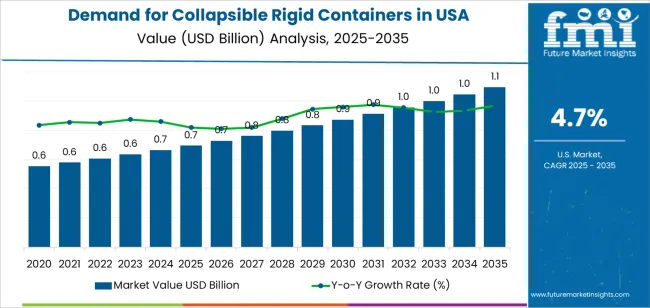
As global supply-chains become more complex and sustainability takes center stage, the market for collapsible rigid containers is gaining unprecedented traction — and both long-standing manufacturers and ambitious newcomers are racing to capitalize on this shift. According to the latest market outlook, demand in the United States alone is set to grow from roughly USD 0.7 billion in 2025 to around USD 1.1 billion by 2035, representing a compound annual growth rate (CAGR) of 4.7%.
At the heart of this surge is the growing need for efficient, reusable containers that cut storage costs, streamline logistics, and support circular-economy principles. Collapsible crates, foldable bulk containers, pallet boxes and jerry cans are replacing one-way packaging — offering dramatic savings in warehouse space and a more sustainable transport footprint as empty units collapse to a fraction of their full size.
Why manufacturers are doubling down
For decades, established players such as Brambles Limited — through its CHEP pooling network — have led the field, supplying standardized containers to big-volume industries. Alongside them, companies like Supreme Industries Limited, Schoeller Allibert Services B.V., DS Smith plc and SSI Schäfer AG have continued evolving container lines to meet growing demand for durability, fold-flat efficiency and reuse-cycle reliability.
But the market’s next wave is being shaped by organizations — both new and traditional — embracing advanced materials, smarter designs, and technology-enabled logistics. Lighter, corrosion-resistant plastics remain the most widely used material, thanks to their strength-to-weight balance and compatibility with automated handling systems. Metal and composite containers, meanwhile, serve heavy-duty or specialized applications where load-bearing capacity and resilience under stress are critical.
Innovation is redefining container design
Emerging manufacturers are turning to hybrid materials, reinforced hinges and modular folding designs that better integrate with automated warehousing, conveyor belts and reverse-logistics networks. This evolution makes collapsible crates and containers not just practical, but long-term assets: built for multiple reuse cycles, delivering 70–80% space savings when empty, and supporting both heavy industrial loads and delicate supply-chain movements.
At the same time, newer entrants are targeting sectors such as food & beverage distribution, agriculture, pharmaceutical supply chains and e-commerce fulfillment centers — all of which increasingly demand hygiene-friendly, temperature-controlled, reusable packaging solutions. The result: containers that not only reduce freight and storage costs, but also help companies meet environmental compliance and corporate sustainability goals.
Growing demand across U.S. regions and industries
Growth is widespread across the United States, with especially strong uptake in the West, South and Northeast — regions defined by dense distribution centers, booming e-commerce logistics, agricultural movement and dynamic retail supply-chains. Automotive parts suppliers, food processors, fresh-produce distributors, and large-scale manufacturers are leading this shift, embracing collapsible rigid containers for their efficiency, reliability and long-term cost benefits.
While larger enterprises often procure directly from manufacturers — enabling customization and volume-based supply agreements — smaller businesses and seasonal operations find value through distributors and indirect channels. This dual supply-channel model ensures that both heavy industrial operators and smaller players can access collapsible container solutions.
An opportunity space for both seasoned leaders and ambitious newcomers
Today’s market narrative is not just about replacement — it’s about reinvention. Established container manufacturers are expanding their product lines, investing in polymer and composite research, and upgrading their supply-chain integration. Meanwhile, emerging players are staking out niches: offering modular, cost-effective, and customized collapsible containers tailored to modern logistics demands.
As companies across industries tighten their focus on sustainability, supply-chain optimization, and cost efficiency, collapsible rigid containers stand out not just as packaging — but as strategic assets. For manufacturers willing to invest in smart design, material innovation and scalable production, the coming decade offers a powerful opportunity to shape the future of industrial logistics.