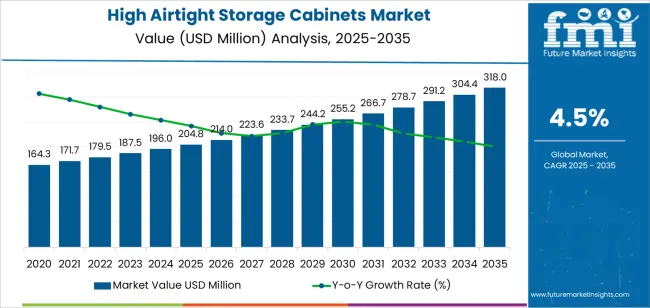
The global market for high-airtight storage cabinets is poised for dynamic expansion from USD 204.8 million in 2025 to an estimated USD 318.1 million by 2035. With a steady compound annual growth rate (CAGR) of 4.5%, this upward trend reflects a growing urgency among industries worldwide to protect sensitive materials — and a rising wave of investment and innovation from both established firms and newer entrants alike.
As sectors such as pharmaceuticals, precision electronics, biotechnology, archival preservation, and advanced manufacturing continue to tighten quality standards, demand for dependable, contamination-resistant, tightly sealed storage solutions has soared. The result: a rapidly intensifying market — and a wealth of opportunity for producers ready to innovate and scale up.
Established Leaders Double Down, New Players Enter the Fray
Major industry incumbents — widely recognized names in airtight storage manufacturing — remain the backbone of the market’s growth. Firms like Erlab, Blundell, XDry Cabinets, CORE-emt, and Totech Europe continue to set high standards for sealing performance, quality control, and reliability. Their existing portfolios of vertical and horizontal cabinet models have long served laboratories, electronics manufacturers, pharmaceutical producers, and archival institutions seeking consistent humidity and dust control.
But the landscape is shifting — and new players are stepping forward with ambition. In regions such as Asia, manufacturers including Tianjin CNRO, Shenzhen Huayu Xiandai, Shenzhen GSWBKJ, Shenzhen Huaboxu Technology, and Chongqing Suisen Environmental Control Technology are increasingly gaining traction. These companies are challenging conventional supply patterns by offering competitively priced, feature-rich cabinets, often with modular designs that appeal to emerging markets and growing industries.
Their growing presence reflects more than cost competition: it signals a broader democratization of airtight storage solutions. As demand spreads beyond traditional strongholds in Europe and North America — into Asia, Latin America, and other high-growth regions — newer manufacturers are positioning themselves to meet both current and evolving needs of a diversifying customer base.
Technology & Innovation: The New Frontier in Storage Solutions
What’s fuelling this second wave of growth isn’t just geography or competition — it’s innovation. Leading manufacturers and ambitious newcomers alike are investing heavily in technologies that make airtight cabinets smarter, more efficient, and more flexible than ever before.
Modern units now routinely feature improved sealing gaskets, multi-zone compartments, and advanced desiccant systems to absorb moisture. More significantly, many cabinets are being outfitted with smart sensor arrays — equipped to monitor internal humidity, pressure, and gas composition in real-time — and often linked to remote monitoring systems, enabling facility managers to ensure optimal conditions without constant onsite supervision.
Some forward-looking manufacturers also offer modular and scalable systems: clients can start with a basic cabinet and expand capacity over time without replacing the entire unit. This flexibility makes high-quality, airtight storage accessible to smaller labs, emerging electronics plants, and biotech startups — groups that previously might have been priced out of the market.
Energy efficiency is another major focus. Enhanced insulation materials, optimized airflow designs, and energy-conscious climate control systems all contribute to lowering total cost of ownership — making sustainability as much a selling point as performance.
Use Cases: From Microchips to Medicines to Museums
While precision electronics remains the largest application segment — accounting for roughly 45% of the market — demand is growing across a spectrum of industries. Electronic components, semiconductors, circuit boards and microchips require dust- and moisture-free environments to function reliably. As device miniaturization advances, the sensitivity of these components only increases, driving up demand for high-performance storage.
Simultaneously, pharmaceutical companies and biotech labs require airtight storage for sensitive compounds, reagents, and biologics, ensuring stability and preventing contamination. Archives, museums, and libraries are tapping into these solutions too — using specially sealed cabinets to preserve delicate manuscripts, artworks, and heritage materials from humidity and pest damage over decades.
This broadening of use cases — spanning cutting-edge electronics to cultural heritage preservation — signals a maturing market that’s embracing versatility and long-term value.
Regional Surge: Emerging Markets Embrace Airtight Storage
Growth is not limited to traditional markets. In countries across Asia, Latin America, and other developing regions, increasing industrialization, rising regulatory standards, and expanding pharmaceutical and electronics sectors are creating strong demand for airtight storage solutions. In particular, India and China are emerging as key growth centers — driven by burgeoning pharmaceutical manufacturing, electronics production, and a growing awareness of the importance of controlled-environment storage.
Newer manufacturers, particularly those with local production and distribution capabilities, are capitalizing on this regional surge — often offering affordable, feature-rich cabinets tailored to local requirements.
What This Means for Businesses, Laboratories & Institutions
For procurement decision-makers in electronics, pharmaceuticals, biotech, cultural heritage, and research, the message is clear: high-airtight storage cabinets are no longer a niche, specialized investment. They are becoming essential infrastructure — critical to protecting valuable assets, ensuring regulatory compliance, and safeguarding long-term quality.
The expanding supplier base and ongoing innovation mean organizations have more options than ever — whether they’re a global enterprise, a startup lab, or a national archive. Affordable, modular solutions; smart monitoring; energy efficiency; and scalable systems make these cabinets a strategic investment rather than a cost burden.
Conclusion: A Market at an Inflection Point
The global high-airtight storage cabinets market is entering a new era: one defined not just by growth, but by diversification, innovation, and accessibility. Established leaders continue to drive quality and reliability; newer manufacturers are bringing fresh energy, competitive pricing, and regional reach; and technology advancements are transforming what it means to store sensitive materials securely and sustainably.
As industries evolve — from electronics manufacturing and pharmaceuticals to biotech, archives, and heritage preservation — the role of airtight storage cabinets is expanding in significance and scope. For businesses and institutions looking ahead, 2025 to 2035 promises to be a decade not just of market growth, but of transformation.