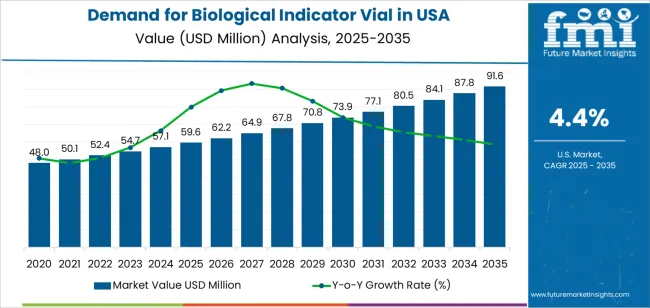
As the healthcare, pharmaceutical, and sterile-manufacturing industries ramp up operations worldwide, demand is surging for reliable sterilization-verification solutions — and biological indicator vials are now at the forefront. According to a recent industry forecast, the market in the United States alone is projected to grow substantially over the coming decade, capturing both the attention of established manufacturers and a new wave of innovative entrants keen to expand their footprint.
Biological indicator vials — microbial-spore–based containers used to validate sterilization cycles — have become indispensable in ensuring sterility of medical devices, pharmaceuticals, food processing lines and more. With regulatory scrutiny increasing and sterilization standards rising across industries, the need for robust, validated sterilization verification is now non-negotiable.
As demand climbs, long-standing industry suppliers such as global leaders and trusted providers are doubling down on production and distribution. At the same time, a growing number of newer manufacturers and technology-driven firms are launching advanced offerings — including rapid-readout vials, self-contained formats, and smart-enabled validation kits — to meet evolving customer expectations.
Market Momentum: Why Business Expansion Looks Promising
Recent projections signal steady growth: from a market valued at USD 59.6 million in 2025, demand for biological indicator vials in the United States is expected to reach USD 91.4 million by 2035. That represents a compound annual growth rate of 4.4%, driven by increasing sterilization needs in pharmaceuticals, healthcare, medical devices, and other sterile-processing sectors.
Much of this growth is rooted in strict sterilization validation requirements. Biological indicator vials verify that sterilization cycles — whether steam-based or chemical (such as ethylene oxide) — have effectively destroyed resistant microbial spores. As more hospitals, labs, and manufacturing facilities adopt rigorous quality-assurance practices, biological indicators have become a critical safety checkpoint before product release, patient use, or packaging.
Moreover, technological advances are transforming what vials can do. Rapid-readout systems reduce incubation time, enabling faster batch release. Self-contained vials simplify work flows. And integration with digital quality-management systems — including barcode tracking, electronic records, and automated reporting — is helping facilities satisfy increasing regulatory and audit demands while cutting manual burden. These innovations are fueling demand beyond traditional sectors and opening the door for agile, tech-savvy newcomers.
New Entrants + Legacy Vendors = A Competitive, Opportunity-Rich Landscape
The market’s competitive landscape remains moderately consolidated: a few large players still command a significant share, thanks to their long-standing reputation, broad product portfolios, and established distribution networks. At the same time, a widening array of smaller and newer manufacturers — often specializing in niche segments or innovation-driven product lines — are carving out space.
Legacy suppliers continue to benefit from their regulatory track record, reliable spore-preparation technologies, and trusted customer relationships. These strengths make them default choices for large pharmaceutical firms, hospitals, and contract-manufacturing organizations seeking proven sterility validation solutions.
However, newer players are gaining traction with offerings that appeal to cost-conscious or efficiency-seeking users: rapid-readout vials that cut downtime, compact self-contained kits for emerging sterile manufacturing setups, and flexible product lines designed for diverse sterilization methods. For many facilities — particularly smaller labs, biotech startups, or contract manufacturers launching aseptic production — such innovations provide an attractive entry point into validated sterilization workflows.
This dual-tier dynamic — established reliability meets fresh innovation — is giving many manufacturers a strong incentive to expand operations, invest in R&D, and broaden their reach across industries.
What This Means for Stakeholders
For existing players, this momentum offers an opportunity to strengthen their market position by investing in faster-readout, data-enabled, and regulatory-ready vial systems. Broadening product portfolios to include self-contained and easy-to-use kits can help tap emerging sterilization segments such as biologics manufacturing, single-use systems, and aseptic processing.
For new and niche manufacturers, the stage is set for meaningful growth — especially if they can deliver flexible, cost-effective, compliance-ready solutions that meet evolving sterilization validation needs. Breakthroughs in automation, digital traceability, and rapid incubation not only lower barriers to entry but also appeal to a broader range of end users, from large hospitals to small laboratories.
Meanwhile, end users — pharmaceutical companies, medical-device makers, food processors, and healthcare facilities — stand to benefit from more options, improved turnaround times, and robust documentation workflows. As regulatory expectations tighten and pressure mounts for fast, reliable sterility validation, biological indicator vials offer a critical safeguard.
Looking Ahead
With demand for biological indicator vials on a clear growth trajectory, the months ahead promise to reshape the landscape. Established manufacturers are expected to reinforce their dominance, while new entrants push forward with technology-driven, customer-centric offerings.
For stakeholders across the value chain — developers, manufacturers, distributors, and end users — the opportunity is significant: to drive innovation, expand capabilities, and raise sterilization assurance standards across industries. As quality assurance becomes ever more central to safety, compliance, and operational excellence, biological indicator vials are poised to play a pivotal role worldwide — and the companies ready to adapt may lead the charge.