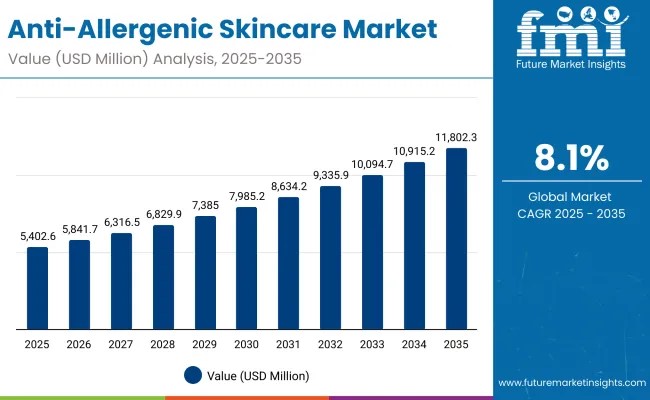
The global Anti-Allergenic Skincare Market is on the verge of a remarkable transformation, poised to expand from USD 5,402.6 million in 2025 to an impressive USD 11,802.3 million by 2035. This staggering growth — nearly 118% over the next decade — reflects a compound annual growth rate (CAGR) of 8.1%, marking a major shift in consumer skincare habits, technological advancements, and the competitive landscape.
Anti-allergenic skincare products are gaining unprecedented traction worldwide, propelled by increasing awareness of sensitive skin conditions such as eczema, allergic contact dermatitis, and rosacea. Consumers are gravitating towards safe, effective, and medically endorsed skincare solutions that reduce irritation and improve skin barrier function.
Subscribe for Year-Round Insights → Stay ahead with quarterly and annual data updates – https://www.futuremarketinsights.com/reports/sample/rep-gb-26514
Market Drivers: Why the Surge in Demand
- Rising Prevalence of Skin Allergies and Sensitive Conditions:
Conditions like eczema affect over 20% of children in developed nations, with urban pollution and lifestyle factors driving sensitivity globally. This has increased reliance on hypoallergenic and barrier-repair products recommended by dermatologists. - Clinical Endorsements and Dermatology-Led Adoption:
Trusted brands such as Cetaphil, La Roche-Posay, and Eucerin maintain leadership through medical validation and presence in pharmacies and clinics. Growing integration of skincare into dermatology clinics’ retail offerings strengthens consumer trust. - Technological Innovation:
The rise of AI-powered personalized skincare and subscription models are transforming the consumer experience, allowing users to receive tailored product recommendations and refillable kits that boost engagement and adherence. - Clean-Label and Vegan Trends:
Increasing consumer preference for fragrance-free, vegan-certified, and eco-friendly products is reshaping product portfolios and marketing strategies across the industry.
Opportunities for Established and New Players
- Established Manufacturers:
Market leaders like Aveeno, Cetaphil, and La Roche-Posay are leveraging their clinical reputation by expanding product lines to include AI-personalized skincare and eco-friendly packaging. They are investing heavily in digital platforms and subscription services to retain and grow their consumer base. - Emerging Innovators:
New entrants focusing on clean-label, fragrance-free, and vegan-certified formulations are gaining market share rapidly through e-commerce and specialty beauty retailers. Brands offering AI diagnostic tools and personalized regimens are carving out competitive advantages, particularly in Asia-Pacific and North America. - Technology Integration:
The future of anti-allergenic skincare lies in a hybrid ecosystem combining product innovation with digital health solutions—such as Cetaphil’s AI-powered Skin Sensitivity Analyzer and La Roche-Posay’s microbiome-focused serums—enabling hyper-personalized care.
Regional Growth Highlights
- Asia-Pacific:
Fastest growth expected with China and India leading at CAGR of 14.4% and 16.2% respectively, fueled by urbanization, rising dermatological awareness, and e-commerce adoption. - North America:
Steady expansion at 6.0% CAGR, driven by dermatology-led recommendations and pharmacy dominance, with growing interest in digital-first solutions. - Europe:
Growth at 8.7% CAGR, supported by strict regulatory frameworks ensuring product safety, and rising consumer preference for clean-label skincare.
Key Segments of the Anti-Allergenic Skincare Market
- By Product Type:
- Hypoallergenic moisturizers (leading with 37.3% market share in 2025)
- Barrier-repair creams
- Soothing serums
- Gentle cleansers
- By Skin Concern:
- Eczema-prone skin
- Allergic contact dermatitis
- Rosacea-prone skin
- General sensitive skin (largest segment at 41.2%)
- By Channel:
- Pharmacies & dermatology clinics (largest channel with 46.7% share)
- E-commerce platforms (rapidly growing, expected to surpass 55% by 2035)
- Specialty beauty retail
- Mass retail
- By End User:
- Infants & children
- Adults
- Senior skin
- Unisex sensitive-skin users
- By Region:
- North America
- Europe
- Asia-Pacific (fastest-growing region)
- Latin America
- Middle East & Africa
Market Trends Shaping the Industry
- Subscription-Based Models:
Subscription services providing curated sensitive-skin kits are growing rapidly, promoting loyalty and recurring revenue. - E-commerce Domination:
Online platforms like Amazon, Tmall, and Nykaa are major distribution channels, especially in Asia and Europe, where consumers seek dermatologist-reviewed products with transparent ingredients. - Sustainability and Packaging Innovation:
Refillable containers, eco-friendly packaging, and vegan certifications are becoming critical purchase drivers.
Competitive Landscape
The anti-allergenic skincare sector is moderately fragmented, with global dermatology-backed giants competing alongside mid-tier clean-label innovators and niche pediatric-focused brands:
- Key Players:
- Aveeno
- Cetaphil
- La Roche-Posay
- Eucerin
- Bioderma
- Avene
- Vanicream
- CeraVe
- Mustela
- Neutrogena
- Competitive Edges:
Clinical validation, AI integration, subscription services, sustainability, and multi-age applicability are key differentiators.
Conclusion
The Anti-Allergenic Skincare Market is set for unprecedented growth and innovation through 2035, driven by rising skin sensitivity cases, digital transformation, and sustainability trends. Both established manufacturers and new players are poised to capitalize on expanding global demand by focusing on medical endorsements, product innovation, and seamless consumer engagement models.
As consumers worldwide increasingly prioritize skin health and safety, anti-allergenic skincare is transitioning from niche medical products to mainstream daily essentials—ushering in a new era of sensitive-skin care that is effective, personalized, and sustainable.
Why FMI: https://www.futuremarketinsights.com/why-fmi
About Future Market Insights (FMI)
Future Market Insights, Inc. (FMI) is an ESOMAR-certified, ISO 9001:2015 market research and consulting organization, trusted by Fortune 500 clients and global enterprises. With operations in the U.S., UK, India, and Dubai, FMI provides data-backed insights and strategic intelligence across 30+ industries and 1200 markets worldwide.
Contact Us:
Future Market Insights Inc.
Christiana Corporate, 200 Continental Drive,
Suite 401, Newark, Delaware – 19713, USA
T: +1-347-918-3531
For Sales Enquiries: sales@futuremarketinsights.com
Website: https://www.futuremarketinsights.com
LinkedIn| Twitter| Blogs | YouTube