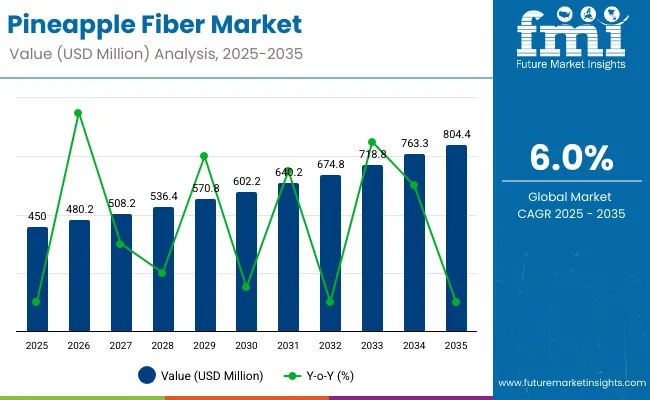
The global pineapple fiber market, valued at USD 450 million in 2025, is set to grow to USD 804.4 million by 2035, expanding at a 6.0% CAGR amid fast-rising adoption of biodegradable, plant-based fibers across fashion, packaging, and composite materials. This transformation is fueled by stricter environmental regulations, surging textile modernization initiatives, and growing industry commitments to circular economy practices.
Leading textile, apparel, and composite manufacturers are actively reducing dependence on synthetic fibers and shifting to natural, waste-derived alternatives—putting pineapple fiber at the center of global sustainability strategies. As agricultural waste valorization gains momentum, pineapple leaves, stem residue, and fruit waste are being commercialized for fashion, automotive interiors, footwear, paperboard solutions, and specialty industrial uses.
Explore trends before investing – request a sample report today! https://www.futuremarketinsights.com/reports/sample/rep-gb-28651
Market Momentum Driven by Eco-Compliance and Processing Innovation
Market growth is strongly influenced by rapidly tightening environmental regulations across Europe and North America, where brands face stronger sustainability reporting requirements and restrictions on synthetic fabrics. As a result, demand for biodegradable and traceable natural fibers has accelerated, positioning pineapple fiber as a high-potential alternative.
Simultaneously, processing technology advancements—including mechanical extraction, enzymatic treatment, and chemical optimization—have significantly improved fiber consistency, tensile performance, and scalability. These innovations enable seamless integration into existing textile manufacturing lines while reducing processing variability.
Key factors shaping adoption include:
• Rising pressure to eliminate petroleum-based fibers
• Strong brand preference for circular and zero-waste sourcing
• Demand for durable, lightweight, and commercially scalable natural fabrics
• Advancements in extraction systems enabling consistent fiber quality
Leaf Fiber Leads With 60% Share as Textiles Dominate Applications
Among all pineapple fiber sources, leaf fiber accounts for 60% of market share, supported by its strong tensile strength, ease of processing, and compatibility with premium apparel and composite applications.
Textile applications represent the largest segment at 40%—driven by fast adoption across:
• Apparel manufacturing (55% within textiles)
• Upholstery and interior applications (25%)
• Footwear and leather-alternative materials (20%)
Pineapple fiber’s versatility, softness, and durability have made it a preferred material for eco-conscious fashion brands integrating sustainable fibers into clothing, accessories, and next-generation non-woven textiles.
Mechanical Extraction Holds 50% Market Share
Mechanical extraction remains the primary processing method, representing 50% of market share in 2025, as manufacturers prioritize cost-efficiency, consistent fiber output, and minimal chemical dependencies. The method aligns well with circular economy requirements, reducing waste and ensuring fiber purity.
Advances in automated extraction and fiber grading systems have also improved scalability—allowing producers to serve both high-volume and specialty applications.
Regional Landscape: Europe and North America Lead Expansion
Europe, South Asia & Pacific, and North America collectively dominate market demand due to strong textile bases and increasingly regulated fashion ecosystems.
- UK (6.5% CAGR) and USA (6.4% CAGR) lead high-value adoption as luxury brands and apparel giants shift from synthetic to plant-based materials.
• China (5.7% CAGR) and India (5.6% CAGR) demonstrate strong production and export potential supported by large-scale textile infrastructure.
• Germany and France continue integrating pineapple fiber in advanced fashion and interior textile applications, driven by sustainability mandates and premium manufacturing standards.
• Brazil, growing at 2.7%, focuses on agricultural integration and cost-competitive production, supported by long-term export strategies.
The global push toward textile circularity, combined with government-backed sustainability programs, is creating fertile ground for large-scale pineapple fiber adoption.
Future Outlook: USD 202.2 Million Growth Expected Between 2030 and 2035
Between 2030 and 2035, the market is projected to add USD 202.2 million, accounting for nearly 57% of decade-long growth, driven by:
- Expansion of advanced extraction and processing facilities
• Introduction of customized fiber grades for premium apparel and composites
• Stronger enforcement of sustainability regulations
• Increased brand investment in waste-derived natural fibers
• Rising demand for fully traceable, low-impact textile inputs
Competitive Landscape: Innovators and Integrators Shape Market Growth
The pineapple fiber industry, though moderately consolidated, is led by material innovators and agrifood conglomerates improving raw material valorization and scalable fiber processing.
Key companies shaping global growth include:
• Ananas Anam (Piñatex®, Piñayarn®)
• Nanollose Ltd
• Tjeerd Veenhoven Studio
• Dole Sunshine Company
• Bambusa Global Ventures
• NEXTEVO
• Textil Santanderina
• U-LONG High Tech Textile
• Panublix
• Go Green Products
These companies are strengthening supply chains through partnerships with pineapple-growing regions, deploying advanced treatment technologies, and supplying high-performance fibers to global fashion, footwear, and packaging brands.