As demand for more efficient, precise, and automated packaging solutions steadily rises, both veteran manufacturers and dynamic newcomers are stepping up — driving growth, innovation, and expansion across the corrugated cardboard cutting machine market in the United States. According to a new industry forecast, market value is expected to nearly double over the coming decade, reflecting a growing appetite for advanced machinery and state-of-the-art manufacturing technologies.
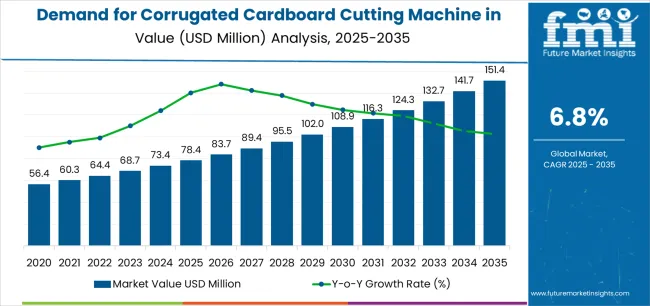
The market for corrugated cardboard cutting machines in the U.S. is projected to grow from USD 78.4 million in 2025 to approximately USD 151.4 million by 2035 — an 81.9% increase with a compound annual growth rate (CAGR) of 6.8%. This dramatic rise is being fueled by a surge in demand for packaging automation, precision-manufacturing technologies, and cutting solutions deployed across logistics operations, manufacturing facilities, and commercial packaging applications. Established infrastructure, mature supplier networks, and growing operational efficiency requirements continue to stimulate this vibrant expansion.
At the heart of this growth are both well-known equipment suppliers with long track records, and emerging manufacturers seeking to make their mark. Leading players — including well-established names — continue to dominate, offering proven reliability and broad distribution. Meanwhile, rising companies, often more agile and technology-savvy, are entering the fray with fresh ideas, modern technologies, and a determination to disrupt the status quo.
Among machine types, single-layer cutting machines currently command the lion’s share of demand, accounting for 62.1% of the market in 2025. Their strong compatibility with existing manufacturing lines, easier integration, and lower calibration requirements make them the preferred choice for many high-volume packaging plants. Yet, as packaging needs evolve — including thicker substrates, custom protective packaging, and digitally driven structural designs — multi-layer cutting machines are gaining momentum. Complementing these, specialty cutting machines are increasingly adopted in environments requiring high precision: design studios, short-run productions, or prototyping operations with intricate contours and flexible tooling demands.
Across industries, the packaging sector leads by application, claiming some 69.3% of total demand in 2025. Fueled by the exploding growth of e-commerce, fragmentation in SKUs, and rising adoption of “box-on-demand” workflows, packaging firms are embracing automated cutting systems to meet short lead times, minimize waste, and handle variable-dimension orders more efficiently. Meanwhile, logistics operations — such as distribution hubs — are integrating automated cutting to optimize in-house packaging, reduce freight inefficiencies, and improve turnaround times. Other manufacturing sectors, including consumer goods, electronics, and industrial products, are also showing steady uptake, especially for custom corrugated inserts and protective packaging solutions.
What’s particularly striking is how this growth is being shaped by technological advancement and smart manufacturing trends. Companies — both large and new — are investing in digital control technologies, centralized performance monitoring systems, and advanced automation networks. Such investments allow for real-time quality control, standardized cutting processes, and scalable operations across multiple facilities. These modern systems are key for meeting increasingly complex packaging demands while maintaining cost efficiency and consistency.
In terms of regional dynamics, demand growth varies across U.S. regions. The West region is poised to lead with the highest projected CAGR of 7.4% through 2035 — powered by advanced manufacturing infrastructure, high innovation adoption, and a concentration of efficiency-focused production policies. The South region follows closely at 6.9%, supported by robust manufacturing presence and favorable production demographics, especially across states with strong industrial corridors. The Northeast and Midwest also show stable growth (6.5% and 6.2% respectively), as manufacturers in these regions increasingly turn to automated cutting systems to modernize operations and stay competitive.
Within this vibrant and evolving landscape, a notable competitive ecosystem is emerging. Industry stalwarts — with deep expertise, wide distribution networks, and established reputations — continue to lead adoption of proven technologies. At the same time, newer manufacturers are gaining ground, bringing fresh ideas and faster-to-deploy technologies that are increasingly attractive for short-run jobs, custom packaging, or businesses exploring automation for the first time. This blend of legacy strength and entrepreneurial agility is creating a dynamic market environment — where innovation, efficiency, and adaptability are becoming the defining traits of success.
As the U.S. packaging and manufacturing sectors evolve, demand for corrugated cardboard cutting machines will likely continue to accelerate. For manufacturers — whether long-standing or emerging — now is a decisive moment: those who invest in automation, cutting-edge technology integration, and flexible cutting solutions stand to benefit the most. The next decade promises expanded opportunities, increased competitiveness, and a reshaped packaging landscape driven by precision, speed, and innovation.
About the Report
The outlook presented is based on a comprehensive market analysis covering demand projections, segmentation by machine type (single-, multi-, and specialty-layer), applications across industries, regional growth trends, and competitive landscape. The report highlights key enabling factors — such as automation adoption, technological integration, and changing packaging demands — that are shaping the future of corrugated cardboard cutting machine demand across the United States.